








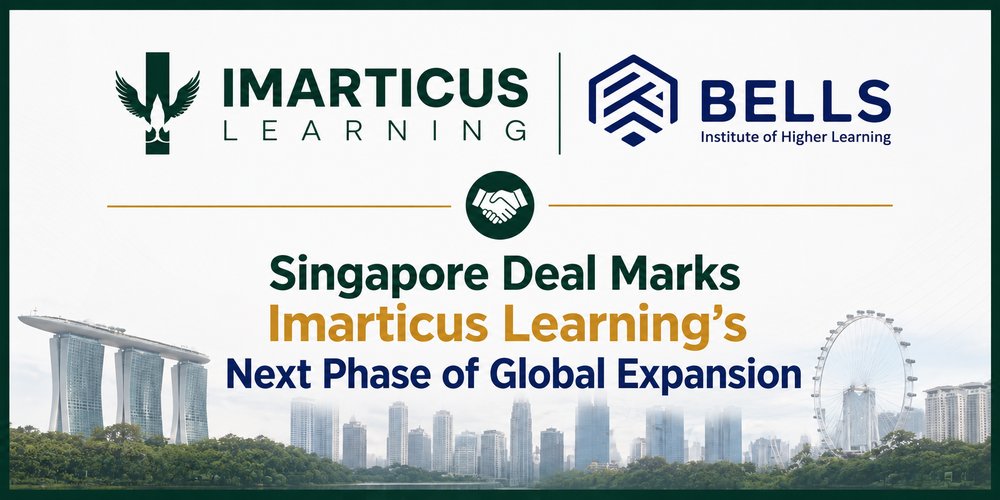
₹800 Crore BELLS Acquisition Accelerates Imarticus Learning’s Global Education Expansion
Imarticus Learning’s acquisition of Singapore-based BELLS signals a major push across Southeast Asia.
India’s professional education and skilling company Imarticus Learning is expanding its international footprint with the acquisition of Singapore-based BELLS Institute of Higher Learning, in a deal reported to be worth around ₹800 crore.
The transaction marks Imarticus Learning’s first international acquisition and represents a significant shift in the company’s growth strategy—from building its professional education ecosystem primarily in India to establishing a stronger presence in international markets. BELLS has also publicly confirmed its merger with Imarticus Learning through a LinkedIn update, describing the development as the beginning of a new chapter focused on future-ready skills, stronger collaboration and greater opportunities for learners across the region.
The acquisition comes as demand for job-oriented education, digital skills and continuous professional development continues to reshape the global education landscape. For Imarticus, Singapore could become more than a new market—it could serve as a strategic gateway into Southeast Asia.
Singapore Emerges as Imarticus Learning’s Southeast Asian Gateway
The acquisition brings together two organisations with closely aligned approaches to professional education, workforce development and employability. BELLS describes itself as a lifelong education and training provider supporting job seekers and working professionals in Singapore. Its portfolio includes upskilling, technology training, AI, cybersecurity, RPA and other professional courses, while its programmes are connected with Singapore’s SkillsFuture and Workforce Singapore ecosystem.
BELLS operates multiple learning centres across Singapore and has built a substantial learner and alumni network over the years. Its established local presence allows Imarticus to enter the Southeast Asian market through an existing education infrastructure rather than building an entirely new operation from the ground up. The combination could also allow the two organisations to bring together local market understanding with Imarticus Learning’s experience in industry-led, career-oriented education.
A Larger Education and Workforce Development Ecosystem
Imarticus Learning has built its reputation around professional programmes designed to connect education with employment outcomes. The company currently highlights more than 1 million learners impacted, 3,500+ hiring partners, 40+ programmes and more than 1,25,000 career transitions across its ecosystem.
Its programmes span areas including:
- Finance
- Data Science
- Analytics
- Artificial Intelligence
- Technology
- Management
- Emerging digital skills
- Executive and professional education
The company also emphasises industry exposure, career assistance, mentorship and job-oriented learning rather than treating education as an isolated academic experience. With BELLS becoming part of the wider ecosystem, the opportunity extends beyond simply adding another geography. The acquisition could help Imarticus develop a broader regional platform for connecting learners, employers, training providers and industry experts.
From India-Focused Growth to International Expansion
For years, Imarticus Learning’s growth story has been closely associated with India’s rapidly expanding professional education and reskilling market. Its acquisition of MyCaptain in 2025, for example, was described by the company as its fourth acquisition in four years. At the time, Imarticus said the combined ecosystem had more than 5 lakh learners and a network spanning more than 1,500 campuses, with ambitions to reach 5 million learners by FY28. The BELLS transaction takes that acquisition-led strategy into a new phase.
Instead of simply adding another Indian education brand to its portfolio, Imarticus is acquiring an established organisation in another national education ecosystem. That distinction matters.
International expansion in education requires more than translating programmes or opening a website in another country. It requires an understanding of local learners, employers, regulations, training frameworks and expectations around professional credentials. BELLS provides an existing foundation from which that expansion can potentially be built.
Why BELLS Could Be Strategically Important
BELLS’ presence in Singapore could give Imarticus access to a market where lifelong learning and workforce upskilling are already deeply embedded in the professional landscape. The institution has been operating since 2008 and focuses on helping Singaporeans build skills and find pathways towards in-demand employment. Its offering is closely connected to Singapore’s national skills-development infrastructure. That creates potential synergies across several areas.
Local Market Access
BELLS already understands Singapore’s learner and employer ecosystem. This could reduce some of the barriers typically associated with entering a new international market.
Professional Upskilling
The two organisations can potentially expand programmes for working professionals seeking to remain competitive as technology changes their industries.
Technology and AI Skills
BELLS already lists AI, cybersecurity, RPA and technology training among its areas of expertise, while Imarticus has built significant capabilities around data, analytics, technology and emerging career skills.
Employer Connections
Imarticus’ extensive hiring-partner network could complement BELLS’ local relationships, creating opportunities to strengthen the connection between training and employment.
AI, Data and Emerging Skills at the Centre
One of the most important elements of the expansion is likely to be the growing demand for skills that sit at the intersection of technology and business. Imarticus has increasingly positioned itself around areas such as AI, data science, analytics and technology, reflecting the changing requirements of employers.
Its wider ecosystem also includes partnerships with leading institutions and programmes designed around professional and executive learning. The company’s finance and business school, for instance, positions itself around bridging the gap between academic knowledge and real-world industry readiness.
This focus could become particularly relevant in Southeast Asia, where businesses are navigating AI adoption, digital transformation and rapidly changing workforce requirements. The real opportunity may therefore not lie simply in exporting existing Indian programmes to Singapore. It could lie in adapting the model to create learning pathways that respond to the specific needs of Southeast Asian employers.
Career Outcomes Remain Central to the Model
The acquisition also reinforces a broader shift taking place across professional education: learners increasingly want to know what education will enable them to do, not simply what qualification they will receive. Imarticus has built much of its proposition around this idea. The company highlights career transitions, hiring partnerships and placement outcomes alongside its programme portfolio. Its website currently lists more than 3,500 hiring partners and more than 1,25,000 career transitions.
This outcome-oriented model could become one of the strongest areas of potential synergy with BELLS. For working professionals, education is increasingly being judged through questions such as:
- Will these skills remain relevant?
- Can this programme improve my career prospects?
- Does it connect me with employers?
- Can I apply what I learn immediately?
- Will the qualification have value beyond the classroom?
These questions are becoming increasingly important as AI and automation reshape traditional career paths.
What the Deal Means for Southeast Asia
The BELLS acquisition could ultimately position Singapore as a launchpad for Imarticus Learning’s broader Southeast Asian ambitions. Singapore offers access to a sophisticated business environment and a regional economy where employers increasingly require professionals with digital, analytical, managerial and technology-related capabilities. From Singapore, Imarticus could potentially explore opportunities in other markets across Southeast Asia, adapting its professional education model to local workforce requirements.
However, the success of that strategy will depend on execution. International expansion in education is not simply about scale. It requires maintaining instructional quality, understanding local employment markets, building credible employer relationships and ensuring that programmes genuinely translate into better career outcomes.
The Bigger Shift: Education Is Becoming a Workforce Infrastructure
Perhaps the most significant aspect of the transaction is what it says about the changing definition of education itself. Professional education is increasingly moving away from the traditional model of learning first and figuring out employment later. Instead, education providers are attempting to sit much closer to the labour market—understanding employer needs, identifying emerging skills and designing programmes around those requirements.
Imarticus Learning’s model reflects this shift through its emphasis on industry-focused education, professional training and career assistance. BELLS, meanwhile, operates within Singapore’s broader lifelong-learning and employability ecosystem. Bringing the two together could therefore represent more than geographic expansion. It could be an attempt to build an education platform that follows learners throughout their careers and across increasingly international job markets.
What Comes Next for Imarticus Learning?
The BELLS acquisition raises an important question: Is Imarticus Learning becoming a global professional education company rather than an Indian edtech company with international ambitions?
The answer will depend on what happens next. If Singapore becomes a genuine regional hub, the acquisition could provide the foundation for further expansion across Southeast Asia. The company could potentially combine its existing content, industry partnerships and career-focused programmes with BELLS’ local infrastructure and market knowledge. The next stage will be about proving that the model can travel. Scaling education internationally requires preserving what made the original model successful while adapting it enough to become genuinely relevant to new learners and employers.
For Imarticus, the ₹800 crore transaction therefore represents not only a financial commitment to international growth but also a test of whether its vision for outcome-led professional education can transcend national boundaries.
Why This Matters
The most important consequence of this acquisition may not be the size of the transaction or the number of training centres added to Imarticus Learning’s network. It is the possibility of a new education model becoming increasingly global. As careers become less linear, skills become shorter-lived and AI changes the requirements of entire professions, learners may increasingly look beyond traditional universities for education that can keep pace with the labour market.
Companies such as Imarticus are positioning themselves precisely in that space. The BELLS acquisition allows the company to test whether an education model developed in India can be adapted successfully to another sophisticated skills ecosystem and potentially become the foundation for a much wider Southeast Asian presence.
Editor’s Note
Education has traditionally asked a relatively simple question: What should a person learn? The future of education may demand a much harder question: What will a person need to remain valuable? That distinction is becoming increasingly important.
A degree once promised stability. A professional qualification promised credibility. Today, neither necessarily guarantees that a person’s skills will remain relevant five or ten years from now. Artificial intelligence can transform a role faster than an institution can redesign a curriculum. Entire industries are being reorganised around technologies that did not exist when many professionals began their careers. This is why the growth of professional education deserves to be examined beyond the language of acquisitions, valuations and expansion.
When an education company spends ₹800 crore to enter a new market, what is it really buying? It may be buying classrooms and infrastructure. It may be buying a learner base, partnerships and local expertise. But more importantly, it may be buying proximity to the future of work. That makes the Imarticus-BELLS deal particularly interesting.
Singapore is not simply another geography to enter. It is a market where lifelong learning, employability and skills development are already closely connected. BELLS brings local knowledge and an established training ecosystem, while Imarticus brings a larger professional-learning platform built around industry relevance and career outcomes.
Frequently Asked Questions
1. What has Imarticus Learning acquired?
Imarticus Learning has acquired Singapore-based BELLS Institute of Higher Learning in a deal reported to be worth around ₹800 crore. BELLS has publicly confirmed its merger with Imarticus Learning.
2. Why is the BELLS acquisition significant for Imarticus Learning?
It is significant because it represents Imarticus Learning’s first international acquisition and gives the company an established presence in Singapore, potentially supporting its wider expansion across Southeast Asia.
3. What does BELLS Institute of Higher Learning do?
BELLS is a Singapore-based lifelong education and training provider focused on skills development, professional training and employment pathways. Its areas include technology, AI, cybersecurity, RPA and other professional courses.
4. How many learning centres does BELLS have?
BELLS has multiple learning centres across Singapore, giving it an established physical presence in the local training ecosystem.
5. What areas does Imarticus Learning specialise in?
Imarticus Learning offers professional education across Finance, Data Science, Analytics, Technology, Management and other career-focused areas. The company currently lists more than 40 programmes and 3,500+ hiring partners.
6. Is the BELLS deal Imarticus Learning’s first acquisition?
No. Imarticus Learning has previously pursued an acquisition-led growth strategy, including its acquisition of MyCaptain, which the company described as its fourth acquisition in four years. The BELLS transaction represents its move into international acquisition-led expansion.
7. Why is Singapore important for Imarticus Learning?
Singapore could serve as a strategic entry point into Southeast Asia because of its established professional training ecosystem, strong business environment and focus on lifelong learning and workforce skills development.
8. Will the acquisition expand Imarticus Learning’s presence beyond Singapore?
The acquisition creates the potential for broader Southeast Asian expansion, although the specific markets and expansion plans that may follow will depend on Imarticus Learning’s future strategy.
9. What role could AI and data skills play in the expansion?
AI, data science, analytics, cybersecurity and other technology skills are increasingly important to employers. Both Imarticus and BELLS have capabilities in technology-oriented education, creating potential areas for programme development and collaboration.
10. What could the acquisition mean for learners?
If successfully integrated, the acquisition could give learners access to a broader range of industry-focused programmes, professional training and career-oriented opportunities across India and Singapore, while potentially creating pathways into a wider regional skills ecosystem.

Skoobuzz
 Skoobuzz
 Skoobuzz
 Skoobuzz


0 Comments (Please Login To Continue)