








BRICS Nations Meet in New Delhi to Expand Higher Education and Research Cooperation
BRICS nations discussed research, academic mobility, AI and indigenous knowledge at the New Delhi conference
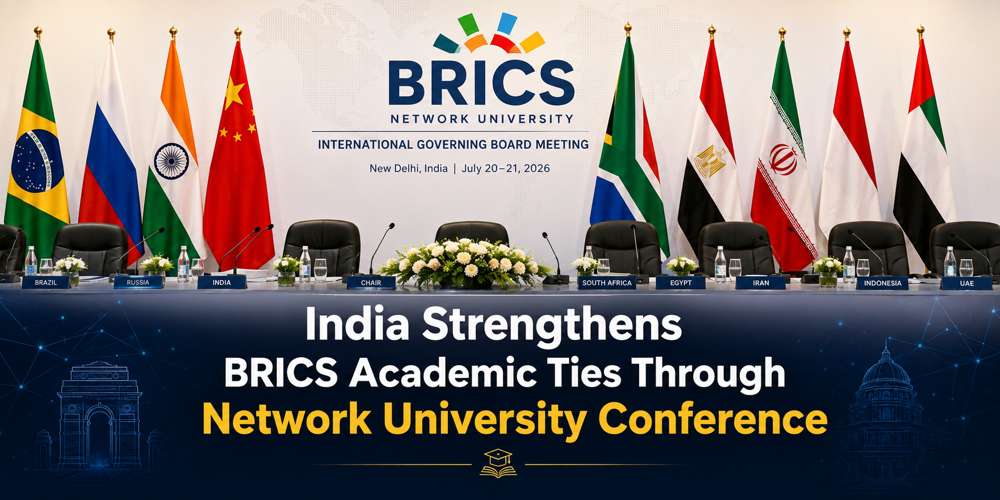
India has reaffirmed its commitment to strengthening international academic partnerships by hosting the International Governing Board (IGB) Meeting of the BRICS Network University in New Delhi. Organised by the Ministry of Education, the two-day engagement brought together policymakers, university leaders, researchers and education experts from BRICS member countries to deepen cooperation in higher education, research and innovation.
The meeting followed the Conference on Traditional and Indigenous Knowledge Systems, reflecting the growing importance of knowledge-sharing in addressing global educational and societal challenges.
BRICS Nations Showcase Educational Initiatives
Representatives from Brazil, China, Egypt, India, Indonesia, Iran, Russia, South Africa, and the United Arab Emirates participated in the discussions, presenting country-specific initiatives and best practices in higher education and research. The deliberations focused on expanding academic collaboration through:
- Collaborative research programmes
- Institutional partnerships
- Faculty and student mobility
- Knowledge exchange across member universities
- Strengthening the BRICS Network University framework
The Ministry of Education said the discussions reaffirmed the collective commitment to enhancing academic cooperation among BRICS nations.
Indigenous Knowledge Takes Centre Stage
A major focus of the conference was the role of traditional and indigenous knowledge systems in contemporary education and research. Participants explored strategies for:
- Mapping and documenting indigenous knowledge
- Preserving cultural and traditional practices
- Responsible digital dissemination of knowledge
- Ethical governance and community ownership
- Equitable benefit-sharing
- Responsible use of emerging technologies, including Artificial Intelligence
The conference also formulated guiding principles to strengthen future academic collaboration on traditional and indigenous knowledge systems, which the International Governing Board will consider.
Roadmap for BRICS Network University
The International Governing Board reviewed several strategic initiatives aimed at expanding the impact of the BRICS Network University.
Key decisions included:
Focus Area | Outcome |
BRICS-NU Action Plan | Reviewed roadmap for 2025–2028 |
Digital Expansion | Discussed development of a new BRICS-NU website |
Academic Cooperation | Explored measures to strengthen institutional collaboration |
Student & Faculty Mobility | Reviewed strategies to increase academic exchanges |
Research | Promoted collaborative research initiatives |
Governance | Adopted the BRICS Network University International Governing Board Declaration |
These initiatives are expected to enhance connectivity among member universities while fostering long-term academic and research partnerships.
Why This Matters
As global challenges become increasingly interconnected, universities are playing a larger role in facilitating international collaboration beyond national borders. Platforms like the BRICS Network University enable institutions to jointly address issues ranging from sustainability and technological innovation to cultural preservation and workforce development.
India's role as host underscores its growing emphasis on educational diplomacy and international knowledge partnerships, positioning higher education as a key pillar of global cooperation.
Editor's Note
International university partnerships are often viewed through the lens of research funding or student exchanges, but their broader significance lies in building shared intellectual ecosystems. The BRICS Network University represents an evolving model of cooperation where diverse education systems contribute different perspectives to common global challenges.
Equally important is the conference's emphasis on indigenous knowledge. In an era increasingly shaped by Artificial Intelligence and digital transformation, preserving traditional wisdom is not an exercise in nostalgia—it is an acknowledgement that innovation and heritage need not exist in opposition. The future of higher education will depend not only on advancing new technologies but also on ensuring that centuries-old knowledge systems continue to inform how societies innovate, govern and grow responsibly.
Frequently Asked Questions (FAQs)
1. What is the BRICS Network University?
The BRICS Network University (BRICS-NU) is a collaborative initiative that brings together leading universities from BRICS member countries to promote academic cooperation, research, innovation and student mobility.
2. Why did India host the BRICS Network University Conference?
India hosted the conference to strengthen higher education partnerships, collaborative research, innovation and institutional cooperation among BRICS nations.
3. Which countries participated in the conference?
Representatives attended from Brazil, China, Egypt, India, Indonesia, Iran, Russia, South Africa, and the United Arab Emirates.
4. What were the main themes of the conference?
The discussions focused on higher education collaboration, research partnerships, academic mobility, indigenous knowledge systems, ethical governance and the responsible use of Artificial Intelligence.
5. Why was indigenous knowledge highlighted?
Delegates explored ways to document, preserve and responsibly share indigenous knowledge while ensuring community ownership, ethical governance and equitable benefit-sharing.
6. What role does Artificial Intelligence play in the initiative?
Participants discussed how AI can support the responsible preservation, documentation and dissemination of traditional and indigenous knowledge while maintaining ethical standards.
7. What is the BRICS Network University Action Plan 2025–2028?
The action plan outlines priorities for expanding institutional collaboration, research partnerships, digital infrastructure, academic exchanges and governance over the next four years.
8. What decisions were taken during the International Governing Board meeting?
The board reviewed the 2025–2028 Action Plan, discussed a new BRICS-NU website, adopted the International Governing Board Declaration and considered measures to strengthen academic cooperation and mobility.
9. How does the BRICS Network University benefit students and researchers?
It creates opportunities for joint research, international academic exchanges, collaborative programmes and access to expertise across universities in BRICS countries.
10. Why is international academic collaboration becoming increasingly important?
Global challenges such as climate change, digital transformation, public health and sustainable development require cross-border research, knowledge sharing and multidisciplinary collaboration among universities.

Skoobuzz

 Skoobuzz

 Skoobuzz
 Skoobuzz


0 Comments (Please Login To Continue)