








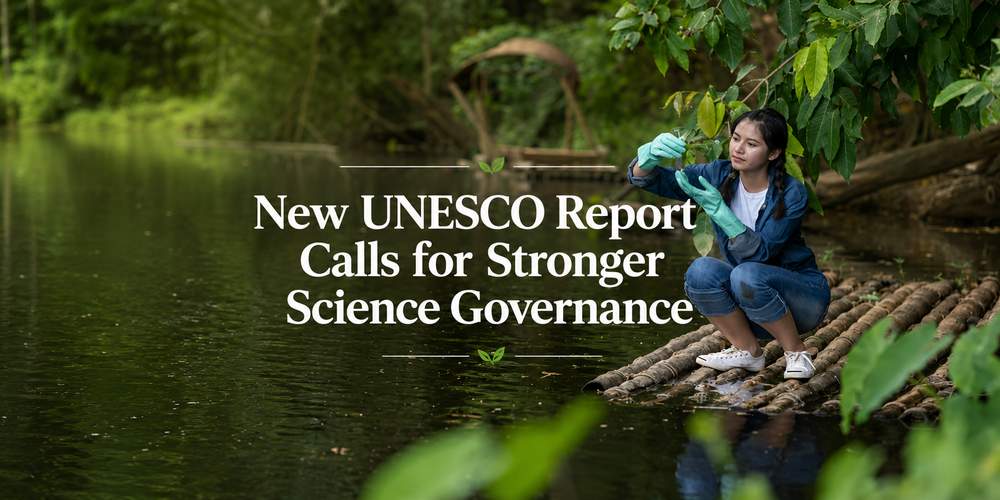
UNESCO Report Warns Scientific Divides Could Slow Global Progress on Sustainable Development Goals
UNESCO's new report urges stronger global collaboration to bridge science gaps and accelerate the SDGs.
UNESCO has released the First Global Report of the International Decade of Sciences for Sustainable Development (IDSSD), warning that persistent inequalities in global scientific participation could undermine progress towards achieving the United Nations Sustainable Development Goals (SDGs).
The report was unveiled during the opening of the 2026 Global Conference of the International Decade of Sciences for Sustainable Development in Paris, where more than 800 ministers, scientists, policymakers and international leaders gathered to assess the role of science in addressing today's most pressing global challenges.
Drawing on data from 397 scientific initiatives across 79 countries, the report celebrates unprecedented scientific collaboration while highlighting the structural barriers that continue to prevent many developing nations from fully participating in global research efforts.
Scientific Momentum Is Growing, But Global Inequality Persists
According to UNESCO, the Science Decade has successfully mobilised USD 50 million in confirmed funding over its first two years, supporting projects linked to all 17 Sustainable Development Goals.
These initiatives address a broad range of interconnected issues, including:
- Climate change and environmental sustainability
- Social and economic inequality
- Artificial intelligence governance
- Quantum science
- Public health and scientific innovation
However, the report also reveals significant disparities in participation.
Despite accounting for 17.5% of the world's population, Africa represents less than 10% of the Science Decade's endorsed initiatives, highlighting ongoing inequalities in access to scientific resources and international collaboration.
Additionally, 40% of participating initiatives identified coordination, not funding, as their greatest challenge, suggesting that stronger governance and institutional cooperation are just as critical as financial investment.
UNESCO Calls for Five Key Reforms
To accelerate progress towards the SDGs, UNESCO recommends five major structural reforms aimed at strengthening the global science ecosystem.
Recommended Reform | Purpose |
Reform research evaluation | Move beyond the "publish or perish" culture and reward meaningful societal impact. |
Expand equitable access | Improve access to scientific infrastructure, research facilities and knowledge worldwide. |
Strengthen science-policy links | Create closer collaboration between researchers and policymakers. |
Rebuild public trust | Promote scientific integrity, inclusion and science literacy. |
Govern emerging technologies responsibly | Develop effective oversight for AI, quantum science and other rapidly evolving technologies. |
UNESCO argues that scientific knowledge already exists to tackle many global challenges, but stronger governance systems are needed to translate research into effective public policy and measurable societal outcomes.
Open Science Progress Remains Uneven
The report also assesses implementation of UNESCO's Recommendation on Open Science, adopted in 2021. Encouragingly, 81 countries have introduced measures aligned with the Recommendation, with 60% of open science policies developed over the past five years explicitly referencing the UNESCO framework.
However, implementation continues to lag behind policy commitments.
Key findings include:
Open Science Indicator | Status |
Countries with an open science policy framework | 79% |
Countries with implementation plans | 41% |
Countries with monitoring mechanisms | Approximately 33% |
UNESCO notes that without clear implementation strategies and accountability systems, many open science commitments risk remaining largely symbolic.
Celebrating the Next Generation of Scientists
Alongside the conference, UNESCO and the AXA Foundation for Human Progress launched Next Generations, a photography exhibition highlighting the work of 11 outstanding early-career researchers from around the world.
The exhibition aims to showcase the scientists who will help shape the next decade of discovery and innovation while inspiring greater public engagement with science.
Conference Focus: Science in Action
Held under the theme "Science in Action: Charting a Sustainable and Equitable Future for All," the conference is addressing several global priorities, including:
- Reducing scientific inequalities between developed and developing nations
- Promoting gender equity in science
- Turning open science commitments into practical action
- Strengthening public confidence in scientific research
- Improving collaboration between researchers and decision-makers
Participants are expected to develop recommendations that can better integrate scientific evidence into public policy and sustainable development planning.
Why This Matters
Scientific research plays a critical role in addressing complex global challenges—from climate change and public health to technological governance and economic inequality. UNESCO's findings suggest that while international collaboration is growing, unequal participation and weak implementation mechanisms continue to limit the impact of science in many regions.
Bridging these gaps will be essential not only for achieving the Sustainable Development Goals but also for ensuring that scientific progress benefits all countries, regardless of their level of development.
Editor's Note
UNESCO's latest report highlights a familiar paradox in global development: scientific knowledge is expanding rapidly, yet its benefits remain unevenly distributed. Investment alone cannot solve this challenge. Stronger partnerships, inclusive governance, and policies that connect research with real-world decision-making will determine whether science becomes a truly global public good. As emerging technologies reshape societies at unprecedented speed, ensuring equitable access to scientific opportunities has become not only a development priority but also a matter of global resilience.
Frequently Asked Questions (FAQs)
What is UNESCO's International Decade of Sciences for Sustainable Development?
It is a global initiative designed to strengthen the role of science in achieving the United Nations Sustainable Development Goals between 2024 and 2033.
What does the new UNESCO report reveal?
The report highlights strong global scientific collaboration but warns that developing countries, particularly in Africa, remain underrepresented in international scientific initiatives.
Why is Africa highlighted in the report?
Although Africa represents 17.5% of the world's population, it accounts for less than 10% of the scientific initiatives endorsed under the Science Decade.
What are UNESCO's five recommended reforms?
The recommendations focus on improving research evaluation, expanding equitable access to science, strengthening science-policy collaboration, rebuilding public trust, and responsibly governing emerging technologies.
What is UNESCO's Recommendation on Open Science?
Adopted in 2021, it encourages countries to make scientific knowledge more accessible, transparent and collaborative while improving public access to research.

Skoobuzz

 Skoobuzz
 Skoobuzz
 Skoobuzz
 Skoobuzz


0 Comments (Please Login To Continue)