








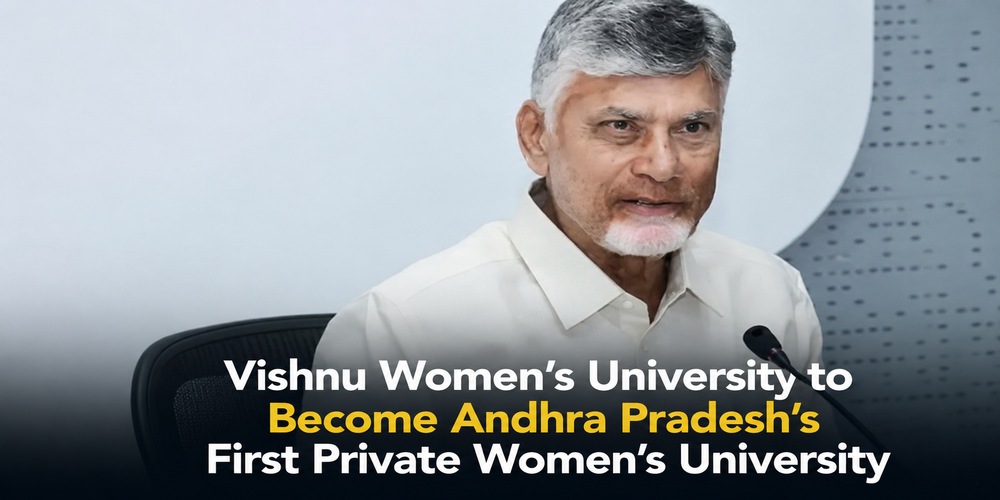
Andhra Pradesh Cabinet Approves Vishnu Women’s University as State’s First Private Women’s University
This marks a new milestone for women’s higher education in the State.
Andhra Pradesh has taken a significant step in expanding opportunities for women in higher education, with the State Cabinet approving the establishment of Vishnu Women’s University, which will become the State’s first private university exclusively for women.
The decision was taken at a Cabinet meeting chaired by Chief Minister N. Chandrababu Naidu, where ministers approved a proposal to amend the Schedule to the Andhra Pradesh Private Universities (Establishment and Regulation) Act, 2016.
The move will allow Vishnu Women’s University to formally enter the State's private university landscape and marks a new phase for an institution that has already spent decades providing education to women.
Cabinet Clears Legislative Amendment
The Cabinet approved the promulgation of an ordinance to amend the existing private universities legislation. Under the proposed amendment, Vishnu Women’s University and Chalapathi University will be added to the Schedule of the Andhra Pradesh Private Universities (Establishment and Regulation) Act, 2016. The amendment will enable their sponsoring bodies to establish the universities under the brownfield category, allowing existing educational institutions to transition into university-level institutions.
Information and Public Relations and Housing Minister Kolusu Parthasarathy announced the Cabinet's decision during a briefing in Amaravati. The move reflects the State government's efforts to expand the higher education ecosystem by enabling established educational institutions to develop into universities.
From Women's College to Private University
Vishnu Women’s University will build on the existing foundation of Sri Vishnu Engineering College for Women in Bhimavaram, which was established around 25 years ago by the Sri Vishnu Educational Society (SVES). The society also operates the BVRIT Group of Colleges, with institutions offering programmes in areas including engineering, pharmacy, management and degree education across Andhra Pradesh and Telangana.
With approval for brownfield expansion, the existing women's engineering college will now transition into a private university. The move represents a considerable institutional shift — from operating as a specialised higher education college to becoming a university with greater scope for academic programmes, research and institutional development.
A First for Andhra Pradesh and the Telugu States
The significance of the announcement extends beyond Andhra Pradesh. Vishnu Women’s University is set to become the first private university exclusively for women in both Andhra Pradesh and Telangana. The two Telugu-speaking States already have women-focused public universities. These include Sri Padmavati Mahila Visvavidyalayam in Tirupati and Veeranari Chakali Ilamma Women’s University in Hyderabad.
However, the establishment of Vishnu Women’s University introduces a private university model specifically dedicated to women's higher education into the region. This could create additional opportunities for women seeking specialised academic environments while also contributing to the broader diversification of India's higher education sector.
Why Women-Only Higher Education Still Matters
The expansion of women-focused higher education comes at an interesting moment. For decades, increasing women's participation in education has been viewed primarily through the lens of access: ensuring that girls and women can enter schools, colleges and universities. But the conversation is gradually becoming more complex.
Access is only one part of educational opportunity. Questions around academic confidence, leadership, research participation, career preparation, safety, representation and institutional support also influence how women experience higher education.
Women-only institutions can offer environments in which students are encouraged to pursue fields where female representation may still be developing, while also creating opportunities for women to take on leadership and collaborative roles.
The long-term impact of Vishnu Women’s University will therefore depend not simply on its status as the first private women's university in the State, but on the kind of academic ecosystem it ultimately builds.
Andhra Pradesh Cabinet Also Approves 3,168 Government Jobs
The Cabinet meeting also addressed employment within the State government. Ministers approved the filling of 3,168 vacancies across various government departments through direct recruitment under Phase II of the Job Calendar 2026–27. The recruitment decision adds an employment dimension to the Cabinet's wider policy agenda, coming alongside the higher education approval.
For young people entering the workforce, such measures highlight the continuing importance of both expanding educational opportunities and creating pathways into employment.
Industrial Infrastructure Plans Also Move Forward
The Cabinet further authorised the Andhra Pradesh Industrial Infrastructure Corporation (APIIC) to execute an addendum to its existing Shareholders’ Agreement and State Support Agreement with the National Industrial Corridor Development and Implementation Trust. The agreement relates to the implementation of industrial parks approved under the Bharat Audyogik Vikas Yojana.
Together with the university and recruitment decisions, the approvals point towards parallel efforts around education, employment and industrial development within the State.
A New Chapter for Women’s Higher Education
The approval of Vishnu Women’s University is more than an institutional reclassification. It represents the transformation of an established women's educational institution into a university with the potential to shape a broader academic ecosystem. As Andhra Pradesh continues to expand its higher education infrastructure, the success of such an institution will ultimately depend on what it offers students beyond a university name — the quality of teaching, access to research, industry connections, employability opportunities and the freedom for students to imagine careers beyond conventional boundaries.
For the women who eventually walk through its doors, the significance of the university may be much more personal: a place where education is not simply about earning a degree, but about developing the confidence and capabilities to determine what comes next.
Editor’s Note
The phrase “first private women’s university” naturally invites celebration. But it is also worth asking what such a milestone should actually mean. For generations, the expansion of women's education has been measured through numbers — enrolment rates, graduation rates, institutions established and programmes offered. These figures matter. But education changes lives most profoundly in ways that are harder to quantify.
What happens when a young woman enters a university and sees women leading laboratories, building companies, conducting research, managing institutions and shaping public life? What happens when she is encouraged to study a subject that her family once considered unsuitable for her? What happens when education gives her not only knowledge, but the confidence to make decisions about her own future?
That is where the deeper promise of Vishnu Women’s University lies. Being the first private university exclusively for women is a distinction. Creating an institution that genuinely expands what women believe is possible for themselves is the larger responsibility.
The university's eventual legacy should therefore not be measured solely by the number of students it enrols or programmes it introduces. It should be measured by the opportunities those students carry beyond their campus. A university can award degrees. The more transformative ones also expand horizons. And perhaps that is the question Andhra Pradesh should ultimately ask of this new institution: Will it simply educate women for the world as it exists, or help prepare them to reshape the world they inherit?
Frequently Asked Questions
1. What has the Andhra Pradesh Cabinet approved?
The Andhra Pradesh Cabinet has approved the establishment of Vishnu Women’s University, which will become the State's first private university exclusively for women.
2. Who chaired the Cabinet meeting?
The Cabinet meeting was chaired by Andhra Pradesh Chief Minister N. Chandrababu Naidu.
3. What legislative change was approved?
The Cabinet cleared a proposal to promulgate an ordinance amending the Schedule to the Andhra Pradesh Private Universities (Establishment and Regulation) Act, 2016.
4. Which universities will be added to the Schedule?
The proposed amendment will include Vishnu Women’s University and Chalapathi University in the Schedule, enabling their sponsoring bodies to establish the institutions under the brownfield category.
5. What institution will become Vishnu Women’s University?
Sri Vishnu Engineering College for Women in Bhimavaram will be transformed into the private university following approval for brownfield expansion.
6. Who established Sri Vishnu Engineering College for Women?
The institution was established around 25 years ago by the Sri Vishnu Educational Society (SVES).
7. Will Vishnu Women’s University be the first women’s university in Andhra Pradesh?
It will be the first private university exclusively for women in Andhra Pradesh. The State already has a government-run women’s university, Sri Padmavati Mahila Visvavidyalayam in Tirupati.
8. Will it be the first private women’s university in both Telugu States?
Yes. Vishnu Women’s University is set to become the first private university exclusively for women in Andhra Pradesh and Telangana.
9. How many government vacancies were also approved?
The Cabinet approved the filling of 3,168 government vacancies through direct recruitment under Phase II of the Job Calendar 2026–27.
10. What other major decision did the Cabinet take?
The Cabinet permitted the Andhra Pradesh Industrial Infrastructure Corporation to execute an addendum with the National Industrial Corridor Development and Implementation Trust for implementing industrial parks approved under the Bharat Audyogik Vikas Yojana.

Skoobuzz


 Skoobuzz
 Skoobuzz
 Skoobuzz
 Skoobuzz


0 Comments (Please Login To Continue)