








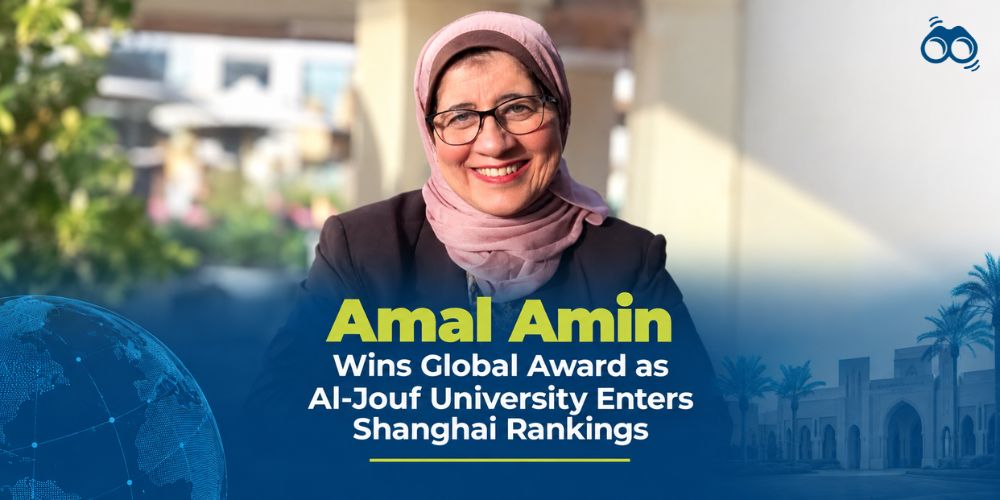
Egyptian Academic Wins International Award as Arab Universities Expand Global Research Partnerships
Dr. Amal Amin receives the Profound Award, while universities across the Arab region strengthen research
Egyptian academic Dr. Amal Amin, a professor at the National Research Centre, has received the international “Profound Award” from the Royal Academy of Science International Trust. The US-based independent international non-governmental academy was established in 1968 by Prince Mohammed bin King Faisal of Iraq. The recognition highlights Amin’s contributions to scientific research and social development, as well as her work in promoting international cooperation and supporting women and young researchers.
The Egyptian Ministry of Higher Education described the award as an important recognition for Egypt’s participation in international scientific forums and said Amin is the first Arab recipient of the honour. Her recognition reflects the growing visibility of researchers from the region in international scientific and academic networks, particularly in areas connecting research, social development and international collaboration.
Amin’s work has also included efforts to support the participation and advancement of women and younger researchers in science. The award therefore recognises both her academic contributions and her broader role in encouraging collaboration and expanding opportunities within the scientific community.
Al-Jouf University Places Four Subjects in 2026 Shanghai Rankings
Saudi Arabia’s Al-Jouf University has secured positions in four subject areas in the 2026 Shanghai Rankings, reflecting its performance across research and academic disciplines. According to the Saudi Press Agency, the university’s nursing programme was placed in the 151–200 range globally, putting it among the top 200 institutions worldwide in the subject.
Three other disciplines also appeared in the rankings. Energy science and engineering, mathematics, and food science and technology were each placed in the 301–400 global range. The university said the results reflect its growing research output and scientific performance, alongside efforts to strengthen the quality of its academic programmes and areas of specialisation.
The Shanghai Rankings, also known as the Academic Ranking of World Universities, originated at Shanghai Jiao Tong University in 2003 and became one of the earliest global university ranking systems. While the rankings have received recognition for their methodology and emphasis on research-related indicators, they have also faced criticism over institutional size, with larger universities potentially benefiting from measures that favour greater research volume.
University of Jordan and German Partner Receive Funding for Water Treatment Research
The University of Jordan and Germany’s Friedrich-Alexander University Erlangen-Nuremberg have secured funding for a collaborative research project focused on using diamond electrode technology for water treatment. The project forms part of the Higher Education Dialogue with the Islamic World – Short-Term Actions 2026/2027 programme, which is supported by the German Academic Exchange Service (DAAD).
The collaboration will bring students and researchers from the two universities together through a winter academy designed to combine research, technical learning and practical experimentation. Participants are expected to take part in scientific meetings, field visits, applied experiments and training activities as they investigate potential approaches to water treatment.
The project is intended to facilitate the transfer of technical knowledge between the partner institutions while strengthening the capabilities of Jordanian students and researchers. It also aims to contribute to the development of innovative approaches to water treatment and address challenges associated with water scarcity in Jordan, linking international academic cooperation with a pressing regional issue.
Yemen and Wuhan University of Technology Renew Academic Cooperation
The Cultural Attaché of the Republic of Yemen’s Embassy in Beijing and Wuhan University of Technology have signed a memorandum of understanding aimed at strengthening academic and scientific cooperation between Yemen and China. Dr. Mohammed Al-Ahmadi, Yemen’s cultural attaché, signed the agreement on behalf of Yemen, while Mai Liqiang, vice president of Wuhan University of Technology, represented the Chinese institution.
The agreement reactivates a previous cooperation framework that had been suspended since 2017, several years after the beginning of Yemen’s ongoing civil war. The renewed arrangement establishes a platform for communication and collaboration between Yemeni and Chinese universities and scientific institutions, with a focus on strengthening academic links.
Areas covered by the memorandum include scientific research, academic exchange and postgraduate education. The agreement is expected to create additional opportunities for Yemeni students and researchers while facilitating cooperation across several academic fields. By reopening institutional channels for research and education, the partnership provides a framework for universities and researchers from both sides to pursue shared academic activities.
Al-Azhar University–Gaza and Bursa Technical University Expand Academic Ties
Al-Azhar University–Gaza and Bursa Technical University in Türkiye have also signed a memorandum of understanding covering practical training, scientific research and academic publishing. The agreement was signed during the annual conference and exhibition of the European Association for International Education (EAIE) in Glasgow, United Kingdom, where the presidents of the two universities were present.
The memorandum establishes a broader framework for cooperation across academic, scientific, social and cultural activities. Planned areas of collaboration include seminars, workshops, conferences and scientific forums, alongside the exchange of academic information and materials. The institutions also intend to facilitate the exchange of faculty members and students and develop joint research projects.
The partnership reflects the role of international education events in creating connections between universities and opening channels for institutional cooperation. For the two universities, the agreement provides a structure for continuing academic engagement through research collaboration, mobility and knowledge exchange.
International Partnerships Continue to Shape Arab Higher Education
The developments highlighted in the bulletin point to a range of international activities taking place across higher education institutions in the Arab region. Individual academic recognition, subject-level rankings, externally funded research and university-to-university agreements are contributing to broader efforts to strengthen research capacity and international engagement.
From scientific collaboration on water treatment in Jordan to renewed academic links between Yemen and China and new cooperation between Al-Azhar University–Gaza and Bursa Technical University, the initiatives demonstrate how universities are using international partnerships to support research, student opportunities and knowledge exchange. At the same time, recognitions such as the Profound Award received by Dr. Amal Amin highlight the role of individual researchers in representing Arab scientific communities on international platforms.
Editor’s Note
International collaboration is increasingly becoming an important component of higher education development across the Arab region. The initiatives covered in this bulletin range from research projects addressing practical challenges to academic agreements that create opportunities for student and faculty exchange.
The developments also demonstrate that internationalisation extends beyond university rankings. Research partnerships, scientific mobility, postgraduate opportunities and recognition of researchers can all contribute to strengthening academic ecosystems and connecting institutions with wider global networks.
Frequently Asked Questions
1. Who received the international Profound Award?
Egyptian academic Dr. Amal Amin, a professor at the National Research Centre, received the international Profound Award from the Royal Academy of Science International Trust.
2. Which Al-Jouf University subjects entered the 2026 Shanghai Rankings?
Al-Jouf University was represented in nursing, energy science and engineering, mathematics, and food science and technology.
3. What was Al-Jouf University’s ranking in nursing?
Its nursing programme was placed in the 151–200 range globally in the 2026 Shanghai Rankings.
4. What is the University of Jordan’s international research project about?
The University of Jordan and Friedrich-Alexander University Erlangen-Nuremberg are working on a project involving diamond electrode technology for water treatment, supported through a DAAD-funded programme.
5. What does the Yemen–Wuhan University agreement cover?
The agreement focuses on scientific research, academic exchange and postgraduate programmes, creating a framework for cooperation between Yemeni and Chinese academic institutions.
6. What areas are covered by the Al-Azhar University–Gaza and Bursa Technical University agreement?
The partnership includes practical training, scientific research, academic publishing, seminars, workshops, conferences, faculty and student exchanges, and joint research projects.

Skoobuzz


 Skoobuzz
 Skoobuzz


0 Comments (Please Login To Continue)