








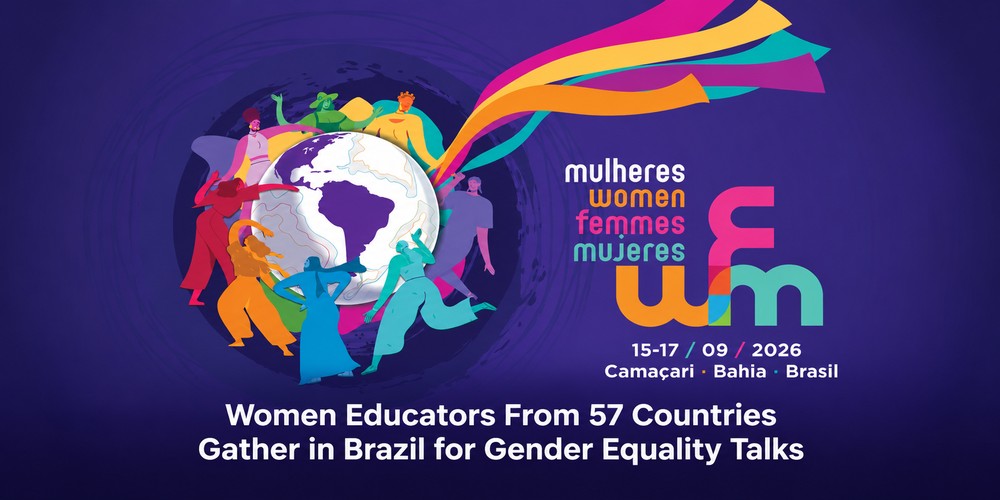
5th Education International World Women’s Conference: Rising United for Gender Justice
Over 300 women education unionists will gather in Brazil to advance gender equality and women’s leadership.
More than 300 women education unionists from 57 countries are coming together in Bahia, Brazil, for the fifth Education International World Women’s Conference, creating a global platform for discussions on gender equality, women’s leadership, workers’ rights and social justice in education. The flagship event will bring together education professionals and union representatives from across the world to share experiences, examine persistent inequalities and develop strategies for advancing gender justice in education systems and education unions.
The conference, being held from September 15 to 17, is centred on the theme “Rising united for gender justice: Educating the world, leading change, fighting for democracy.” It is being co-hosted by Education International member organisations in Brazil, including CNTE, CONTEE and PROIFES. The event aims to provide an inclusive and supportive environment for women education unionists to participate in discussions, exchange knowledge, strengthen leadership skills and develop collective approaches to challenges affecting women in the education workforce.
Global Gathering Puts Women’s Leadership at the Centre
The World Women’s Conference comes at a time when women form a substantial majority of the education workforce in many parts of the world but continue to face barriers to equal representation in leadership and decision-making. While women play a central role as teachers, education professionals and union members, their presence at senior levels within educational institutions and unions does not always reflect their participation across the sector.
The conference seeks to address this gap by placing women’s leadership at the heart of conversations about the future of education and organised labour. Participants will have the opportunity to discuss how education unions can strengthen women’s participation, create more equitable leadership structures and ensure that women have a meaningful role in shaping policies that affect their professional lives and the wider education system.
Education International Vice-President Marième Sakho Dansokho has stressed the importance of using collective strength to advance women’s leadership and gender equality. The conference’s focus on international solidarity reflects the view that gender justice requires coordinated action across borders, particularly as many challenges facing women educators are shared across different education systems and regions.
Women Form the Backbone of Global Education
Women educators are at the centre of education systems in numerous countries. They represent the majority of teachers in many parts of the world and make up a significant proportion of education union members. Despite this, women remain underrepresented in leadership positions, creating a continuing imbalance between their participation in the profession and their influence over institutional and union decision-making.
This disparity has implications for how education policies and workplace priorities are developed. Leadership positions determine which issues receive attention, how resources are allocated and what working conditions are prioritised. Increasing women's participation in these roles is therefore not simply about improving representation; it is also about ensuring that education systems benefit from the experiences and perspectives of the people who make up much of their workforce.
The conference will provide an opportunity to examine these structural challenges and consider ways of creating stronger pathways for women to enter and remain in leadership. It will also explore how unions can support women educators through professional development, collective organising and policies that address barriers to career progression.
Working Conditions Remain a Major Concern
Gender equality cannot be separated from the broader working conditions experienced by educators. Across the education sector, teachers and other education workers continue to face concerns related to low salaries, difficult working environments, excessive workloads and rising levels of stress. These pressures are affecting the attractiveness and sustainability of the teaching profession and are contributing to the global teacher shortage.
For women educators, workplace pressures can also intersect with unequal care responsibilities and expectations around emotional labour. The combination of professional demands and responsibilities outside the workplace can create additional barriers to career progression and leadership, particularly when institutions lack adequate support systems.
Addressing these challenges requires a broader approach to gender justice. Encouraging women to take on leadership positions will have limited impact if the professional environment remains characterised by excessive workloads, inadequate compensation and insufficient support. Sustainable change therefore requires education systems and unions to consider both representation and the conditions that allow educators to thrive professionally.
Teacher Shortages Put Education Systems Under Pressure
The conference also highlights the relationship between gender equality and the wider sustainability of the education workforce. Teacher shortages in many countries are placing additional pressure on existing educators, increasing workloads and making it harder for education systems to maintain quality and continuity.
Improving working conditions is therefore important not only for teachers but also for students and communities. When educators are overworked or leave the profession because of poor conditions, schools can struggle to recruit and retain experienced professionals. Creating fairer and more supportive workplaces can help strengthen the profession and improve long-term education outcomes.
Women’s leadership can play an important role in these discussions because women educators bring direct experience of many of the workplace challenges being debated. Giving them greater influence within unions and institutions can help ensure that policies addressing teacher welfare and professional sustainability reflect the realities of the workforce.
Gender Justice Linked to Democracy and Social Justice
The conference’s theme also connects gender equality with democracy and social justice. Education plays a major role in shaping how individuals understand participation, equality, rights and civic responsibility. The institutions responsible for educating future generations are therefore closely connected to the broader health of democratic societies.
Education International President Mugwena Maluleke has emphasised this connection, arguing that stronger women’s leadership can contribute to stronger unions, better education systems and healthier democracies. From this perspective, gender justice is not an isolated issue within the education sector but part of a wider effort to create institutions where participation and decision-making are more inclusive.
The focus on democracy comes as conservative and far-right political forces gain influence in different parts of the world. Education International has warned that these developments can put previous progress on gender equality and civil rights under pressure. The conference consequently provides a space for education unionists to consider how collective organising can help protect democratic and social gains.
Conference to Explore Women’s Leadership and Education
From September 15 to 17, participants will discuss a range of issues affecting the teaching profession and the wider education workforce. The programme will include discussions on advancing women’s leadership within education institutions and unions, alongside broader conversations about democracy, social justice and the future of the education profession.
The event will feature plenary sessions, breakout discussions, capacity-building activities and informal networking opportunities. This combination is intended to give participants opportunities not only to hear from international speakers but also to exchange practical experiences and develop ideas that can be applied within their own organisations.
Capacity-building is particularly relevant to the conference’s leadership objectives. Creating more opportunities for women to develop skills, networks and confidence can strengthen the pipeline of future leaders. However, such initiatives are most effective when accompanied by institutional changes that ensure women have genuine opportunities to use those skills and participate in decision-making.
Building Solidarity Across Borders
Bringing women education unionists together from 57 countries also creates an opportunity to strengthen international solidarity. Although education systems and labour conditions differ significantly across countries, many women educators face similar challenges, including unequal access to leadership, workplace discrimination, excessive workloads and limited recognition of their contributions.
International exchanges can help unions identify common patterns and learn from strategies being implemented elsewhere. Sharing experiences can also prevent individual organisations from having to develop solutions in isolation and can strengthen collective advocacy around issues that have global dimensions.
The conference’s international character is therefore an important part of its purpose. By connecting women working within different education systems, Education International aims to strengthen a global movement capable of advocating for gender equality while recognising the specific realities of educators in different regions.
Moving Beyond Representation Towards Real Influence
One of the central questions for education unions is how to move from simply increasing the number of women in leadership to ensuring that women have meaningful influence once they reach those positions. Representation is an important first step, but it does not automatically guarantee equality.
Meaningful leadership requires access to decision-making authority, professional opportunities, resources and supportive organisational structures. It also requires institutions to recognise and address the barriers that can prevent women from progressing, rather than placing the responsibility for overcoming those barriers entirely on individual women.
The World Women’s Conference offers a platform for examining these issues collectively. By bringing together women unionists with different experiences and perspectives, the event can help identify practical approaches to strengthening leadership and creating organisations where gender equality is reflected not only in membership numbers but also in institutional power.
The Road Ahead for Gender Equality in Education
The discussions in Bahia are expected to contribute to wider efforts to advance gender equality across the education sector. However, the lasting impact of the conference will depend on how effectively its discussions are translated into action after the event.
For education unions and institutions, this could mean strengthening leadership development programmes, improving workplace policies, addressing pay and workload concerns, creating more inclusive decision-making structures and ensuring that women have sustained opportunities to shape education policy.
The conference therefore represents both a moment of international reflection and a call for continued action. Its emphasis on solidarity, leadership and democracy underlines the idea that gender equality requires more than individual progress. It requires changes to the systems and institutions in which educators work.
Editor’s Note
The fifth Education International World Women’s Conference arrives at an important point for the global education sector. Women already constitute a significant part of the education workforce in many countries, yet their strong presence in classrooms and education institutions has not consistently translated into equal representation in leadership. This makes the conference’s focus on gender justice particularly relevant: the conversation must move beyond acknowledging women’s contribution to examining whether education systems and unions are giving women the authority, opportunities and support needed to shape the future of the profession.
The broader challenges facing education make this discussion even more urgent. Teacher shortages, workload pressures, low pay and workplace stress affect the sustainability of education systems, while threats to gender equality and democratic values add another layer of concern. The conference can therefore be meaningful if it helps turn international solidarity into practical changes in leadership, workplace conditions and policy. Ultimately, its success should not be measured only by the conversations held in Bahia, but by whether those conversations lead to stronger representation, better working environments and greater decision-making power for women educators long after the conference concludes.
Frequently Asked Questions
1. What is the Education International World Women’s Conference?
The Education International World Women’s Conference is a global event focused on gender equality, women’s leadership, education unions, workers’ rights and social justice.
2. Where is the fifth World Women’s Conference being held?
The fifth conference is being held in Bahia, Brazil.
3. When is the 2026 World Women’s Conference taking place?
The conference is scheduled from September 15 to 17, 2026.
4. How many women education unionists are participating?
More than 300 women education unionists from 57 countries are expected to participate.
5. What is the theme of the conference?
The theme is “Rising united for gender justice: Educating the world, leading change, fighting for democracy.”
6. Why is women’s leadership important in education?
Women make up a large proportion of the education workforce in many countries but remain underrepresented in leadership. Greater participation in decision-making can help ensure that education policies and workplace priorities reflect the experiences of women educators.
7. What issues will be discussed at the conference?
Discussions will cover women’s leadership, the teaching profession, education workforce challenges, working conditions, democracy, social justice and gender equality.
8. Which organisations are co-hosting the event in Brazil?
The conference is being co-hosted by Education International member organisations CNTE, CONTEE and PROIFES in Brazil.

Skoobuzz
 Skoobuzz
 Skoobuzz
 Skoobuzz
 Skoobuzz


0 Comments (Please Login To Continue)