








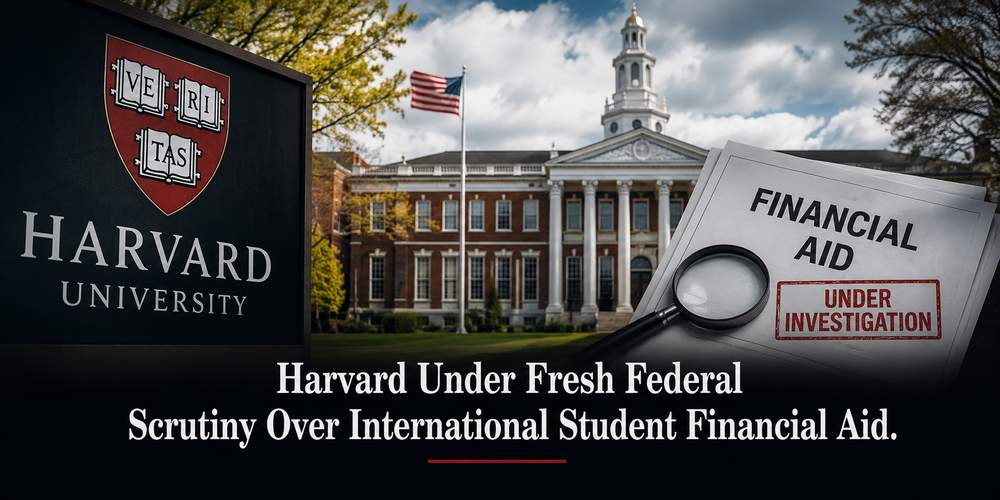
US Justice Department Investigates Harvard's International Financial Aid Over Alleged Discrimination
The federal review examines whether China-funded Harvard scholarships unlawfully exclude American students
Harvard University is facing another federal investigation as the US Department of Justice (DOJ) examines whether its international financial aid programmes, supported by Chinese donors, unlawfully exclude American students. Announced on July 21, the inquiry is the latest action in an ongoing series of federal investigations involving Harvard during the Trump administration. Justice Department officials said the review focuses on whether scholarships funded by donors from China violate US civil rights laws by limiting eligibility based on a student's country of origin.
The department clarified that the investigation is still in its early stages and that no conclusions have been reached.
What Is the Investigation About?
According to the Justice Department, Harvard's foreign funding disclosures raised concerns that some financial aid programmes supported by Chinese donors may only be available to students from specific countries. Officials argue that restricting scholarships based solely on national origin could amount to unlawful discrimination against American students under federal civil rights laws.
The review specifically examines Harvard's China-based financial aid programmes, although the department has not publicly identified the scholarships or donors currently under investigation. Harmeet Dhillon, Assistant Attorney General leading the Justice Department's Civil Rights Division, said educational institutions receiving federal funding cannot accept foreign donations that intentionally exclude US citizens from scholarship opportunities if doing so violates federal law.
Harvard Responds
Harvard University said it is reviewing the Justice Department's notice and maintains that it complies with all legal reporting and anti-discrimination requirements. In a statement, the university said it follows federal reporting obligations for foreign donations and does not unlawfully discriminate based on race, ethnicity or national origin when awarding financial aid.
Harvard remains one of the few American universities that offers need-based financial aid to international students using its own institutional resources rather than US federal aid.
China Calls for Educational Cooperation
Responding to the announcement, the Chinese Embassy in Washington defended educational exchanges between the two countries. A spokesperson said academic cooperation between China and the United States benefits both nations and should not become a casualty of political disagreements. The statement emphasised that normal educational collaboration should continue without political interference.
Foreign Donations Under Increased Scrutiny
Like many leading American universities, Harvard receives funding from international donors through gifts, research partnerships and contracts. According to federal disclosures, Harvard has reported receiving approximately:
- $630 million from Chinese sources over several decades.
- $4.5 billion in total foreign funding.
While citing these figures, the Justice Department did not identify which donations or scholarship programmes are being reviewed. Officials have increasingly argued that foreign funding, particularly from geopolitical rivals, raises concerns related to transparency and national security.
A Scholarship Programme Under the Spotlight
Although the Justice Department has not named the scholarships under investigation, one well-known example of China-funded financial aid at Harvard dates back to 2014. Chinese entrepreneurs Pan Shiyi and Zhang Xin, co-founders of SOHO China, donated $15 million to establish financial aid for Chinese students studying at Harvard.
At the time, the donation attracted criticism within China from those who believed the funds should have supported domestic universities instead. Whether this or similar programmes are part of the current investigation has not been confirmed.
A New Legal Argument
The Justice Department's review introduces an unusual legal question. Rather than examining discrimination based on race or ethnicity, officials are considering whether directing privately donated scholarships exclusively toward students from certain countries unfairly disadvantages applicants from other nationalities—including American citizens.
The investigation has been launched as a federal compliance review, meaning it was initiated by the government rather than following a complaint from an outside party.
Part of a Broader Dispute Between Harvard and the Trump Administration
The latest inquiry adds to a series of legal and administrative actions involving Harvard and the federal government. In recent months, the university has faced investigations and legal challenges concerning:
- Alleged discrimination and campus policies
- Federal research funding
- International student enrolment
- Admissions practices
- Military recruitment access
The Trump administration has argued that elite universities should be more accountable for foreign funding and campus policies, while Harvard has challenged several federal actions in court. A federal judge has previously blocked attempts to suspend billions of dollars in federal research funding while litigation continues.
Key Facts at a Glance
Topic | Details |
Investigating Agency | US Department of Justice |
Institution | Harvard University |
Focus | China-funded international financial aid programmes |
Main Concern | Possible discrimination based on national origin |
Investigation Type | Federal compliance review |
Harvard's Position | Denies unlawful discrimination |
Chinese Funding Reported | Approximately $630 million |
Total Foreign Funding | Approximately $4.5 billion |
Why This Matters
The investigation reflects growing federal scrutiny of how American universities manage foreign funding and international scholarship programmes. While institutions increasingly rely on global philanthropy to support research and student aid, questions surrounding transparency, donor conditions and equal access are becoming central to higher education policy.
The outcome of the review could influence how universities structure donor-funded scholarships in the future and may shape broader discussions around international education, civil rights and foreign partnerships.
Editor's Note
Universities have long depended on philanthropy to expand educational access, support research and strengthen international collaboration. Donor-funded scholarships have opened doors for countless students worldwide, but they also raise important questions about fairness, accountability and institutional responsibility.
As governments place greater scrutiny on foreign funding in higher education, universities may find themselves balancing two equally important priorities: preserving the generosity that makes global education possible while ensuring that every scholarship programme aligns with national laws and principles of equal opportunity. Whatever the outcome of this investigation, it is likely to influence how institutions worldwide approach international philanthropy and student financial aid for years to come.
Frequently Asked Questions
Q1. Why is the US Justice Department investigating Harvard?
The department is reviewing whether China-funded scholarship programmes at Harvard unlawfully exclude American students based on national origin.
Q2. Has Harvard been found guilty of violating any laws?
No. The Justice Department has stated that the investigation is ongoing and no conclusions have been reached.
Q3. What prompted the investigation?
Federal officials said Harvard's foreign funding disclosures raised concerns about scholarship programmes funded by Chinese donors.
Q4. How much funding has Harvard received from China?
Federal disclosures indicate Harvard has reported approximately $630 million in funding from Chinese sources over several decades.
Q5. How has Harvard responded?
Harvard says it complies with all federal reporting requirements and does not unlawfully discriminate in awarding financial aid.

Skoobuzz
 Skoobuzz
 Skoobuzz
 Skoobuzz
 Skoobuzz
 Skoobuzz


0 Comments (Please Login To Continue)