








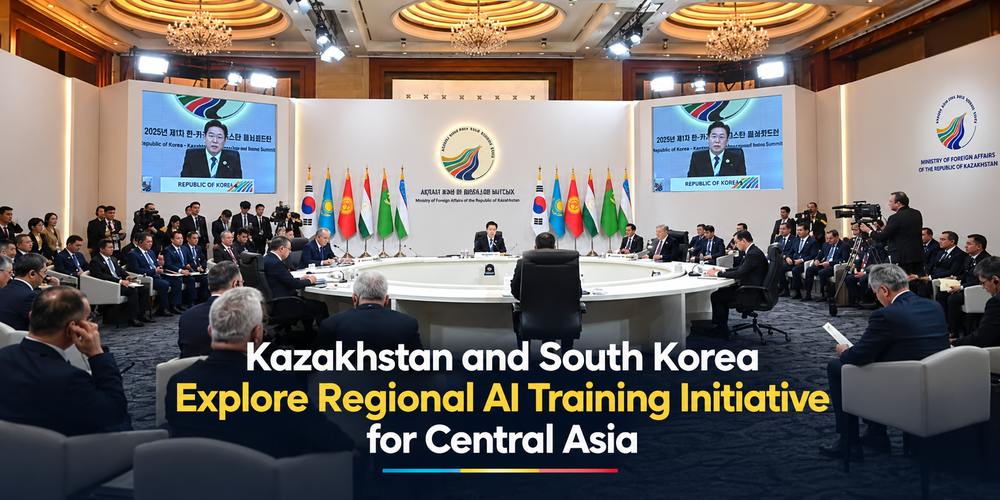
Kazakhstan Proposes Regional AI Talent Programme With South Korea
Initiative aims to train AI specialists across Central Asia while expanding Kazakhstan-South Korea cooperation
Kazakhstan has proposed a regional AI Talent programme with South Korea to train artificial intelligence specialists for countries across Central Asia, as cooperation between the two sides expands across education, technology, digitalisation and energy.
Kazakh President Kassym-Jomart Tokayev proposed the inaugural Central Asia-Republic of Korea Summit in Seoul, where he outlined opportunities for deeper collaboration between Kazakhstan, South Korea and other Central Asian countries. The proposal forms part of a broader push to strengthen regional capabilities in artificial intelligence and create new links between universities, research institutions and technology companies.
Kazakhstan and South Korea explore regional AI skills development
During his address, Tokayev highlighted South Korea’s position in advanced technology and said Kazakhstan was also becoming increasingly involved in digital transformation. He pointed to several developments within Kazakhstan’s AI ecosystem, including the opening of the Alem.ai International Centre for Artificial Intelligence in Astana, the launch of supercomputing infrastructure and the establishment of a specialised university focused on artificial intelligence.
The Kazakh president said cooperation with South Korea was already producing new education and technology initiatives. These include the opening of Woosong University in Turkistan and plans to establish an AI Institute in Kyzylorda in cooperation with SeoulTech.
Tokayev also identified the planned KAIST branch in Alatau City as a significant project in Kazakhstan-South Korea cooperation. The project is intended to strengthen connections between the two countries in education, science and research.
KAIST branch to strengthen education and research links
The planned branch of the Korea Advanced Institute of Science and Technology (KAIST) is part of wider Korean involvement in the development of Alatau City. Recent presentations on the Alatau Smart City project have included cooperation with KAIST, Korea Overseas Infrastructure & Urban Development Corporation (KIND) and Korea Airports Corporation. Areas of cooperation include educational and research infrastructure, digital technologies, artificial intelligence, K-Smart Town development and new urban mobility systems.
The development is being positioned as a platform combining urban development with education, research, industry, logistics, digital technology and investment cooperation.
AI SilkNet centre expands research cooperation
Tokayev also highlighted the AI SilkNet predictive analytics and foresight centre, established in cooperation with the Korea Institute of Science and Technology Information. The centre began operating in 2026 and is intended to support cooperation in areas related to artificial intelligence, predictive analytics and technological foresight.
The Kazakh president proposed bringing together scientific institutions, universities and technology companies from Kazakhstan and South Korea through the centre. He also said Kazakhstan was ready to use the capabilities of the Alem.ai International Centre for Artificial Intelligence to develop joint initiatives with South Korean partners.
Regional AI Talent programme proposed
Against this backdrop, Tokayev proposed establishing the AI Talent regional programme in partnership with South Korea. The initiative would focus on training artificial intelligence specialists for Central Asian countries, potentially creating a shared regional framework for developing advanced technology skills.
Tokayev said the programme could contribute to the development of a new technological space supporting economic and scientific development across the region. The proposal comes as Central Asian countries seek to strengthen digital capabilities and expand cooperation with South Korea in technology, education and innovation. The first Central Asia-Republic of Korea Summit brought the region and Seoul together at the highest political level to discuss broader cooperation.
Kazakhstan also seeks cooperation in hydrogen energy
AI and digitalisation were not the only areas discussed during the summit. Tokayev also expressed Kazakhstan’s interest in studying South Korea’s experience in hydrogen energy. Several joint initiatives are reportedly being considered, including the Green Energy Complex project in East Kazakhstan.
Tokayev said Kazakhstan wanted to move towards pilot projects involving the production and use of clean hydrogen. At the same time, he noted that coal remains an important component of Kazakhstan’s energy system. According to figures cited by the Kazakh president, the country has approximately 33 billion tonnes of coal reserves, while coal-fired power generation accounts for more than 60 per cent of electricity production.
He therefore highlighted the introduction of advanced “clean coal” technologies as an important priority and invited South Korean companies, including Doosan, KEPCO E&C and Midland Power, to participate in projects involving the modernisation of coal-fired power plants and emissions-management technologies.
Broader Kazakhstan-South Korea cooperation
The AI initiative forms part of a wider expansion of Kazakhstan-South Korea relations. During his state visit to South Korea, Tokayev also discussed trade, investment, infrastructure, manufacturing and smart-city development with Korean officials and business leaders.
Kazakhstan has said South Korean investment in its economy has exceeded $12 billion, while Korean companies continue to operate in several sectors of the Kazakh economy. Tokayev also noted that around 51,000 South Korean citizens visited Kazakhstan in 2025, with expanded direct air connections contributing to increased travel between the two countries. The two sides have also been discussing cooperation involving Alatau City, including smart-city infrastructure, digital technologies and AI applications.
Education becomes a key area of bilateral cooperation
The emerging education and technology initiatives demonstrate how Kazakhstan and South Korea are expanding cooperation beyond traditional economic sectors. The proposed AI Talent programme would add a regional dimension by focusing not only on Kazakhstan’s own technology workforce but also on developing AI specialists across Central Asia.
Meanwhile, projects involving KAIST, Woosong University, SeoulTech and the AI SilkNet centre create potential links between higher education, research and industry. For universities and students, such partnerships can create opportunities for cross-border academic cooperation, technology training and research collaboration. For governments, the initiatives provide a framework for developing specialised skills alongside emerging digital and industrial sectors.
The proposed AI Talent programme has therefore placed skills development, higher education and artificial intelligence at the centre of a broader regional cooperation agenda between Central Asia and South Korea.
Editor’s Note
The proposed AI Talent programme reflects a broader shift in how countries are approaching artificial intelligence: the focus is moving beyond acquiring technology towards developing the people and institutions capable of using, researching and advancing it. For Central Asia, cooperation with South Korea could provide an avenue for connecting universities, research organisations and technology companies around specialised AI skills and regional projects.
The education dimension is particularly significant. AI development requires more than computing infrastructure; it also depends on universities, researchers, educators and industry partnerships that can continuously develop specialised talent. Kazakhstan’s existing initiatives with Korean institutions, combined with the proposed regional programme, indicate an approach that links higher education with national and regional technology priorities. The eventual impact of the proposal will depend on how the programme is structured, which countries and institutions participate, and how training opportunities translate into research, employment and technology development.
Frequently Asked Questions
1. What AI initiative has Kazakhstan proposed with South Korea?
Kazakhstan has proposed a regional AI Talent programme with South Korea to train artificial intelligence specialists for countries across Central Asia.
2. Who proposed the AI Talent programme?
Kazakhstan’s President Kassym-Jomart Tokayev proposed the initiative during the first Central Asia-Republic of Korea Summit in Seoul.
3. Which countries could benefit from the proposed programme?
The proposed initiative is intended to train AI specialists for Central Asian countries, although the specific participating countries, institutions and programme structure have not been detailed in the announcement.
4. What is Kazakhstan’s Alem.ai centre?
The Alem.ai International Centre for Artificial Intelligence is a Kazakhstan-based initiative focused on artificial intelligence and related technology development. Tokayev said Kazakhstan was ready to use its potential for joint initiatives with South Korea.
5. What is the AI SilkNet centre?
AI SilkNet is a predictive analytics and foresight centre established through cooperation between Kazakhstan and the Korea Institute of Science and Technology Information. Tokayev proposed using it to bring together scientific institutions, universities and technology companies from the two countries.
6. What role will KAIST play in Kazakhstan?
A branch of the Korea Advanced Institute of Science and Technology (KAIST) is planned for Alatau City. The project is intended to strengthen cooperation between Kazakhstan and South Korea in education, science and research.

Skoobuzz

 Skoobuzz
 Skoobuzz
 Skoobuzz
 Skoobuzz
 Skoobuzz


0 Comments (Please Login To Continue)