








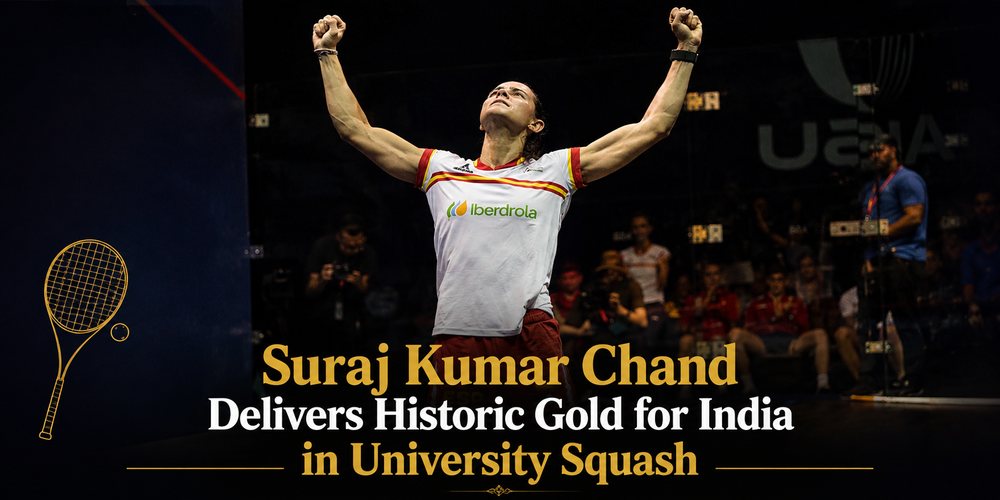
India Wins Men’s Singles Gold at 2026 FISU World University Squash Championship
Suraj Kumar Chand won men’s singles gold as India also secured team silver at the 2026 FISU Squash Championship
India has marked a significant achievement in university-level international sport, with Suraj Kumar Chand winning the men’s singles gold medal at the 2026 FISU World University Championship Squash in Mumbai. The championship concluded with India claiming one gold and one silver medal. Chand, a student of Somaiya Vidyavihar University, emerged victorious in the men’s singles competition, while India finished second in the team event.
The seven-day championship brought together student-athletes from 14 countries, turning Mumbai into an international stage for university squash. The tournament was held at the Eklavya Sports Complex of Somaiya Vidyavihar University, giving the host institution an especially memorable role in the competition.
Suraj Kumar Chand Clinches Men’s Singles Gold
The highlight of India’s campaign came in the men’s singles final, where Suraj Kumar Chand faced Hungary’s Benedek Takács. Chand eventually prevailed in a closely fought five-game contest, winning 5-11, 11-8, 11-5, 6-11, 11-4.
The victory earned him the Men’s Singles World Championship title and gave India its first men’s singles gold at the FISU World University Championship Squash in 16 years. For Chand, the achievement carried an added significance. He won the title on the very courts at Somaiya Vidyavihar University where he had trained for several years. His victory therefore represented not only success on an international university stage but also a homecoming moment on familiar courts.
A Historic Return to the Top for India
Chand’s gold medal ended a 16-year wait for India in the men’s singles category at the FISU World University Championship Squash. The result adds another significant achievement to India’s growing presence in university sport, where student-athletes increasingly have opportunities to compete against some of the strongest young sporting talent from around the world.
The final also produced a milestone for Hungary. Takács' silver medal marked Hungary’s first men’s singles silver at the championship in two decades. India’s Om Semwal and France’s Joshua Jacques-Phinera completed the men’s singles podium with bronze medals.
Spain Retains Women’s Singles Title
The women’s singles competition saw Spain’s Marta Domínguez Fernández successfully defend her world university championship title. Fernández defeated Hong Kong (China)’s Ching Hei Fung in the final to retain the crown. Her victory carried a personal touch as well, coming on her father's birthday. The result strengthened Spain’s position in the women’s singles competition while giving Hong Kong (China) a silver medal.
India Finishes With Team Silver
India continued its strong campaign in the team competition, eventually securing the silver medal. The team final saw India face Hong Kong (China) in a closely contested battle. Both sides won two of their four matches, leaving the final result to be determined by the number of games won.
Hong Kong (China) edged India on game difference, winning eight games compared with India's six. As a result, Hong Kong (China) took the team gold, while India finished with silver. Spain and France secured the bronze medals. The result gave India a second podium finish at the championship after Chand's individual triumph.
From Individual Battles to Team Competition
The team competition brought together several of the players who had already competed individually during the seven-day championship. The shift from individual matches to team competition added another dimension to the tournament. Players who had competed against one another on the court individually now represented their respective universities and countries collectively.
For India, the team silver demonstrated the depth of its university-level squash talent and complemented Chand’s individual gold.
Mumbai Becomes a Global University Sports Stage
The 2026 championship brought together student-athletes from 14 countries, providing them with an opportunity to compete in an international university sporting environment. Hosting the event in Mumbai also placed Indian university sport in the spotlight.
The tournament was held at the Eklavya Sports Complex of Somaiya Vidyavihar University, which hosted athletes and teams throughout the week. The event was hosted by Somaiya Vidyavihar University in collaboration with the Association of Indian Universities (AIU), with support from the Squash Rackets Federation of India (SRFI).
Why University Sport Matters
The significance of the championship extends beyond the medals. University sport occupies a unique space between school-level competition and professional athletics. It gives young athletes the opportunity to continue pursuing competitive sport while simultaneously building their academic careers.
For student-athletes such as Chand, the university environment can provide access to structured training, competition and education within the same ecosystem. International championships also expose young players to different playing styles, sporting cultures and levels of competition. The presence of athletes from 14 countries in Mumbai demonstrates how university competitions can serve as important pathways for developing sporting talent and creating international connections.
India’s Growing University Sports Ambition
Chand’s men’s singles victory and India’s team silver together underline the potential of Indian university sport to produce athletes capable of competing successfully on international platforms. The achievement is particularly notable because it combines individual excellence with team performance.
While Chand’s gold represents a historic individual milestone, the team silver suggests that India's strength extends beyond a single player. As universities increasingly become important spaces for balancing higher education with elite sport, competitions such as the FISU World University Championships can play a crucial role in identifying and developing the next generation of athletes.
More Than a Medal
For Chand, the significance of the championship goes beyond the medal around his neck. Winning an international title on courts where he spent years training adds a deeply personal dimension to the achievement. It connects the discipline of long-term preparation with the moment when that preparation finally becomes visible to the world. For India, meanwhile, the championship offers a reminder that sporting excellence does not begin or end with professional leagues and major global tournaments.
Sometimes, it begins on a university campus — with a student balancing lectures, training and competition, while quietly building towards a moment that can redefine what they believe is possible.
Editor’s Note
It is tempting to look at a sporting victory through the simplest lens: gold, silver, bronze. But university sports asks us to look a little deeper. Behind every medal is a student navigating two demanding identities at once. There is the athlete who has to train when others are studying, recover when others are resting and perform under pressure. And there is the student who must continue learning, attending classes and preparing for a future that may extend far beyond sport. That makes Suraj Kumar Chand’s victory particularly meaningful.
He did not simply win an international title. He won it on the very courts where he had spent years training. There is something quietly powerful about that detail. The place where the work happened became the place where the result was celebrated.
If universities are expected to prepare young people for the future, perhaps that preparation should not be limited to classrooms and examinations. Sporting arenas can teach discipline, resilience, teamwork, failure and the ability to perform when the outcome is uncertain — qualities that have value long after an athlete leaves the court. The 2026 FISU World University Championship Squash, therefore represents more than India's medal tally. It asks a broader question: What happens when young people are given the space to pursue both education and excellence?
Perhaps the answer is visible in Mumbai — in a student who turned years of training on familiar courts into a world university championship, and in a university sporting ecosystem beginning to show just how much potential it can hold.
Frequently Asked Questions
1. Who won the men’s singles gold at the 2026 FISU World University Championship Squash?
India’s Suraj Kumar Chand won the men’s singles gold medal at the 2026 FISU World University Championship Squash in Mumbai.
2. Who did Suraj Kumar Chand defeat in the final?
Chand defeated Hungary’s Benedek Takács in five games, winning the final 5-11, 11-8, 11-5, 6-11, 11-4.
3. What medal did India win in the team competition?
India won the team silver medal after losing to Hong Kong (China) on game difference in the final.
4. Why was Suraj Kumar Chand’s victory significant?
Chand’s victory gave India its first men’s singles gold at the FISU World University Championship Squash in 16 years.
5. Where was the 2026 FISU World University Championship Squash held?
The championship was held at the Eklavya Sports Complex of Somaiya Vidyavihar University in Mumbai.
6. How many countries participated in the championship?
Student-athletes from 14 countries participated in the seven-day championship.
7. Who won the women’s singles title?
Spain’s Marta Domínguez Fernández won the women’s singles title and successfully retained her championship.
8. Who won the team gold medal?
Hong Kong (China) won the team gold after edging India on game difference.
9. Which countries won the team bronze medals?
Spain and France won the bronze medals in the team competition.
10. Who won the men’s singles silver medal?
Hungary’s Benedek Takács won the men’s singles silver medal, marking Hungary’s first men’s singles silver at the championship in 20 years.
11. Who won the men’s singles bronze medals?
India’s Om Semwal and France’s Joshua Jacques-Phinera won the men’s singles bronze medals.
12. Who hosted the 2026 FISU World University Championship Squash?
Somaiya Vidyavihar University hosted the championship in collaboration with the Association of Indian Universities (AIU) and with support from the Squash Rackets Federation of India (SRFI).
13. Why is university sport important for student-athletes?
University sports provide young athletes with the opportunity to pursue competitive sports while continuing their higher education, offering access to structured training and international competition.
14. What does India’s performance mean for university squash?
India’s men’s singles gold and team silver highlight the country's competitive potential in university squash and demonstrate the growing role of higher-education institutions in supporting young sporting talent.

Skoobuzz


 Skoobuzz

 Skoobuzz


0 Comments (Please Login To Continue)