








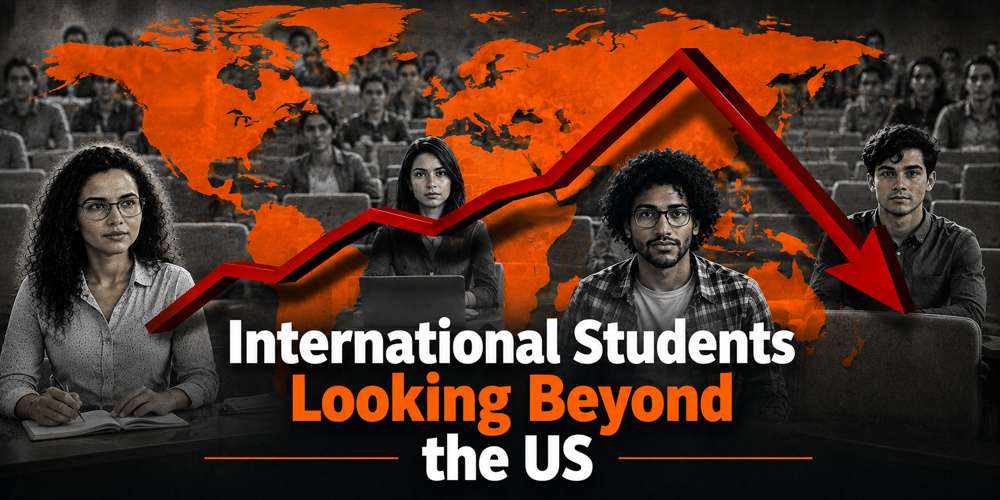
Graduate Programmes Face the Greatest Enrollment Pressures: Takeaways from the Latest IIE Report
Survey reveals declining applications, evolving recruitment strategies, and growing competition for global talent.
For decades, the United States has remained one of the world's most sought-after study destinations, attracting millions of students with its globally ranked universities, research opportunities, and post-study career pathways. But the landscape is changing.
A new Spring 2026 Snapshot released by the Institute of International Education (IIE) paints a picture of a higher education sector adapting to a rapidly evolving global environment. From visa uncertainty and shifting immigration policies to rising competition from countries like Canada, Australia, and the UK, American universities are being forced to rethink how they recruit, support, and retain international students.
The survey, which gathered responses from 585 colleges and universities across the United States, suggests that while institutions remain committed to international education, they are increasingly focused on resilience rather than rapid growth. Below are the report's biggest insights—and what they mean for the future of global higher education.
International Student Recruitment Is Still a Long-Term Priority
Despite a challenging recruitment cycle, universities have not backed away from international education. According to the survey, 82% of institutions say recruiting international students remains a strategic priority. Although this represents a slight decline from 89% in 2025, the overwhelming majority of universities continue to view international students as an essential part of campus life.
Institutions cited several reasons for maintaining this commitment:
- Building culturally diverse learning environments.
- Strengthening research collaboration and innovation.
- Supporting institutional growth and global partnerships.
- Maintaining financial sustainability through international enrollment.
Rather than questioning the value of international students, universities are increasingly asking how recruitment strategies need to evolve in a changing world.
Recruitment Is Becoming More Digital, Personal, and Student-Centric
One of the report's clearest findings is that universities are no longer relying on traditional recruitment methods alone. Instead, institutions are investing in more personalised and technology-driven approaches to connect with prospective students.
Among the strategies gaining momentum are:
- Virtual recruitment fairs and webinars.
- One-on-one counselling sessions.
- Student ambassador programmes.
- Alumni testimonials and storytelling.
- Enhanced digital marketing campaigns.
- Greater emphasis on online and hybrid degree options.
Some universities also reported growing interest in remote learning from students who remain uncertain about relocating to the United States because of changing immigration policies and travel concerns.
The shift reflects a broader change in international recruitment—from simply attracting applicants to building trust long before students submit an application.
Falling Application Numbers Signal Growing Hesitation
The report indicates that international enrollment challenges begin well before students arrive on campus. Nearly six in ten institutions (59%) reported receiving fewer international applications during the 2025–26 admissions cycle, suggesting that many prospective students are reconsidering the United States before they even apply.
The decline has been especially pronounced among graduate programmes.
Programme | Institutions Reporting Significant Declines |
Graduate Programmes | 43% |
Undergraduate Programmes | 31% |
Universities also highlighted noticeable decreases in applications from India, the largest source of international students in the United States.
While demand for US education remains strong globally, the report suggests that students are increasingly weighing factors such as visa certainty, affordability, political stability, and long-term employment opportunities before choosing where to study.
Enrollment Expectations Remain Cautious for the Coming Year
The challenges are not expected to disappear anytime soon. According to the survey, 63% of institutions anticipate another decline in international enrollment over the next academic year.
Graduate programmes are expected to experience the greatest impact, while doctoral universities appear particularly concerned about future recruitment. Institutions identified several issues likely to influence enrollment:
- Continued visa processing delays.
- Travel restrictions affecting student mobility.
- Uncertainty surrounding immigration policies.
- Stronger competition from other international study destinations.
- Rising recruitment costs with lower enrollment returns.
Many respondents acknowledged that attracting international students now requires greater investment and longer recruitment cycles than in previous years.
Universities Are Recalibrating Expectations—Not Retreating
Although enrollment numbers have softened, institutions are not abandoning their international strategies. Instead, many universities are adopting a more measured approach by diversifying recruitment markets, expanding digital outreach, and strengthening support services for prospective students.
Some institutions also reported exploring offshore programmes, international partnerships, and flexible learning models to remain competitive in an increasingly global education market. Rather than chasing rapid enrollment growth, universities appear focused on building more sustainable international recruitment models that can better withstand future policy or economic disruptions.
Study Abroad Continues to Show Signs of Stability
Interestingly, while universities are preparing for fewer incoming international students, confidence in outbound student mobility remains strong. The survey found that:
- 43% expect study abroad participation to increase.
- 44% believe participation will remain stable.
- Nearly half anticipate funding levels will remain unchanged.
However, some institutions cautioned that tighter budgets could reduce scholarships and limit participation for students with greater financial need. The findings suggest that while global student mobility is changing, interest in international learning experiences remains resilient.
The Numbers Behind the Report
Key Indicator | Finding |
Institutions surveyed | 585 |
Institutions prioritising international recruitment | 82% |
Institutions reporting fewer international applications | 59% |
Institutions expecting enrollment declines | 63% |
Institutions expecting study abroad growth | 43% |
Why This Matters
International students contribute far more than tuition revenue. They fuel research, strengthen innovation, diversify classrooms, and help universities build lasting global partnerships.
As countries around the world compete more aggressively for international talent, the ability to offer stability, clear immigration pathways, strong career outcomes, and an inclusive campus environment is becoming just as important as academic reputation. For US institutions, maintaining global leadership in higher education will increasingly depend on how effectively they respond to these changing expectations.
Editor's Note
The latest IIE report is less a story of declining numbers than one of changing priorities. International students are approaching higher education with greater scrutiny, evaluating not only university rankings but also policy stability, career prospects, affordability, and the overall student experience. At the same time, universities are recognising that recruitment is no longer a transactional process—it is about building confidence in an increasingly competitive global market. How institutions respond today will shape where the world's brightest students choose to study tomorrow.
Frequently Asked Questions (FAQs)
1. What is the IIE Spring 2026 Snapshot?
The Spring 2026 Snapshot is a survey conducted by the Institute of International Education (IIE) that examines international enrollment trends, recruitment strategies, and study abroad activity across US colleges and universities.
2. How many institutions participated in the survey?
The report is based on responses from 585 US colleges and universities.
3. Are US universities still prioritising international student recruitment?
Yes. According to the survey, 82% of institutions continue to view international recruitment as a strategic priority despite recent enrollment challenges.
4. Why are international student applications declining?
Universities cite visa uncertainty, changing immigration policies, travel restrictions, and growing competition from other study destinations as major contributing factors.
5. Which students have been most affected?
Graduate programmes experienced the sharpest decline in applications, with institutions also reporting significant decreases in applicants from India.
6. What does the report suggest about the future of international education in the US?
The report indicates that universities remain committed to international education but are shifting towards more personalised recruitment, diversified markets, and sustainable long-term strategies rather than relying on traditional enrollment models.

Skoobuzz
 Skoobuzz
 Skoobuzz
 Skoobuzz
 Skoobuzz
 Skoobuzz


0 Comments (Please Login To Continue)