








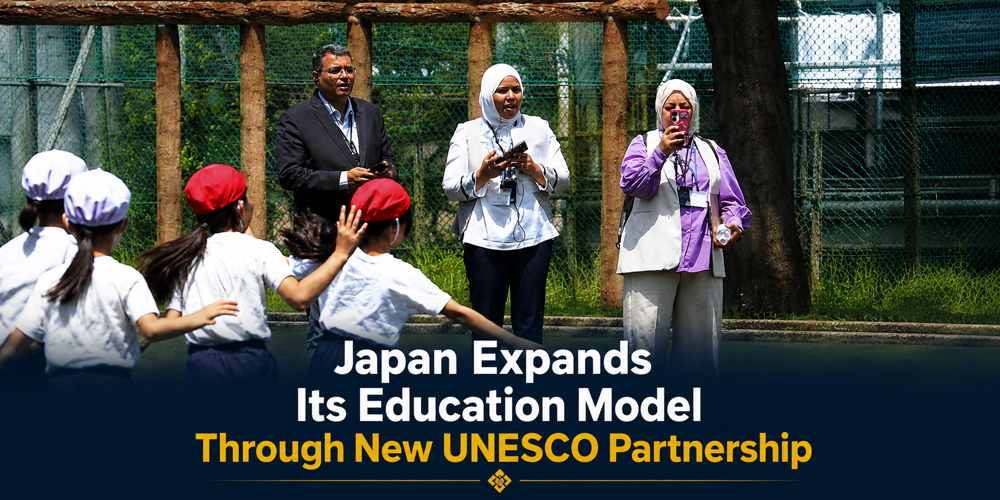
Japan and UNESCO Partner to Expand Japanese-Style Education Across the Global South
The partnership aims to promote responsibility, teamwork, and holistic learning in emerging and developing nations
Japan is strengthening its global education outreach through a new partnership with UNESCO aimed at promoting Japanese-style educational practices across emerging and developing countries. Building on successful initiatives in nations such as Egypt and Ghana, the collaboration seeks to share teaching approaches that emphasise responsibility, teamwork, discipline, and character development alongside academic achievement.
The initiative reflects Japan's broader commitment to expanding educational cooperation with countries in the Global South while supporting sustainable development through quality education.
Japan and UNESCO Deepen Education Partnership
The Japanese government has announced that it will work closely with UNESCO to introduce elements of Japan's distinctive school culture to more countries across Africa and Asia.
The partnership follows discussions between Japan's Minister of Education, Culture, Sports, Science and Technology, Yohei Matsumoto, and UNESCO Director-General Khaled El-Enany, who requested Japan's support in expanding its education model to emerging and developing nations. The collaboration is expected to serve as a long-term framework for sharing educational practices that go beyond traditional classroom instruction.
A Focus on Character, Responsibility, and Teamwork
Unlike many education systems that focus primarily on academic outcomes, Japanese schools are widely recognised for integrating life skills into daily learning.
The model encourages students to:
- Clean their own classrooms and shared spaces.
- Participate in classroom discussions and collaborative decision-making.
- Take turns serving as nitchoku (daily classroom coordinators), responsible for managing routine classroom activities.
- Develop leadership, discipline, independence, and respect for their peers.
These practices are designed to help students become active contributors to their school communities while building social responsibility from an early age.
Egypt Leads the Adoption of Japanese Educational Practices
Egypt has emerged as one of the strongest examples of Japan's international education model. The first Japanese-style schools were established in 2018, and approximately 70 schools now incorporate these educational practices. The number is expected to exceed 100 by 2027, demonstrating growing confidence in the approach.
The partnership between Japan and Egypt has become a model for how educational cooperation can be adapted to local contexts while maintaining the core values of the Japanese system.
Ghana Joins Japan's Expanding Education Network
Japan has also begun expanding its educational partnerships elsewhere in Africa. Last year, Japan signed a Memorandum of Understanding with Ghana to promote Japanese-style educational activities, marking another step toward building a broader international education network across the continent. These agreements aim to strengthen institutional collaboration while providing teachers and schools with practical frameworks for student-centered learning.
UNESCO Sees Global Potential in Japan's Education Model
UNESCO believes Japan's approach offers valuable lessons for countries seeking to improve both educational quality and student development. Rather than focusing solely on examination performance, the model highlights values such as cooperation, civic responsibility, leadership, and community participation—qualities increasingly viewed as essential for preparing young people for modern societies.
The partnership demonstrates UNESCO's interest in adapting proven educational practices to diverse cultural and national contexts.
Future Expansion Across Africa and Asia
Japan plans to work alongside UNESCO and the Egyptian government to encourage more countries to adopt similar initiatives. One of the major opportunities for expanding the programme is expected to come during the next Tokyo International Conference on African Development (TICAD) in 2028, where Japan hopes to establish additional education agreements with African nations.
The initiative is expected to strengthen educational diplomacy while creating new opportunities for international collaboration in curriculum development, teacher training, and school leadership.
Why This Matters
As countries increasingly recognize the importance of developing both academic excellence and life skills, Japan's education model is attracting growing international attention. By partnering with UNESCO, Japan is helping reshape conversations around global education—showing that qualities such as responsibility, collaboration, and community engagement can be just as important as classroom performance.
Editor's Note
Japan's decision to expand its education model through UNESCO reflects a broader shift in global education—from measuring success solely through academic achievement to recognising the importance of character, responsibility, and social development. As countries look for sustainable ways to strengthen their education systems, Japan's emphasis on discipline, collaboration, and student ownership offers an alternative approach that extends beyond textbooks and examinations.
This partnership is also a reminder that education has become an increasingly powerful form of international cooperation. By sharing classroom practices that cultivate leadership, independence, and community values, Japan is exporting more than an educational framework—it is contributing to conversations about how future generations can be prepared for a rapidly changing world. If successfully adapted to local contexts, these initiatives could influence education reform across the Global South while strengthening long-term academic and diplomatic ties between participating nations.
FAQs
1. What is the Japan–UNESCO education partnership?
It is a collaboration aimed at introducing Japanese-style educational practices to emerging and developing countries across Africa and Asia.
2. Which countries have already adopted Japanese-style education?
Egypt has implemented the model in around 70 schools, while Ghana has also signed an agreement to promote similar educational practices.
3. What are Japanese-style educational activities?
They include students cleaning classrooms, serving as daily classroom leaders (nitchoku), participating in collaborative discussions, and learning responsibility through everyday school activities.
4. Why is UNESCO supporting this initiative?
UNESCO sees value in Japan's holistic education model, which combines academic learning with character development, leadership, and social responsibility.
5. How will the partnership expand in the future?
Japan plans to work with UNESCO and partner governments to establish similar agreements with additional countries, particularly across Africa, through future international cooperation initiatives.

Skoobuzz

 Skoobuzz
 Skoobuzz
 Skoobuzz
 Skoobuzz
 Skoobuzz


0 Comments (Please Login To Continue)