








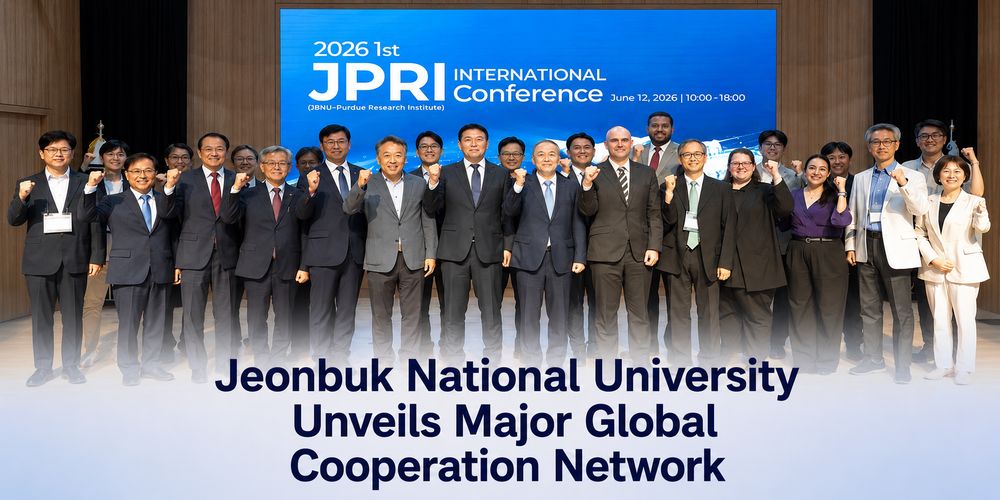
Jeonbuk National University Builds Global Network of Universities, Companies and International Organisations
A global network linking leading universities and organisations to expand education and talent opportunities.
Jeonbuk National University (JBNU) is strengthening its international presence through its largest-ever global cooperation initiative, bringing together leading universities, multinational companies and international education organisations under a wider partnership network. The South Korean university said it will establish a Global Advisory Committee comprising presidents of overseas partner universities while also developing major education, research and industry initiatives with global companies and international organisations. The initiative signals a broader approach to internationalisation, moving beyond conventional university exchanges to create closer links between higher education, advanced research, industry expertise and global talent.
The university said the new framework is intended to expand opportunities for students while strengthening its research capabilities and international competitiveness. Through the network, JBNU plans to deepen joint degree programmes and student exchanges, develop collaborative research in advanced technology fields, provide practical internship opportunities and organise special lectures involving prominent scholars and industry leaders. At the same time, the university wants to attract outstanding international students, researchers and high-skilled professionals to South Korea while connecting its international partnerships with the industrial development of North Jeolla Province.
Global University Leaders to Join Advisory Committee
A central element of the initiative will be the establishment of the Global Advisory Committee, which will bring together presidents of JBNU's overseas partner universities from North America, Europe, Asia and Africa. The institutions identified by the university include Purdue University in the United States, Université Sorbonne Nouvelle in France, China University of Geosciences, Universitas Gadjah Mada in Indonesia and Mohammed V University in Rabat, Morocco. By bringing senior university leaders into a dedicated international advisory structure, JBNU aims to strengthen cooperation at an institutional level and create a more strategic foundation for future academic and research initiatives.
The committee is expected to provide a platform for university leaders to exchange perspectives on emerging challenges in higher education, identify new areas of collaboration and support projects that extend beyond individual departments or exchange programmes. The involvement of university presidents also reflects JBNU's intention to make international cooperation a core component of its institutional development rather than treating overseas partnerships as separate academic activities. As universities compete globally for students, researchers, funding and industry partnerships, stronger leadership-level connections could help JBNU build longer-term relationships with institutions across different regions.
Industry and International Organisations Join the Network
The initiative will also extend beyond universities by incorporating the expertise of global companies and international education organisations. Thales Group, the French defence and technology company, and the Agence universitaire de la Francophonie (AUF) are among the partners participating in the initiative. AUF has a network of more than 1,000 French-speaking universities worldwide, providing JBNU with another potential channel for international academic cooperation and connections across a broad higher education community.
The inclusion of industry and international organisations represents an important shift in the way JBNU is approaching global education. Rather than keeping academic partnerships separate from professional and industrial networks, the university is seeking to create a structure in which universities can work alongside companies and international organisations on education, research and talent development. Such an approach could help students gain greater exposure to real-world industry requirements while giving researchers access to practical challenges and technological expertise. It could also help companies engage more closely with emerging talent and academic research.
Expanding Global Opportunities for Students
For students, one of the most significant potential benefits of the new network will be access to a wider range of international academic and professional experiences. JBNU plans to expand joint degree programmes with overseas partner universities and strengthen student exchange opportunities, allowing students to gain exposure to different education systems and international academic environments. The university also intends to introduce more hands-on internship opportunities and special lectures featuring internationally recognised scholars and industry leaders, creating additional opportunities for students to connect classroom learning with global research and professional practice.
This broader approach reflects the changing expectations of higher education. International experience is increasingly connected not only with cultural exposure but also with employability, research experience and professional networks. Students entering technology-intensive and internationally connected industries may need to understand how their fields are developing across different countries and markets. By combining university partnerships with company participation, JBNU is seeking to create an environment in which students can develop academic knowledge alongside practical experience and international connections.
Research Partnerships to Focus on Advanced Technology
Research collaboration will form another major pillar of the initiative. JBNU plans to pursue joint research projects with overseas universities and global companies, particularly in advanced technology fields where academic research and industrial innovation increasingly overlap. Bringing companies into these projects could allow researchers to engage with real-world technological challenges while giving businesses access to university expertise and emerging ideas. Such collaboration could also create opportunities for students and researchers to work in more interdisciplinary environments, particularly in areas where technology is rapidly transforming industries.
JBNU's existing relationship with Purdue University provides an example of the direction in which the university is moving. The two institutions have established the JBNU-Purdue Research Institute, creating a platform for collaboration between their academic and research communities. The wider global network could build upon partnerships such as this by connecting JBNU researchers with a larger range of institutions and companies. As research becomes increasingly international and collaborative, these relationships could strengthen the university's ability to participate in large-scale projects and develop expertise in emerging fields.
Attracting International Students and Global Talent
JBNU is also positioning the initiative as a way to strengthen its ability to attract international students and highly qualified global talent. The university said it wants to create stronger opportunities for outstanding international students while attracting researchers and professionals who can contribute to its academic and research ecosystem. A broader network of overseas universities and industry partners could make JBNU more attractive to students looking for international exposure, research opportunities and connections with employers.
The strategy is also designed to create a two-way flow of talent. While JBNU wants to provide Korean students with opportunities to study, research and gain professional experience internationally, it also wants to bring international students, researchers and industry expertise into North Jeolla Province. This could contribute to a more internationally connected campus while strengthening links between the university and the wider global research community. In this sense, internationalisation is being positioned not simply as an opportunity for students to leave the country, but also as a means of bringing global knowledge and talent into the region.
Connecting Global Education With Regional Development
The initiative has a strong regional dimension, with JBNU seeking to connect its international network with the advanced industrial infrastructure of North Jeolla Province. The university plans to develop industry-academia collaboration programmes that can link global companies, researchers and students with the region's existing industrial strengths. This could create opportunities for applied research, internships and professional training while helping local industries access international expertise and talent.
Such a model could be particularly important for regional universities, which increasingly face the challenge of competing for students and highly skilled researchers with institutions located in larger metropolitan centres. By building international connections while remaining closely connected to its region, JBNU is attempting to position itself as a bridge between global opportunities and local development. The university could potentially become a place where international students and researchers access South Korean industry, while local students and businesses gain stronger connections to overseas institutions and global companies.
Supporting South Korea's Regional Talent Strategy
JBNU said the initiative will also support its ambition to strengthen its role as a hub for higher education innovation under the government's regional growth-linked talent development programme, known as the 10 Seoul National Universities initiative. The broader objective is to strengthen the relationship between universities and regional development by ensuring that higher education institutions contribute to local talent creation, innovation and economic growth. JBNU's international strategy fits into this approach by combining global partnerships with programmes designed around the needs of North Jeolla Province.
The university's president, Yang Oh-bong, said the combination of educational expertise from world-class universities with the industry knowledge of organisations such as Thales and AUF would strengthen JBNU's global competitiveness. He also described the goal of creating an ecosystem in which Korean students can pursue opportunities around the world while global high-tech talent and companies are attracted to North Jeolla Province. The ambition is therefore not simply to make JBNU more international, but to use internationalisation as a tool for strengthening both the university and the region in which it operates.
From International Partnerships to a Global Education Ecosystem
JBNU's initiative reflects a wider shift in the role of international partnerships within higher education. Traditionally, universities have often measured internationalisation through indicators such as student exchanges, overseas agreements and international enrolment. While these remain important, universities are increasingly expected to connect international education with research, employment, innovation and regional economic development. JBNU's new network attempts to bring these different priorities together by placing universities, companies and international organisations within the same cooperation framework.
The significance of the initiative will ultimately depend on how effectively these partnerships translate into meaningful outcomes. A network of prestigious institutions can strengthen a university's visibility, but the long-term value will be determined by whether students gain genuine access to international learning and employment opportunities, whether research partnerships lead to new discoveries and whether companies become active contributors to education and innovation. For North Jeolla Province, the measure of success will be whether these global relationships help attract talent, strengthen industries and create new opportunities for the regional economy.
Why This Matters
The most important aspect of JBNU's initiative may be the university's attempt to redefine what global education can look like. Internationalisation is no longer simply about sending students overseas or signing agreements with foreign universities. As technology, employment and research become increasingly interconnected across borders, students need opportunities to understand international markets, researchers need access to global networks and employers need talent capable of working across cultures and disciplines.
JBNU is attempting to bring these elements together. If the university can turn its partnerships into meaningful joint programmes, research collaborations, internships and talent pathways, the network could become more than an internationalisation strategy. It could provide a model for how regional universities use global connections to strengthen local development while giving students access to opportunities that extend far beyond their immediate surroundings.
Editor's Note
What does it really mean for a university to be global?
For years, the answer appeared relatively simple. A university became more international by attracting foreign students, sending its own students abroad, signing agreements with overseas institutions and increasing the number of international programmes on offer. But the world students are preparing to enter is no longer organised around the boundaries of individual countries or even individual industries. A graduate may study in South Korea, work for a company headquartered in Europe, collaborate with colleagues in Singapore and contribute to a project whose technology is being developed across several continents.
That reality forces universities to reconsider what international education should actually achieve. JBNU's new initiative is interesting because it attempts to place universities, companies and international organisations in the same ecosystem. That is more significant than simply adding another collection of international partnerships. A university provides knowledge and research. An industry partner brings practical challenges and technological expertise. An international organisation brings networks that can connect institutions and people across borders. When those elements genuinely interact, education can become much more connected to the world students will eventually enter.
But there is an important distinction between having global partners and creating a global education experience. Universities can announce dozens of partnerships that never meaningfully reach students. Companies can join advisory boards without creating substantive opportunities. International agreements can generate impressive photographs and headlines while producing little change in the everyday experience of learning. The real measure of JBNU's ambition will therefore come after the announcement. It should become a measure of access and possibility. That may ultimately be the most meaningful test of JBNU's strategy. A truly global university should not simply make its students look outward. It should also make the world look towards its campus.
Frequently Asked Questions
1. What is Jeonbuk National University launching?
Jeonbuk National University is launching its largest international cooperation network to date, bringing together overseas universities, global companies and international education organisations. The initiative is designed to strengthen education, research, industry collaboration and international talent development.
2. What is the Global Advisory Committee?
The Global Advisory Committee will bring together presidents of JBNU's overseas partner universities from regions including North America, Europe, Asia and Africa. The committee is intended to provide a higher-level structure for developing long-term international academic and research cooperation.
3. Which universities are part of the initiative?
The institutions identified by JBNU include Purdue University in the United States, Université Sorbonne Nouvelle in France, China University of Geosciences, Universitas Gadjah Mada in Indonesia and Mohammed V University in Rabat, Morocco.
4. Which companies and organisations are involved?
French defence and technology company Thales Group and the Agence universitaire de la Francophonie (AUF) are among the partners joining the initiative. AUF has a network of more than 1,000 French-speaking universities worldwide.
5. How could the initiative benefit students?
Students could gain access to expanded exchange programmes, joint degrees, international research projects, industry internships and special lectures from international academics and business leaders. The broader network could also expose students to professional opportunities beyond South Korea.
6. Will JBNU expand joint degree programmes?
Yes. Expanding joint degree programmes with overseas partner universities is one of the university's planned initiatives, alongside stronger student exchange programmes and other international learning opportunities.
7. What role will companies play?
Companies such as Thales can bring industry expertise into the university's education and research ecosystem. Potential areas of cooperation include advanced technology research, industry-linked programmes, internships and practical learning opportunities.
8. What is the JBNU-Purdue Research Institute?
The JBNU-Purdue Research Institute is an existing research collaboration between Jeonbuk National University and Purdue University. It provides a foundation for deeper academic and research cooperation and represents the type of international partnership that JBNU hopes to build upon.
9. Why is attracting international talent important?
Attracting international students, researchers and highly skilled professionals can strengthen the diversity and research capabilities of a university. JBNU also sees global talent as a potential contributor to the development of North Jeolla Province's advanced industries.
10. How is the initiative connected to North Jeolla Province?
JBNU wants to link its global partnerships with North Jeolla Province's industrial infrastructure through industry-academia programmes. The aim is to connect international expertise with regional industries while creating opportunities for students and researchers.
11. What does the initiative mean for regional higher education?
The initiative demonstrates how a regional university can use international partnerships to strengthen its academic competitiveness while contributing to local economic and talent development. It could offer a model for connecting global education with regional growth.
12. What will determine whether the initiative succeeds?
The success of the network will depend on whether its partnerships produce tangible outcomes, including meaningful student opportunities, joint research, industry collaborations, international talent recruitment and measurable benefits for North Jeolla Province.

Skoobuzz


 Skoobuzz
 Skoobuzz



0 Comments (Please Login To Continue)