








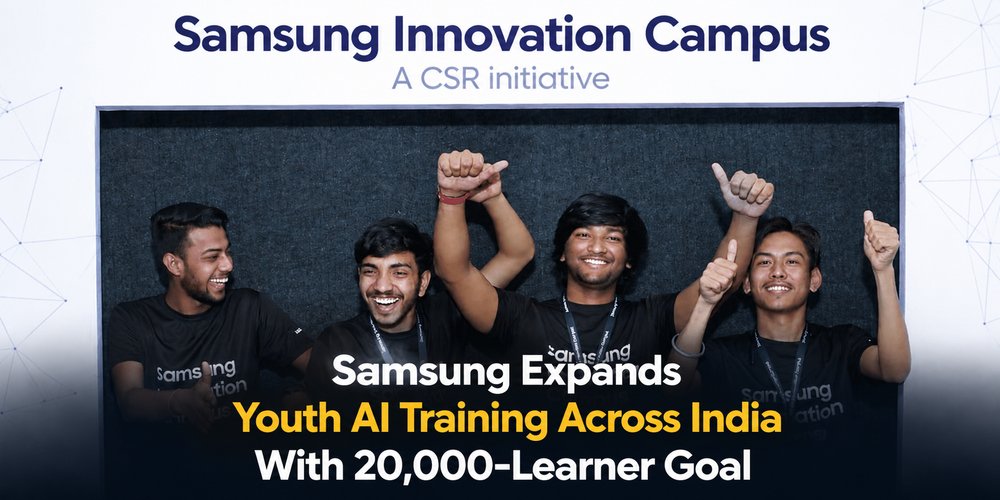
20,000 Young Indians to Receive AI Training as Samsung Innovation Campus Returns for 2026
Samsung Expands AI Skilling Push Across India
Artificial intelligence is rapidly moving from being a specialised technology to becoming a fundamental part of how industries operate, businesses innovate and people work. As India strengthens its ambitions to become a global leader in AI, one of the biggest questions is whether its young workforce will have the skills needed to participate meaningfully in that transformation. Samsung India is attempting to address that challenge through the 2026 edition of Samsung Innovation Campus, which will aim to provide AI training to 20,000 young Indians across 10 states.
Now entering its fourth year in India, the programme will offer young people aged 18 to 25 practical training in artificial intelligence, alongside project-based learning, mentorship and exposure to real-world applications. The initiative will be delivered in collaboration with the Electronics Sector Skills Council of India (ESSCI) and the Telecom Sector Skill Council (TSSC), with an emphasis on making industry-relevant AI education more accessible to young learners.
From Learning AI to Applying It
The growing demand for AI professionals means that understanding artificial intelligence can no longer be limited to theoretical knowledge. Samsung Innovation Campus is therefore designed around practical learning. Participants will work on projects and explore real-world applications of AI while developing skills that could be relevant to future employment.
Alongside technical capabilities, the programme will focus on problem-solving, critical thinking and collaboration. This broader approach recognises that working with AI requires more than simply understanding algorithms or tools. Young professionals will increasingly need to know how to identify problems, evaluate solutions and work alongside rapidly evolving technologies.
The programme comes at a time when AI is being integrated into an expanding range of sectors, including healthcare, manufacturing, education and everyday services. As adoption increases, organisations will require professionals who can understand both the possibilities and practical limitations of AI. For young learners, gaining this exposure early could help bridge the gap between classroom education and the skills increasingly expected in the workplace.
A Four-Year Journey of Technology Skilling
Samsung Innovation Campus was launched in India in 2022 and has since trained more than 26,500 young people in emerging technologies. The 2026 edition represents a significant expansion of its focus on artificial intelligence, with the programme setting a target of reaching 20,000 learners in a single year. The initiative also had a notable gender representation in its previous edition. In 2025, women accounted for 48% of participants, highlighting the participation of young women in technology-focused learning programmes.
With AI increasingly influencing career pathways across industries, expanding access to training could become particularly important for students and young professionals who may not otherwise have opportunities to gain hands-on exposure to emerging technologies.
Making AI Education More Accessible
JB Park, President and CEO of Samsung South West Asia, highlighted accessibility as an important part of India's AI ambitions.
“AI represents one of the greatest opportunities of our time, and India is uniquely positioned to lead this transformation through the strength of its young talent.”
Park also emphasised the need for sustained investment in skills, innovation and accessible AI education, regardless of learners' backgrounds. That emphasis is significant because India's AI opportunity is not simply about producing a small pool of highly specialised engineers. As AI becomes embedded across sectors, a much larger workforce will need at least a functional understanding of how the technology works and how it can be applied. Programmes that combine technical education with practical projects and mentorship can potentially help make that transition less intimidating for young people entering the workforce.
Beyond Artificial Intelligence
Samsung Innovation Campus is part of Samsung India's wider efforts around youth skilling, innovation and employability. The company also runs Solve for Tomorrow, which supports young innovators and entrepreneurs, while Samsung DOST focuses on preparing candidates for sales and technical service roles.
Together, these initiatives reflect a broader focus on connecting young people with skills that correspond to changing employment opportunities. The expansion of Samsung Innovation Campus comes as Samsung marks 30 years in India, adding another dimension to the company's long-term engagement with the country's technology and talent ecosystem.
Why the 20,000-Learner Target Matters
The significance of the programme ultimately goes beyond the number 20,000. India has one of the world's largest young populations, giving the country an enormous potential talent base for the AI economy. But demographic advantage alone does not guarantee technological leadership. Young people need access to education, practical experience, mentorship and opportunities to experiment with emerging technologies. The challenge is also becoming more urgent as AI changes the nature of existing jobs rather than simply creating entirely new ones.
A student studying business, a graduate entering manufacturing, a young professional working in healthcare or someone pursuing a career in technology may all encounter AI in different ways. Developing AI literacy, therefore, could increasingly become part of being prepared for the modern workplace. Samsung's 2026 programme attempts to address one part of that larger challenge: giving young Indians an opportunity to move from simply hearing about AI to actually working with it.
The Bigger Question for India's AI Future
India's AI ambitions will ultimately be measured not only by the technologies it develops, the investments it attracts or the companies it produces, but also by who gets to participate in the transformation. Training 20,000 young people is meaningful, but it also raises a larger question: how can India ensure that access to AI education reaches millions more?
The future of AI will not be shaped solely inside laboratories or technology companies. It will also be shaped by classrooms, training centres and the experiences of young people learning how to use these technologies for the first time.
For the participants of Samsung Innovation Campus 2026, the programme could therefore represent more than another certification or training opportunity. It could be an early step towards understanding a technology that is likely to influence the careers they build and the industries they enter.
Editor's Note
There is something worth pausing over when we hear that 20,000 young Indians will receive AI training. Numbers like these can make technological progress feel almost abstract. Twenty thousand sounds impressive, but behind that number are individual young people standing at very different points in their lives — students wondering what kind of career will still exist when they graduate, first-generation professionals trying to enter an increasingly competitive workforce, and young women deciding whether technology is a space in which they can see themselves belonging.
The real measure of an AI-skilling programme, therefore, may not be how many people complete it. It may be whether those learners leave with greater confidence in their ability to create, question and shape the future, rather than simply adapt to a future designed by others. India's greatest AI advantage may not ultimately be its technology. It may be the young people who are allowed to decide what that technology should be used for.
Samsung Innovation Campus' 2026 target reflects the growing importance of AI skills within India's workforce. By combining technical education with practical projects, mentorship and exposure to real-world applications, the programme seeks to help young Indians build skills for an economy increasingly shaped by artificial intelligence.
The larger opportunity, however, lies beyond the 20,000 participants. If AI is set to reshape India's future, expanding access to meaningful and responsible AI education could determine whether young people merely experience that transformation — or actively help create it.
Frequently Asked Questions
1. What is Samsung Innovation Campus?
Samsung Innovation Campus is a youth skilling initiative that provides training in emerging technologies, practical learning, mentorship and project-based experiences.
2. How many young Indians will receive AI training in 2026?
Samsung Innovation Campus aims to train 20,000 young people in artificial intelligence during 2026.
3. Who can participate in the programme?
The 2026 programme is aimed at young people between 18 and 25 years of age.
4. How many states will the programme cover?
The AI training programme will be delivered across 10 states in India.
5. Who is Samsung partnering with for the programme?
Samsung India will collaborate with the Electronics Sector Skills Council of India and the Telecom Sector Skill Council to deliver the programme.
6. What will participants learn?
Participants will receive practical AI training supported by project-based learning, mentorship and exposure to real-world applications. The programme will also encourage problem-solving, critical thinking and collaboration.
7. When did Samsung Innovation Campus begin in India?
Samsung Innovation Campus was launched in India in 2022 and is entering its fourth year in the country in 2026.
8. How many people has Samsung Innovation Campus trained so far?
Since its launch in India, the programme has trained more than 26,500 young people in emerging technologies.
9. How many women participated in the programme in 2025?
Women represented 48% of participants in 2025, highlighting significant female participation in the initiative.
10. Why is AI training important for young Indians?
As artificial intelligence becomes increasingly integrated into industries such as healthcare, manufacturing, education and technology, AI-related knowledge and digital skills are becoming increasingly relevant to future employment.
11. Is Samsung Innovation Campus Samsung's only youth-focused initiative?
No. Samsung also runs Solve for Tomorrow, which supports young innovators and entrepreneurs, and Samsung DOST, which focuses on preparing candidates for sales and technical service careers.

Skoobuzz

 Skoobuzz
 Skoobuzz


0 Comments (Please Login To Continue)