








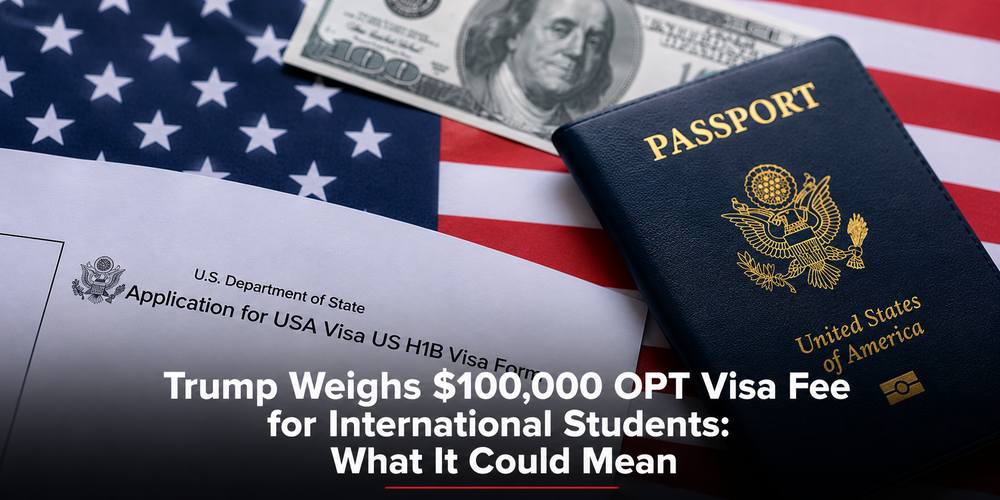
Trump Administration Considers $100,000 OPT Visa Fee
A proposed $100,000 fee on OPT visas could significantly increase the cost of post-study work in the US
The Trump administration is reportedly considering a proposal to impose a $100,000 fee on Optional Practical Training (OPT) visas, a program that allows international students to work in the United States after completing their studies. According to The Wall Street Journal, the proposal is being evaluated by the US Department of Homeland Security (DHS). If implemented, it would dramatically increase the cost of post-graduation employment for hundreds of thousands of international students and could reshape global study destination choices.
The proposal has not been officially announced, and DHS says no policy should be considered final until formally introduced.
What Is OPT and Why Does It Matter?
Optional Practical Training (OPT) is an extension of the F-1 student visa that allows international graduates to gain practical work experience in the United States. Under the current system, eligible students can work:
- Up to 12 months after graduation for most degree programs.
- Up to 36 months for qualifying STEM graduates through the STEM OPT extension.
The work must be directly related to the student's field of study.
For many international students, OPT serves as a bridge between education and long-term employment in the US, often leading to H-1B sponsorship or opportunities for permanent residency.
Why Is the Administration Considering the Fee?
The reported proposal comes after a US court struck down an earlier plan to impose a $100,000 fee on H-1B visas. According to reports, the administration is now exploring similar measures for the OPT program as part of broader efforts to tighten legal immigration policies.
A DHS spokesperson said:
"No policies should be considered final until formally announced. At DHS we are always having conversations about how to use all tools in our arsenal to protect the integrity of our legal immigration system."
How Many Students Could Be Affected?
The impact could be substantial. According to the latest available government data:
Category | Details |
Students on OPT (2024) | Approximately 419,000 |
Eligible visa | F-1 international student visa holders |
Work period | 1–3 years, depending on degree program |
A $100,000 fee would represent one of the most expensive post-study work requirements proposed by the US government.
Green Card Bond Proposal Also Under Review
The administration is reportedly examining another immigration measure that would require certain green card applicants applying from outside the US to pay a $100,000 refundable bond.
The bond would only be returned after the applicant relocates to the United States and successfully becomes a US citizen. Like the OPT proposal, this measure remains under consideration and has not been finalised.
Industry Concerns Over the Proposal
Technology companies, universities, and employers have historically relied on international graduates to fill skilled positions. Earlier proposals to increase H-1B visa costs faced opposition from major technology employers, who argued that higher immigration costs could reduce access to global talent.
If a similar fee is introduced for OPT, universities may also face challenges in attracting international students, many of whom choose the United States because of its post-study work opportunities.
What Could This Mean for International Students?
If approved, the proposal could have several consequences:
- Significantly increase the financial burden of studying in the US.
- Reduce the attractiveness of the US as a study destination.
- Encourage students to consider countries with more affordable post-study work pathways, such as Canada, Australia, or the UK.
- Affect employers that recruit international graduates through university hiring programs.
However, since the proposal has not yet become official policy, current OPT rules remain unchanged.
Why This Matters
Post-study work opportunities are one of the biggest factors influencing where international students choose to study. A substantial increase in OPT costs could reshape global student mobility, university enrollment patterns, and employer recruitment strategies, with long-term implications for the US higher education sector.
Editor's Note
The reported $100,000 OPT visa fee is currently under consideration and has not been implemented. Any policy change would likely undergo a formal rulemaking process before taking effect. International students should continue following official updates from the US Department of Homeland Security and their universities rather than making decisions based solely on preliminary reports.
Frequently Asked Questions (FAQs)
1. What is an OPT visa?
OPT (Optional Practical Training) is a work authorization available to eligible F-1 international students, allowing them to gain practical work experience related to their degree after graduation.
2. Has the $100,000 OPT fee been approved?
No. The proposal has been reported as being under consideration. It has not been officially announced or implemented.
3, Who would be affected if the proposal becomes law?
International students using the OPT program after graduating from US universities would potentially be impacted.
4. How long can international students work under OPT?
Most graduates can work for up to 12 months, while eligible STEM graduates may receive a 24-month extension, allowing up to 36 months of employment.
5. Why is OPT important?
OPT provides graduates with US work experience and often serves as a pathway to employer-sponsored visas such as the H-1B.
6. Are there other immigration proposals being considered?
Yes. Reports indicate officials are also evaluating a $100,000 refundable bond requirement for some green card applicants outside the US.

Skoobuzz

 Skoobuzz
 Skoobuzz
 Skoobuzz
 Skoobuzz
 Skoobuzz


0 Comments (Please Login To Continue)