








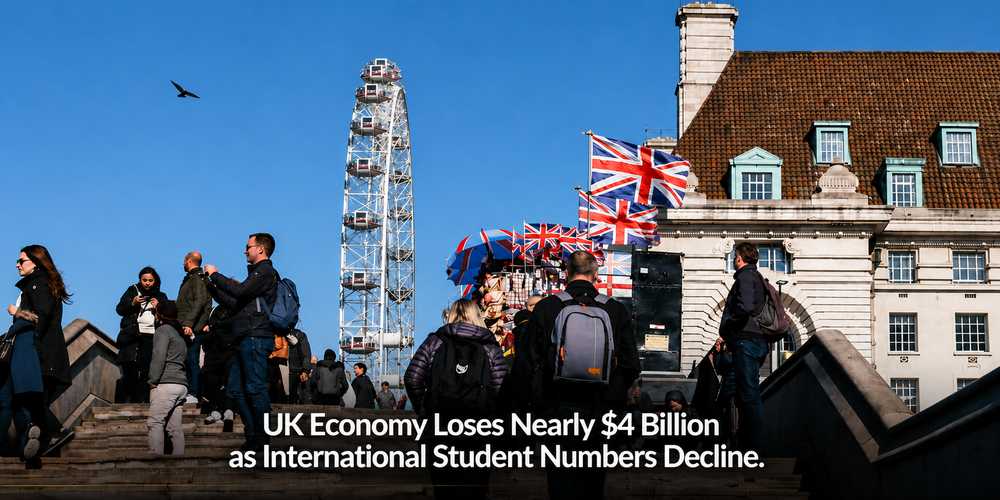
UK Economy Loses Nearly $4 Billion as International Student Numbers Decline, Report Reveals
New report links declining international student enrolment to a £2.9 billion loss for the UK's economy
New economic analysis highlights the financial impact of stricter immigration policies, warning that falling international enrolment could weaken the UK's higher education sector and global competitiveness. The United Kingdom has incurred an estimated £2.9 billion (US$3.89 billion) economic loss following a sharp decline in international student enrolment, according to a new report commissioned by the Higher Education Policy Institute (HEPI) and Kaplan International Pathways.
The report, prepared by economic consultancy London Economics, estimates that first-year international student enrolment has fallen by approximately 54,500 students, representing a 12% decline over the past two academic years. Researchers attribute much of the decrease to recent immigration reforms, including restrictions on dependents accompanying international students and tighter visa regulations.
The findings reinforce the significant role international students play in supporting the UK's universities, local communities, and broader economy.
International Students Continue to Deliver Strong Economic Returns
Despite the recent downturn in enrolment, international students remain one of the UK's most valuable economic contributors. According to the report, 685,565 international students commenced higher education programmes during the 2024–25 academic year. By evaluating tuition fee income, student expenditure, and spending by visiting family members and friends, researchers calculated that each international student generates an average net economic contribution of approximately £100,000.
Collectively, the current cohort is expected to generate £45.1 billion in economic benefits throughout the duration of their studies. Although international students will account for an estimated £4.7 billion in public expenditure through services such as healthcare, policing, and public infrastructure, the report concludes that they will still contribute a net economic benefit of £40.4 billion—equivalent to a 9.7-to-1 return on public investment.
The findings underscore that the economic value created by international students substantially outweighs the costs associated with supporting them.
Visa Reforms Linked to Falling Enrolment
The report points to a series of immigration policy changes that have reshaped the UK's international education landscape. Among the most significant measures are restrictions preventing most international students from bringing family members to the country. In addition, beginning in January, graduates completing bachelor's and master's degrees will see the Graduate Route visa shortened from two years to 18 months, reducing the amount of time available to gain post-study work experience.
The government has also increased the financial maintenance requirements for student visa applicants. Depending on their study destination, applicants must now demonstrate monthly living funds ranging from £1,171 to £1,529. Together, these changes have coincided with a decline in international student demand at a time when global competition for international talent continues to intensify.
Economic Benefits Extend Beyond University Campuses
The report highlights that the economic contribution of international students is distributed across the UK rather than being concentrated solely in university cities. The parliamentary constituency of Holborn and St Pancras recorded the largest economic benefit, with more than 11,500 international students contributing over £1 billion to the local economy.
Other constituencies also experienced measurable gains:
Constituency | Estimated Net Economic Contribution |
Holborn and St Pancras | Over £1 billion |
Makerfield | Approximately £4 million |
Clacton | Around £2.1 million |
The report notes that international students support a wide range of sectors, including housing, retail, hospitality, transportation, tourism, and local businesses, creating economic activity that extends well beyond higher education institutions.
Sector Leaders Call for a More Welcoming Approach
Reacting to the findings, Rose Stephenson, Director of Policy and Strategy at HEPI, said the report offers important evidence for policymakers as discussions surrounding immigration reform continue.
She emphasised that any future decisions to reduce international student numbers should be weighed against the substantial economic consequences highlighted in the research.
Meanwhile, Linda Cowan, Managing Director at Kaplan International Pathways, observed that the international education market has become increasingly competitive.
She noted that while the UK has traditionally been one of the world's leading study destinations alongside the United States, Australia, and Canada, it now competes with a growing number of emerging education hubs. Cowan stressed that maintaining a welcoming environment for international students will be essential if the UK wishes to preserve its reputation as a global leader in higher education.
Why This Matters
International students are increasingly recognised as long-term contributors to national economies rather than simply tuition-paying learners. Beyond supporting university finances, they generate demand across housing, transport, retail, hospitality, tourism, and local services while strengthening research capacity, innovation, and international collaboration.
The report suggests that policies designed to curb migration may carry wider economic consequences for higher education institutions and regional economies. As countries compete aggressively to attract global talent, the balance between immigration control and international education strategy is becoming an increasingly important policy consideration.
Editor's Note
The report arrives at a pivotal moment for international higher education. While immigration policies are often framed around reducing net migration, the findings illustrate that international students represent a distinct category of temporary migrants whose economic footprint extends far beyond university campuses. Their contribution supports jobs, local businesses, research ecosystems, and regional development across the UK.
For policymakers, the debate is no longer solely about migration figures—it is equally about economic competitiveness. As countries across Europe, Asia, and the Middle East continue expanding scholarship programmes, post-study work opportunities, and student-friendly visa policies, the UK's ability to remain a preferred destination will increasingly depend on how effectively it balances border policy with higher education strategy. The report serves as a reminder that attracting international students is not simply an educational objective, but a long-term investment in economic growth, global influence, and talent development.
FAQs
Q1. How much has the UK economy lost due to declining international student enrolment?
The report estimates the UK economy has lost £2.9 billion (US$3.89 billion) following a 12% decline in first-year international student enrolment over the past two academic years.
Q2. What caused the decline in international student numbers?
The report links the decline to tighter immigration policies, including restrictions on dependent visas, shorter post-study work rights, and increased financial proof requirements for student visa applicants.
Q3. How much do international students contribute to the UK economy?
The 2024–25 cohort is expected to generate £45.1 billion in economic benefits, resulting in a net contribution of £40.4 billion after public expenditure is considered.
Q4. What changes have been made to UK student visas?
Recent reforms include limiting dependent visas, reducing the Graduate Route from two years to 18 months for most graduates, and raising maintenance fund requirements for visa applicants.
Q5. Why is this report important for higher education?
The findings demonstrate that international students are a major driver of economic growth. They suggest that policies affecting international enrolment have implications not only for universities but also for local economies, workforce development, and the UK's global competitiveness.

Skoobuzz

 Skoobuzz
 Skoobuzz
 Skoobuzz
 Skoobuzz
 Skoobuzz


0 Comments (Please Login To Continue)