








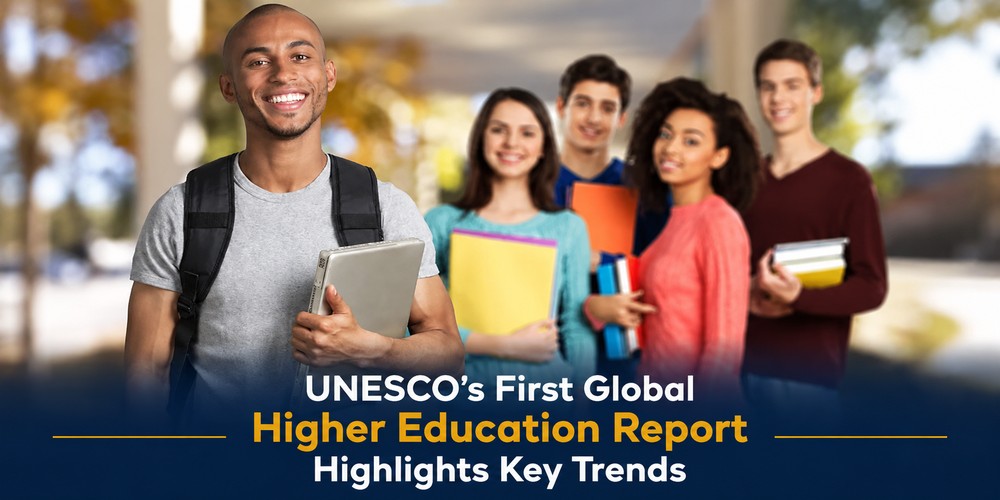
UNESCO’s First Global Higher Education Trends Report Highlights Key Shifts Shaping the Sector
Trends report examines enrolment, equity, student mobility, investment and governance worldwide.
UNESCO has released its first-ever global report examining the major trends shaping higher education systems worldwide, offering policymakers and education leaders new insights into how enrolment, student progression, investment, equity, international mobility and governance are evolving.
The Higher Education Global Trends Report, launched by the UNESCO International Institute for Higher Education in Latin America and the Caribbean (UNESCO IESALC) in Paris on May 12–13, 2026, brings together international data and policy analysis to provide a broad picture of the higher education landscape.
The report arrives at an important point for global education systems, as countries approach the final years of the UN Sustainable Development Goal 4 (SDG 4) timeline and begin considering priorities for the post-2030 education agenda. By combining policy indicators with higher education statistics, UNESCO aims to provide governments and institutions with evidence that can support more effective and equitable policymaking.
UNESCO’s First Global Higher Education Trends Report
The inaugural report represents a significant step in UNESCO’s efforts to understand higher education through a global policy and data lens. Rather than focusing on a single region or issue, it examines multiple dimensions of higher education systems and identifies patterns that can influence their future development.
The analysis draws heavily on the UNESCO Higher Education Policy Observatory, a global resource covering nearly 150 countries and more than 50 policy indicators. It is also supported by higher education statistics monitored by the UNESCO Institute for Statistics (UIS).
Together, these sources allow the report to connect changes in student participation with broader questions surrounding funding, access, internationalisation, institutional capacity and governance.
Enrolment and Student Progression Remain Central Concerns
One of the key areas highlighted by the report is the changing pattern of higher education participation. As more students around the world seek access to tertiary education, governments and institutions face the challenge of expanding capacity while ensuring that students can progress successfully through their programmes.
Growing enrolment does not automatically translate into greater educational opportunity. Access, continuation and completion are closely connected, making student progression an important measure of whether higher education systems are delivering meaningful outcomes.
The report’s focus on enrolment and progression therefore places attention not only on how many students enter higher education, but also on whether institutions have the resources and support systems necessary to help diverse student populations succeed.
For policymakers, this means that expanding participation must increasingly be accompanied by policies that address affordability, academic support, institutional capacity and barriers faced by disadvantaged learners.
Investment and Equity Are Closely Connected
Another major theme emerging from the report is the relationship between investment in higher education and equity. Higher education systems require sustained investment to expand infrastructure, recruit and retain qualified faculty, support research and provide students with appropriate learning resources. However, investment decisions also have implications for who can access quality education and which groups benefit from expansion.
The report highlights the importance of looking at higher education through an equity lens. As participation expands, policymakers need to consider whether opportunities are being distributed fairly across different social and economic groups.
This is particularly relevant as countries seek to make higher education more inclusive while dealing with competing pressures on public spending. Ensuring that expansion does not widen existing inequalities is likely to remain an important policy challenge in the years ahead.
Student Mobility Is Changing
International student mobility is another area receiving attention in UNESCO’s global analysis. Students increasingly cross borders in search of academic opportunities, specialised programmes, research experiences and stronger employment prospects. At the same time, changes in immigration policies, economic conditions, demographic trends and geopolitical relationships are influencing where students choose to study.
The shifting nature of student mobility has consequences for both destination and sending countries. Universities that attract international students can benefit from greater diversity, international partnerships and additional revenue, while students can gain access to academic environments and career opportunities unavailable in their home countries.
However, changing mobility patterns also require governments and institutions to reconsider how international education is managed. Visa policies, recognition of qualifications, affordability and student support can all influence the attractiveness of a study destination. The UNESCO report's inclusion of mobility trends reinforces the growing importance of internationalisation within discussions about the future of higher education.
Governance and Institutional Capacity Under the Spotlight
The report also examines governance and capacity, two factors that can determine how effectively higher education systems respond to changing demand. Universities are operating in an increasingly complex environment shaped by demographic change, technological developments, changing labour-market requirements and growing expectations around inclusion and sustainability. Effective governance is therefore becoming essential to help institutions adapt while maintaining academic quality.
Institutional capacity is equally important. Expanding enrolment or introducing new policies requires universities to have the financial, administrative and human resources necessary to implement them effectively.
The report's focus on governance suggests that future higher education reforms will need to go beyond enrolment targets and funding increases. Strong institutions also require effective leadership, reliable data, clear policy frameworks and the ability to respond to changing student and societal needs.
Why the Report Matters for Global Higher Education
UNESCO's first global higher education trends report provides a broader framework for understanding developments that are often examined separately. Enrolment, equity, investment, international mobility and governance are interconnected. For example, expanding international enrolment can place new demands on institutional capacity, while changes in funding can influence access and equity. Similarly, student mobility can be affected by government policy as well as economic and demographic conditions.
By bringing these issues together, UNESCO's analysis can help policymakers consider how changes in one part of the higher education system may affect others. The report also provides an important evidence base as governments begin looking beyond the 2030 deadline for the Sustainable Development Goals. With the post-2030 education agenda taking shape, data on participation, investment and policy trends could play a significant role in determining future priorities.
What the Findings Mean for Universities
For universities, the report highlights the need to remain adaptable as higher education continues to change. Institutions may need to reassess how they support student progression, respond to increasingly diverse student populations and strengthen international engagement. At the same time, universities will need to build institutional capacity that allows them to respond to new technologies, labour-market expectations and demographic shifts.
Internationalisation is likely to remain an important component of this transition. However, universities may increasingly need to look beyond simply increasing international student numbers and focus on sustainable mobility, student outcomes and meaningful global partnerships.
The report's emphasis on governance and capacity also suggests that institutional resilience will become increasingly important. Universities that can use data effectively, anticipate policy changes and respond to changing student expectations may be better positioned to navigate future disruptions.
Implications for Students and International Education
For students, particularly those considering studying abroad, changing global higher education trends could influence the opportunities available to them. International students are increasingly making decisions based not only on academic reputation, but also on affordability, post-study opportunities, immigration policies, employability and overall student experience. As destination countries adjust their higher education and migration policies, students may also diversify the countries and institutions they consider.
The trends identified by UNESCO therefore have relevance beyond governments and universities. Education counsellors, international recruitment teams and students themselves will need to monitor how changes in policy and mobility reshape the global education marketplace.
UNESCO’s Role in the Post-2030 Education Agenda
The timing of the report is particularly significant because the global education community is approaching the final years of the SDG 4 framework. SDG 4 seeks to ensure inclusive and equitable quality education and promote lifelong learning opportunities for all. Higher education is an important part of that objective, particularly as countries seek to develop skilled workforces and expand opportunities for young people and adult learners.
UNESCO's new report can contribute to discussions about what should come next. Its cross-country analysis provides policymakers with a foundation for identifying persistent gaps, emerging challenges and areas where international cooperation may be required.
As the post-2030 agenda develops, questions around access, equity, quality, internationalisation and institutional resilience are likely to remain central to the global higher education conversation.
The Bigger Picture
UNESCO's inaugural global higher education trends report underscores that the sector is undergoing changes that cannot be understood through enrolment figures alone. The future of higher education will depend on how effectively countries balance expansion with quality, investment with equity, internationalisation with sustainable mobility, and institutional autonomy with effective governance.
For universities and policymakers, the report provides a valuable global reference point at a time when higher education systems are being asked to respond to rapid social, economic and technological change. For students, it offers wider context on the forces shaping the institutions and study destinations they may consider in the coming years.
As governments begin developing the next generation of global education priorities, the evidence gathered by UNESCO could help ensure that higher education remains accessible, resilient and responsive to the needs of increasingly diverse student populations.
Editor’s Note
UNESCO’s first global higher education trends report comes at a time when universities and policymakers are navigating major shifts in student demand, international mobility, funding and institutional capacity. Its value lies in bringing these developments together rather than viewing them as isolated trends. As countries prepare for the post-2030 education agenda, the report provides an important evidence base for assessing whether higher education systems are becoming more accessible, equitable, resilient and responsive to changing global needs.
Frequently Asked Questions
1. What is UNESCO’s Global Higher Education Trends Report?
It is UNESCO IESALC’s first global report examining major trends in higher education, including enrolment, student progression, investment, equity, international student mobility, governance and institutional capacity.
2. When was the report launched?
UNESCO IESALC launched the inaugural report in Paris on May 12–13, 2026.
3. How many countries does the UNESCO Higher Education Policy Observatory cover?
The Higher Education Policy Observatory covers nearly 150 countries and includes more than 50 policy indicators.
4. Why is international student mobility important?
International student mobility affects universities, students and national education systems. Changes in migration policies, affordability, demographics and economic conditions can influence where students choose to study.
5. Why does higher education investment matter?
Investment supports institutional capacity, infrastructure, teaching, research and student services. It also plays an important role in determining whether higher education expansion benefits students equitably.
6. How does the report relate to SDG 4?
The report provides evidence relevant to the final years of the SDG 4 timeline and can contribute to discussions about priorities for the global education agenda beyond 2030.

Skoobuzz
 Skoobuzz

 Skoobuzz
 Skoobuzz
 Skoobuzz


0 Comments (Please Login To Continue)