








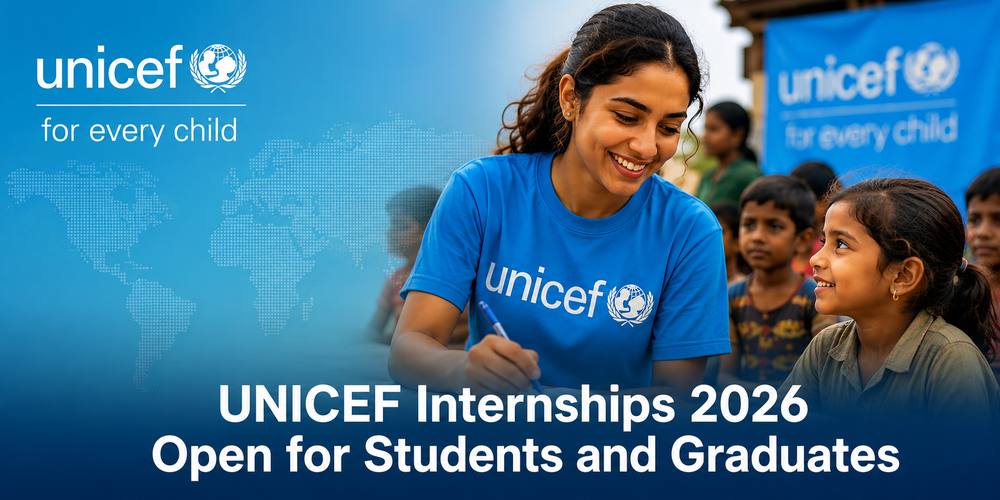
UNICEF Internship 2026: Global Work Opportunities Open for Students and Graduates
UNICEF internships offer students and recent graduates international work experience to support global development.
The UNICEF Internship Programme 2026 is offering students and recent graduates an opportunity to gain practical experience while contributing to work focused on children, young people and communities around the world. The programme allows participants to work with the United Nations Children’s Fund (UNICEF) on real projects and gain exposure to an international organisation operating across a wide range of social and development priorities. With opportunities available across different academic and professional areas, the internships can be relevant to students looking to complement their classroom education with hands-on experience and graduates seeking to strengthen their early-career profile.
For students, an internship with an international organisation such as UNICEF can provide a different perspective on professional life. Rather than learning exclusively through lectures, assignments or examinations, interns can gain experience working on projects that have practical implications for communities and children. Depending on the specific position, interns may work alongside UNICEF teams, contribute to research or programme activities, support communications and operations, or assist with other projects connected to the organisation's work. The exact responsibilities, duration and benefits vary according to the individual internship vacancy, so applicants should carefully review the details of each position before applying.
Who Can Apply for UNICEF Internship 2026?
The UNICEF Internship Programme is open to students at different stages of higher education, including Bachelor's, Master's and PhD students, as well as eligible recent graduates. The broad academic scope means that students do not necessarily need to come from a single discipline to explore opportunities with UNICEF. Instead, eligibility and requirements can depend on the specific internship position and the skills or academic background sought by the relevant team.
This makes the programme potentially useful for students who are interested in areas beyond traditional development studies. Depending on available vacancies, opportunities can relate to areas such as research, communications, policy, programme support, technology, administration, social development and other functions. Students should therefore look beyond the title of an internship and examine the complete job description to understand whether their education, skills and interests match the position.
Applicants may include:
- Bachelor's degree students
- Master's degree students
- PhD students
- Eligible recent graduates
- Candidates from different academic and professional backgrounds, depending on the vacancy
Applicants should remember that meeting the broad programme criteria does not automatically mean that they qualify for every UNICEF internship. Individual vacancies may have additional educational, technical, language or experience requirements.
What Makes a UNICEF Internship Valuable?
An internship at UNICEF can provide students with an opportunity to understand how a large international organisation operates while contributing to work connected to children and communities. For someone beginning their career, this kind of exposure can help bridge the gap between academic knowledge and professional practice. Interns may be expected to contribute to ongoing projects, conduct research, prepare materials, support teams or assist with programme-related tasks, depending on their assigned role.
The experience can also help students develop professional skills that are difficult to acquire through academic study alone. Working with colleagues from different backgrounds can strengthen communication, collaboration and adaptability, while working on real assignments can help interns understand deadlines, project management and professional accountability.
The international nature of UNICEF's work is another important aspect of the experience. Students can gain insight into how social and development challenges are approached across different countries and communities, potentially giving them a broader understanding of global issues and the complexities involved in creating meaningful change.
Internship Duration Can Vary by Position
The duration of a UNICEF internship is not necessarily identical for every placement. According to the information provided for the 2026 programme, internships can range from approximately six to 26 weeks, with the exact duration depending on the position and its requirements.
Working arrangements can also vary. Some opportunities may be full-time, while others can offer part-time arrangements, depending on the specific vacancy and the intern's circumstances. Students who are still completing their education should carefully examine the working hours and duration before applying to ensure that the internship is compatible with their academic schedule.
This flexibility can make internships particularly useful for students who want professional exposure without necessarily putting their studies on hold. However, applicants should always treat the individual vacancy announcement as the final source for information about working arrangements, duration and eligibility.
Financial Support and Other Benefits
Selected interns may receive financial support in the form of a monthly stipend, intended to assist with living expenses during the internship. However, the availability and nature of financial support can depend on the specific internship and applicable UNICEF policies.
Some placements may also provide support related to travel or visa expenses where funding is available and where the relevant internship terms permit it. Applicants should therefore avoid assuming that every UNICEF internship provides identical financial benefits. The specific vacancy should be checked carefully for details about stipends, travel, visa arrangements and any other support.
Beyond financial assistance, the professional value of the internship can be significant. Students can gain experience working within an international organisation, develop new skills and potentially build a network of professional contacts. These experiences can strengthen a CV, particularly for students considering careers in international development, public policy, communications, research, humanitarian work or related fields.
Potential benefits include:
- Monthly stipend, where applicable
- International professional experience
- Exposure to UNICEF's global work
- Practical experience through real projects
- Opportunities for professional development
- Experience working in multicultural environments
- Potential travel or visa support for eligible placements, where funding is available
- Flexible duration or working arrangements for certain positions
How to Apply for UNICEF Internship 2026
Students and graduates interested in applying should begin by visiting the UNICEF Careers Portal and searching for currently available internship positions. Rather than submitting a single application that automatically applies to every internship, applicants should identify vacancies that match their academic background, skills and interests and then follow the instructions provided for that particular position.
Candidates will generally need to create an online profile and provide relevant information about their education and experience. Depending on the vacancy, applicants may also be asked to submit a CV and cover letter or other supporting information. A strong application should clearly demonstrate why the candidate is suited to the specific role rather than simply expressing a general interest in working for UNICEF.
Before submitting an application, candidates should read the complete vacancy description and verify the required qualifications, duration, location, working arrangement and other conditions. Paying attention to these details can help applicants avoid applying for positions for which they do not meet the stated requirements.
Application process at a glance:
- Visit the UNICEF Careers Portal.
- Search for available internship opportunities.
- Review the eligibility requirements and job description.
- Select a position that matches your academic background and interests.
- Create or update your online profile.
- Prepare your CV and cover letter, where required.
- Submit the application and supporting information before the stated deadline.
- Monitor the application portal or email for further communication.
Why Students Should Look Beyond the Internship Title
One of the biggest mistakes students can make when searching for international internships is focusing only on the prestige of the organisation. While the name of an institution can add value to a CV, the actual learning experience depends heavily on the work an intern is able to perform.
For this reason, students considering UNICEF internships should ask themselves what they want to learn from the experience. Someone interested in communications may benefit from a role involving content or public engagement, while a student interested in policy may want an opportunity involving research, analysis or programme development. Choosing an internship based on the actual responsibilities can make the experience considerably more meaningful than selecting one simply because of the organisation's reputation.
A good internship should ideally create a connection between what a student already knows and what they want to learn next. UNICEF's broad range of work can potentially provide those connections across different disciplines, but applicants need to take the time to identify the opportunities that align with their longer-term goals.
UNICEF Internship 2026 and the Value of Global Experience
International work experience can be particularly valuable at the beginning of a career because it exposes students to professional environments that may differ significantly from those they encounter at university. Working with colleagues from different cultural, educational and professional backgrounds can encourage students to become more adaptable and thoughtful communicators.
An organisation such as UNICEF also provides an opportunity to see how complex global challenges are addressed through programmes, partnerships, research and policy. For students who are interested in careers with international organisations, NGOs, governments or development institutions, this kind of exposure can help them understand what the work actually involves rather than relying solely on assumptions about the sector.
At the same time, students should approach the opportunity with realistic expectations. An internship is not simply a line on a CV. It requires responsibility, consistency and a willingness to learn. The greatest value may come from the ability to turn the experience into a deeper understanding of one's own strengths, interests and professional direction.
Editor's Note
There is something particularly powerful about an internship that allows a young person to see the consequences of their work beyond a classroom, a grade or a corporate metric. For many students, education is structured around proving that they understand something. An internship begins to ask a different question: What will you do with what you know?
That distinction matters. A degree can provide knowledge, but experience forces us to confront the uncertainty that comes with applying it. A carefully written assignment has a clear deadline and evaluation criteria. Real work can be messier. Problems change, people disagree, information is incomplete and the "right" answer is not always obvious.
An experience with UNICEF can be particularly thought-provoking because the work is connected to people and communities rather than existing only as an abstract business objective. Whether an intern is working on communications, research, technology, administration or programme support, the larger context is a reminder that professional work can have a human dimension.
Frequently Asked Questions
1. What is the UNICEF Internship Programme 2026?
The UNICEF Internship Programme offers students and recent graduates who are eligible to gain practical professional experience while contributing to the organisation's work in supporting children and communities worldwide.
2. Who can apply for UNICEF internships?
The programme can be open to Bachelor's, Master's and PhD students, as well as eligible recent graduates. Specific eligibility requirements may vary depending on the internship vacancy.
3. Can students from any academic field apply?
UNICEF offers internships across different areas, so opportunities may be available to candidates from a wide range of academic backgrounds. However, applicants must meet the specific educational and skills requirements listed for the individual position.
4. How long does a UNICEF internship last?
Internship duration can vary by position. The information provided for the 2026 programme indicates that internships can range from approximately six to 26 weeks, depending on the specific opportunity.
5. Is a UNICEF internship paid?
Selected interns may receive a monthly stipend to help with living expenses. Financial benefits can vary by internship, so applicants should check the individual vacancy for the exact terms.
6. Does UNICEF cover travel and visa costs?
Some placements may provide support for travel and visa-related expenses where funding is available and the internship terms permit it. Applicants should check the specific vacancy rather than assuming these costs are covered for every internship.
7. Can students work part-time during a UNICEF internship?
Some UNICEF internships may offer part-time arrangements, while others may be full-time. The working arrangement depends on the individual position and should be confirmed in the vacancy details.
8. How can I apply for a UNICEF internship?
Applicants can visit the UNICEF Careers Portal, search for available internship vacancies, create an online profile and submit the required application materials, which may include a CV and cover letter.
9. Do recent graduates qualify for UNICEF internships?
Yes, eligible recent graduates can apply for UNICEF internship opportunities. However, the exact eligibility window and requirements may vary by vacancy.
10. Is a UNICEF internship useful for building a career?
A UNICEF internship can provide practical work experience, professional development and exposure to an international organisation. Its value will depend on the specific role, responsibilities and skills the intern develops during the placement.

Skoobuzz

 Skoobuzz

 Skoobuzz
 Skoobuzz
 Skoobuzz


0 Comments (Please Login To Continue)