








World Education Summit 2026 Brings India’s Education Leaders Together to Shape What Comes Next
This will bring education leaders, policymakers and innovators together in Delhi to drive meaningful change.
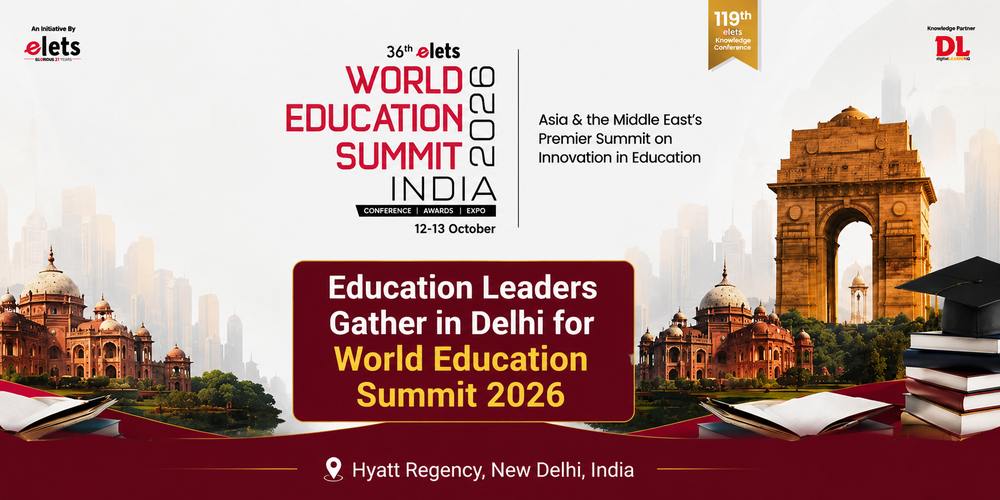
Transformation is often easy to announce. The more difficult task is turning ambitious ideas into decisions, policies and institutional action that create measurable change. That question will take centre stage at the 36th Elets World Education Summit, scheduled for October 12–13, 2026, at Hyatt Regency Delhi. Designed as a curated, closed-door and invite-only leadership gathering, the summit will bring together senior decision-makers from universities, schools, government, EdTech, industry and international education networks to discuss the issues shaping the future of learning in India.
Rather than functioning as a conventional conference focused primarily on presentations and large audiences, the World Education Summit 2026 aims to create a more focused environment where education leaders can exchange ideas, discuss institutional challenges and explore partnerships. With India’s education ecosystem undergoing rapid changes driven by artificial intelligence, policy reforms, employability demands and internationalisation, the summit seeks to provide a platform where these developments can be examined through the experiences of those responsible for implementing them.
Why the World Education Summit 2026 Stands Out
Education conferences often bring together large numbers of participants, but meaningful outcomes depend on the quality and relevance of the conversations taking place. The World Education Summit is positioned around this principle, with participation curated to bring together individuals who influence education policy, lead institutions, develop solutions and build strategic partnerships.
The summit will bring Higher Education and School Education into one connected ecosystem, allowing conversations to extend across different stages of the education journey. This creates an opportunity to examine how developments in one part of the system can influence another, while also giving institutional leaders a space to discuss challenges that increasingly overlap.
Among the key questions expected to shape discussions are:
- How can institutions adopt AI responsibly across teaching, learning, assessment and governance?
- How effectively is NEP 2020 translating from policy into institutional practice?
- What can universities do to strengthen employability, research and global partnerships?
- How can schools become future-ready while continuing to prioritise student wellbeing?
- What forms of collaboration can create meaningful value for institutions, learners and education providers?
- How can education leaders prepare institutions for skills and workforce requirements that are still emerging?
These questions reflect a wider shift in education. Institutions are no longer preparing students only for existing careers; they are increasingly expected to equip them to navigate technologies, industries and professional environments that may look very different within the next decade.
Senior Education Leaders Set to Join the Summit
The strength of a leadership gathering is ultimately shaped by the people around the table. The higher education cohort at World Education Summit 2026 includes prominent institutional leaders such as Prof. Bharat Bhasker, Director, IIM Ahmedabad; Prof. Kamal Kishore Pant, Director, IIT Roorkee; Prof. Rajeev Ahuja, Director, IIT Ropar; Prof. Ashok Banerjee, Director, IIM Udaipur; Dr. Vinita S. Sahay, Director, IIM Bodh Gaya; and Prof. Atul Khosla, Founder and Vice Chancellor, Shoolini University.
The school education community will also be represented by senior figures including Raghav Podar, Chairman, Podar Education; Francis Joseph, India CEO, GEMS Education; Dr. Tim Hughes, Director of Academic Quality Assurance and School Improvement, Bloom Education; Preeti Kwatra, Chairperson, Petals Group of Schools; Hema Harchandani, Founder and Managing Director, Canvas International Group of Schools; and Dr. Anirudh Gupta, CEO, DCM Group of Schools.
Their participation brings together perspectives from some of the country’s leading higher education and school education institutions. More importantly, it creates the possibility of conversations between people who are directly responsible for making decisions, managing institutions and responding to the rapidly changing expectations of learners, families, employers and policymakers.
From AI to Employability, Education Faces a New Set of Questions
Artificial intelligence is likely to be one of the defining themes of the education conversation in 2026. The question for institutions is no longer simply whether AI should be used, but how it should be integrated responsibly. From personalised learning and academic research to assessment, administration and governance, AI is beginning to influence almost every layer of the education ecosystem.
At the same time, institutions continue to face longstanding challenges around employability, research quality, student outcomes and international competitiveness. Universities are increasingly expected to demonstrate their relevance beyond classrooms by creating stronger links with industry, developing research ecosystems and preparing students for a global workforce.
Schools, meanwhile, are navigating a different but equally significant transformation. They must prepare students for an increasingly technology-driven future while ensuring that education does not become disconnected from creativity, curiosity, human relationships and wellbeing. The World Education Summit 2026 provides a space to examine these competing priorities together rather than treating them as isolated issues.
What Can Participation Mean for Education Leaders?
For institutional leaders, the value of a summit is often found beyond the sessions themselves. A conversation with another university or school leader could lead to an academic partnership, faculty collaboration, student exchange programme or new approach to institutional development.
For school leaders, discussions with peers and education providers could offer insights into areas such as AI adoption, teacher development, curriculum innovation and student outcomes. For EdTech companies and industry partners, the summit can create an opportunity to understand institutional needs directly rather than approaching education through assumptions about what schools and universities require.
Potential opportunities may include:
- Academic and institutional partnerships
- Industry-academia collaborations
- International education initiatives
- AI and EdTech partnerships
- Research and innovation opportunities
- Leadership networking and peer learning
- Curriculum and employability initiatives
The larger idea is to move beyond networking for its own sake and create conversations that can potentially continue after the event.
Creating a More Connected Education Ecosystem
One of the summit’s central propositions is that education cannot be transformed by individual institutions working in isolation. Universities, schools, policymakers, technology companies, employers and international partners increasingly need to understand one another’s priorities.
A school preparing students for university needs to understand how higher education is changing. Universities preparing graduates for employment need closer engagement with industry. Technology companies developing education solutions need direct insight into institutional realities. Policymakers need feedback from the people implementing reforms on the ground. Bringing these stakeholders together can help bridge some of these gaps and create a more connected education ecosystem where ideas can move more effectively from discussion to implementation.
Why the Right Room Matters
The most valuable professional gatherings are not necessarily the ones with the largest audiences. They are often the ones where the right people are able to have the right conversations at the right time. For an education leader considering an Education Summit 2026 in India, the more useful question may therefore not be how many people will attend, but who will be in the room and what can happen because they are there.
For a university, it could be the beginning of an international partnership. For a school, it could lead to a new approach to technology or teacher development. For an education company, it could become an opportunity to understand an institution’s actual challenges. And for policymakers and sector leaders, it could provide a closer look at how national ambitions are being translated into practice.
Will Your Institution Be Part of the Conversation?
The 36th Elets World Education Summit is positioned as a leadership platform for those looking to understand where Indian education is heading and, more importantly, participate in shaping that direction. With senior representatives from higher education and schools, along with education technology, industry and international stakeholders, the October 12–13 gathering aims to create a space for conversations that extend beyond conventional conference discussions.
Participation opportunities include delegate passes, speaking opportunities and partnerships, with participation subject to review and availability. As India’s education ecosystem enters a period defined by AI, skills transformation, international collaboration and evolving policy priorities, the conversations taking place today could influence the institutions of tomorrow.
Editor’s Note
Education transformation is often discussed in the language of disruption: new technologies, new policies, new models and new skills. But perhaps the more important question is what happens after the excitement of the announcement fades. A policy does not transform a classroom by itself. AI does not automatically create better learning. A new curriculum does not guarantee curiosity. And a partnership does not create value simply because two institutions have signed an agreement.
That is why gatherings such as the World Education Summit matter when they move beyond speeches and into honest conversations about implementation. The real measure of an education summit should not be the number of people who attend or the number of photographs taken, but whether someone leaves the room with a better question, a stronger partnership or the conviction to change something within their institution.
As education becomes increasingly shaped by technology, global competition and changing workforce expectations, perhaps the greatest advantage will belong to institutions willing to listen as carefully as they innovate. The future of education may not be decided by the loudest prediction about what comes next, but by the leaders willing to sit together and ask what should come next — and why.
Frequently Asked Questions
1. What is the World Education Summit 2026?
The World Education Summit 2026 is the 36th Elets World Education Summit, a curated leadership gathering focused on the future of education in India.
2. When will the World Education Summit 2026 take place?
The summit is scheduled for October 12–13, 2026.
3. Where will the World Education Summit 2026 be held?
The summit will take place at Hyatt Regency Delhi.
4. Who will participate in the summit?
The summit will bring together senior leaders from higher education, school education, policymaking, EdTech, industry and international education networks.
5. What are the major themes of the summit?
Key areas include AI in education, NEP 2020 implementation, employability, research, internationalisation, student wellbeing, curriculum innovation and institutional partnerships.
6. Will both school and higher education leaders participate?
Yes. The summit features dedicated Higher Education and School Education tracks within one connected education ecosystem.
7. Why is AI expected to be an important discussion at the summit?
AI is rapidly changing teaching, assessment, research, administration and workforce requirements, making responsible and effective adoption an important issue for education leaders.
8. What opportunities can the summit provide to institutions?
Participation can create opportunities for peer learning, academic partnerships, industry collaborations, international initiatives, technology partnerships and leadership networking.
9. Who can participate in the World Education Summit?
The event is positioned as a closed-door, invite-only leadership gathering, with delegates, speakers and partners subject to participation review.
10. Why is the summit relevant to India’s education sector?
The summit brings multiple parts of the education ecosystem together, creating an opportunity to discuss how policy, technology, skills, institutional priorities and international collaboration can shape the next phase of Indian education.

Skoobuzz

 Skoobuzz
 Skoobuzz



0 Comments (Please Login To Continue)