








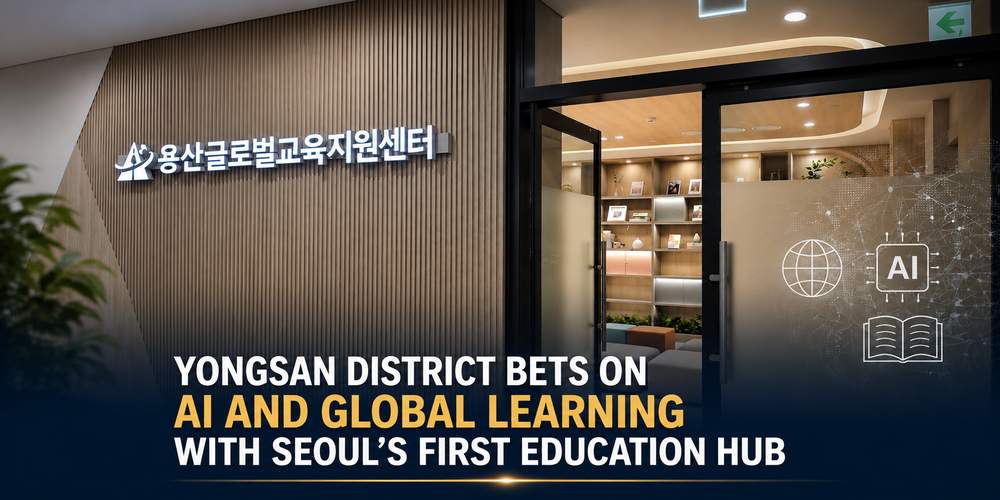
Yongsan District Launches Seoul’s First Global Education Hub, Eyes International Education Zone Status
The new education hub integrates AI, global leadership, and student support as Yongsan pursues zone designation.
In a significant move to redefine public education, Seoul’s Yongsan District has inaugurated the Yongsan Global Education Support Center, marking the city's first dedicated hub for internationally focused learning. The launch forms the cornerstone of the district's bid to become Seoul's first Special International Education Zone, reflecting a broader vision of preparing students for an increasingly interconnected and AI-driven world.
Known as one of South Korea's most internationally connected districts, Yongsan is home to numerous foreign embassies, diplomatic residences, and multicultural communities. Rather than viewing these characteristics solely as geographic advantages, district leaders are now transforming them into educational assets that expose students to global perspectives, emerging technologies, and cross-cultural collaboration.
Building a Future-Ready Education Ecosystem
The Yongsan Global Education Support Center represents a departure from conventional education models that often treat international learning as an extracurricular opportunity. Instead, the district is integrating global competency, digital literacy, and civic engagement into everyday learning experiences.
The initiative aims to equip students with the knowledge and skills required to thrive in rapidly changing academic and professional environments by focusing on:
- Global citizenship and leadership
- Artificial intelligence (AI) literacy
- Cross-cultural communication
- Critical thinking and collaborative problem-solving
- Academic and emotional wellbeing
District Mayor Kim Kyung-dae described the initiative as a long-term investment in both students and the city's future.
"Education is the most valuable investment we can make for future generations and a key asset that determines a city's long-term competitiveness. Through the Yongsan Global Education Support Center, we are building an environment where students can expand their horizons on the global stage."
Moving Beyond Traditional Language Education
One of the center's flagship initiatives is the Global Leader School, where students will participate in Model United Nations (MUN) simulations to debate international issues, negotiate policy solutions, and strengthen leadership and public speaking skills.
Complementing these experiences are AI-powered language learning platforms, enabling students to develop multilingual communication skills while learning to work alongside emerging technologies. The emphasis is not merely on language acquisition but on cultivating the ability to think critically, collaborate across cultures, and navigate complex global challenges.
Democratizing Educational Opportunities
The center also seeks to bridge longstanding inequalities in access to educational guidance by offering comprehensive support services under one roof.
Students will have access to:
- University admissions counselling
- Academic planning and mentoring
- Career guidance
- Psychological and wellbeing support
By making these resources publicly accessible, Yongsan aims to reduce dependence on costly private tutoring while ensuring that students from diverse backgrounds receive quality academic and personal support.
A Pilot for the Future of Public Education
The district's application for Special International Education Zone designation extends beyond local ambitions. If approved, the initiative could establish a replicable framework for other metropolitan districts seeking to modernize education through AI integration, international collaboration, and equitable access to learning opportunities.
By leveraging its unique concentration of embassies, international organizations, and multicultural communities, Yongsan hopes to create an education ecosystem that prepares students not only for university admissions but also for leadership in an increasingly global workforce.
Why This Matters
As artificial intelligence reshapes industries and international collaboration becomes central to solving global challenges, education systems are under growing pressure to evolve. Yongsan's initiative signals a shift from measuring educational success solely through academic achievement to developing globally competent, digitally fluent, and socially responsible citizens. Its success could influence how cities around the world rethink public education for the next generation.
Editor's Note
Education is increasingly being measured not by how much information students can memorise, but by how effectively they can interpret complexity, collaborate across cultures, and adapt to technological change. Yongsan's initiative reflects this evolving philosophy. By combining AI literacy with diplomacy, wellbeing, and equitable access to academic guidance, the district is asking a fundamental question: Should schools prepare students merely for examinations, or for a world where continuous learning, global cooperation, and ethical decision-making define success? If this model proves effective, it may encourage policymakers to rethink public education not as a local service, but as a strategic investment in national competitiveness and global citizenship.
Frequently Asked Questions (FAQs)
1. What is the Yongsan Global Education Support Center?
The Yongsan Global Education Support Center is Seoul's first dedicated public education hub focused on global learning. It provides AI-based learning, leadership programmes, university admissions guidance, and student wellbeing services.
2. Why is Yongsan seeking Special International Education Zone designation?
The designation would formally recognise Yongsan's efforts to develop an internationally focused education ecosystem that leverages the district's multicultural environment and global connections.
3. What programmes will students participate in?
Students will engage in Model United Nations simulations, AI-powered language learning, global leadership training, university admissions counselling, academic mentoring, career guidance, and psychological support.
4. How does this initiative improve educational access?
By providing admissions counselling, academic mentoring, and wellbeing services through a public education hub, the district aims to reduce reliance on expensive private tutoring and make quality support accessible to a broader range of students.
5. Why is AI a key component of the initiative?
AI tools are being integrated to strengthen language learning, digital literacy, and future workforce skills, ensuring students are prepared for an increasingly technology-driven global economy.
6. Could this become a model for other cities?
Yes. If Yongsan receives Special International Education Zone designation, its integrated approach to AI, global citizenship, and public education could serve as a blueprint for other urban districts seeking to modernise their education systems.

Skoobuzz
 Skoobuzz
 Skoobuzz
 Skoobuzz
 Skoobuzz
 Skoobuzz


0 Comments (Please Login To Continue)