








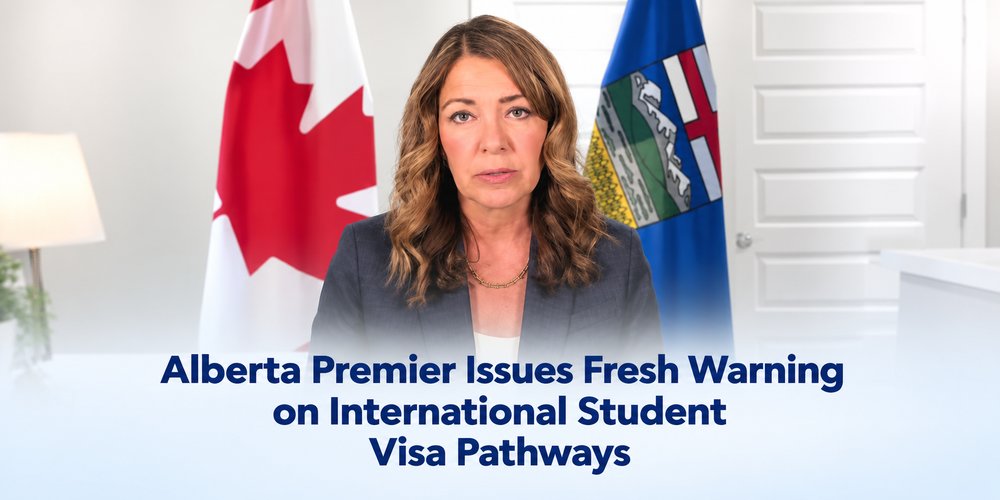
Alberta Premier Warns International Students That Study Permits Do Not Guarantee Permanent Residency
International students urged to understand study permit limits as Canada tightens immigration and post-study pathways.
Alberta Premier Danielle Smith has issued a strong reminder to international students considering or currently pursuing higher education in the province: a Canadian study permit is temporary and does not automatically provide a pathway to permanent residency. Her comments come as Canada continues to tighten its immigration framework, leaving international students increasingly focused on changing rules around post-study work opportunities and settlement.
Smith said international students remain welcome in Alberta when capacity permits, but emphasised that the primary purpose of the province’s colleges and universities is to serve local students. International students should therefore approach education in Canada as an academic opportunity first and understand that any subsequent right to work or remain in the country depends on meeting separate immigration requirements.
Study Permit Does Not Guarantee Permanent Residency
Smith’s comments highlight a distinction that prospective international students increasingly need to understand before choosing Canada as a study destination. Admission to a Canadian university or college does not, by itself, provide a permanent right to remain in the country. A study permit allows an eligible student to pursue education in Canada for a specified period, subject to the conditions attached to that permit.
After graduation, some students may qualify for post-graduation work opportunities or immigration programmes, but federal and provincial policies govern these options and eligibility depends on the individual. Factors such as the programme studied, institution, field of study, work experience, language ability and other immigration requirements can influence whether a graduate qualifies for a subsequent pathway.
This means students should not treat admission to a Canadian institution as an indirect guarantee of permanent settlement. Instead, they need to evaluate education and immigration as two connected but legally separate decisions.
Canada Tightens Rules for International Students
The premier’s warning comes against the backdrop of significant changes to Canada’s temporary immigration system. The federal government has reduced international student targets and introduced additional requirements affecting study permits and post-graduation work opportunities.
Financial eligibility has also become an increasingly important consideration. From September 1, 2026, a student applying to study outside Quebec must demonstrate access to CAD 23,448 for living expenses, excluding tuition fees and travel costs. For international students and their families, the higher financial threshold adds to the overall cost of planning a Canadian education.
The changing environment means students can no longer rely on assumptions based on policies that applied to previous cohorts. A course that provided a particular post-study option in the past may not necessarily offer the same opportunity to students enrolling under future rules.
Indian Students Face a Changing Calculation
The developments are particularly important for Indian students, who have historically represented one of Canada's largest international student communities. For many Indian families, Canada has traditionally offered a combination of internationally recognised education, work experience and potential long-term immigration opportunities.
That calculation is now becoming more complicated. Students must consider not only the reputation and cost of an institution but also whether their chosen programme is eligible for relevant post-graduation opportunities and whether it aligns with current labour-market and immigration priorities.
The situation has also contributed to concerns among some international graduates in Alberta. Protests and public discussions have highlighted frustrations from graduates who say their expectations regarding post-graduation work permits and immigration opportunities did not match the pathways available to them after completing their studies.
For prospective students, these developments reinforce the need to verify immigration information through official government sources rather than relying exclusively on consultants, agents or recruitment materials.
Education and Immigration Are Separate Pathways
Smith’s remarks reinforce a principle that is becoming increasingly important in Canada's international education landscape: studying in Canada and immigrating to Canada are not the same process.
An international student may complete a degree or diploma and subsequently qualify for permission to work or apply for permanent residency. However, eligibility is determined by immigration regulations rather than simply by the completion of a Canadian qualification.
Alberta provides opportunities for eligible graduates to explore employment and immigration pathways, including provincial programmes where applicants meet the relevant criteria. However, these programmes can change as governments adjust immigration levels and respond to labour-market priorities.
Students therefore need to view any potential immigration benefit as conditional rather than guaranteed.
What Students Should Check Before Choosing a Course
For students considering Alberta, course selection now requires a more detailed assessment than simply comparing university rankings, tuition fees or campus facilities. Prospective students should examine the programme’s duration, institution, costs and eligibility for post-graduation work opportunities while also reviewing the latest federal and provincial immigration requirements.
Students should also establish how their chosen qualification fits into Canada's current labour-market needs. A programme that appears attractive from an academic perspective may not necessarily provide the post-study opportunities a student expects.
This is particularly important for families making a substantial financial investment. Tuition, accommodation, travel and living expenses can represent a significant commitment, making it essential to understand the potential outcomes before enrolment.
Students should also be cautious about claims promising guaranteed employment or permanent residency. Immigration policies can change, and no private consultant can guarantee an outcome that ultimately depends on government rules and an applicant’s individual circumstances.
Alberta Reflects Canada’s Broader Immigration Shift
Smith’s comments form part of a wider transformation in Canada's approach to international education and temporary immigration. International students have long contributed to Canadian universities, colleges and the wider economy, with many graduates eventually entering the labour market and seeking permanent residency.
However, concerns surrounding housing availability, infrastructure, population growth and pressure on public services have contributed to a more cautious approach towards temporary residents. The federal government has responded by reducing international student targets and introducing tighter eligibility requirements, while provinces are increasingly considering how international education can support their specific labour-market needs.
For students, the implications are clear. Canada remains an important international education destination, but the pathway from classroom to long-term settlement is becoming more selective and dependent on changing policy priorities.
What Alberta’s Message Means for International Students
Smith’s comments do not mean international students must automatically leave Canada after completing their studies. Graduates who remain eligible can continue to explore work permits and immigration pathways under the rules in effect at the time.
The central issue is maintaining legal status and meeting the requirements for any subsequent permit or immigration programme. Students who do not obtain another lawful status or permanent residency before their authorised stay ends are expected to leave Canada.
This makes long-term planning increasingly important. Prospective students should understand what their study permit permits them to do, what options may be available after graduation and what conditions they would need to satisfy to remain in Canada legally.
Editor’s Note
Alberta Premier Danielle Smith’s warning arrives at an important moment for Canada's international education sector. For years, the country's appeal to international students was built around a powerful combination of education, employment and the possibility of permanent residency. That model helped make Canada one of the world's most attractive destinations for students, particularly from countries such as India. But the policy environment has changed, and students who continue to make decisions based on the assumptions of previous years could face considerable financial and personal uncertainty.
The most important takeaway is not that Canada is closing its doors to international students, but that the relationship between education and immigration is becoming more conditional. A Canadian qualification can still provide valuable academic and professional opportunities, but it should not be presented or understood as a guaranteed settlement route. Students need to assess the qualification on its educational and career value first, then separately examine whether they could qualify for an immigration pathway.
This distinction is particularly relevant for Indian families, many of whom make significant financial commitments based on expectations about what happens after graduation. As policies become more targeted, the choice of programme, institution and field of study can have consequences beyond the classroom. Students should therefore research current federal and provincial rules, verify post-study eligibility and consider multiple outcomes before committing to a course.
Ultimately, Canada's changing approach is a reminder that international education decisions cannot be based solely on destination popularity or promises of future residency. The strongest strategy for students is to choose programmes that offer genuine academic and career value while treating any future immigration opportunity as conditional, policy-dependent and subject to individual eligibility.
Frequently Asked Questions
1. Does a Canadian study permit guarantee permanent residency?
No. A study permit allows an eligible international student to study in Canada for a specified period. Permanent residency requires a separate application and eligibility under an applicable immigration programme.
2. Can international students stay in Canada after graduation?
Some graduates may qualify for post-graduation work permits or other immigration pathways, depending on their programme, institution, qualifications and the rules in force at the time. Students who do not obtain lawful status to remain must leave Canada when their authorised stay ends.
3. Why are Alberta’s comments important for international students?
The comments reinforce that studying in Canada should not automatically be viewed as a guaranteed route to permanent settlement. Students need to understand the difference between education and immigration pathways before choosing a programme.
4. Are Indian students affected by Canada's changing rules?
Yes. Indian students form one of Canada's largest international student groups, so changes to study permits, post-graduation work opportunities and immigration programmes can have a significant impact on prospective and current students from India.
5. How much money must a single student show for living expenses outside Quebec?
From September 1, 2026, a single student applying to study outside Quebec must demonstrate CAD 23,448 for living expenses, in addition to tuition and travel costs.
6. What should students check before choosing a Canadian course?
Students should review the institution, programme duration, tuition and living costs, post-graduation work eligibility, labour-market relevance and current federal and provincial immigration requirements before enrolling.
7. Can consultants guarantee permanent residency after studying in Canada?
No. Immigration outcomes depend on government regulations and an individual's eligibility. Students should be cautious of consultants or recruiters making guarantees about employment or permanent residency.

Skoobuzz

 Skoobuzz
 Skoobuzz

 Skoobuzz


0 Comments (Please Login To Continue)