








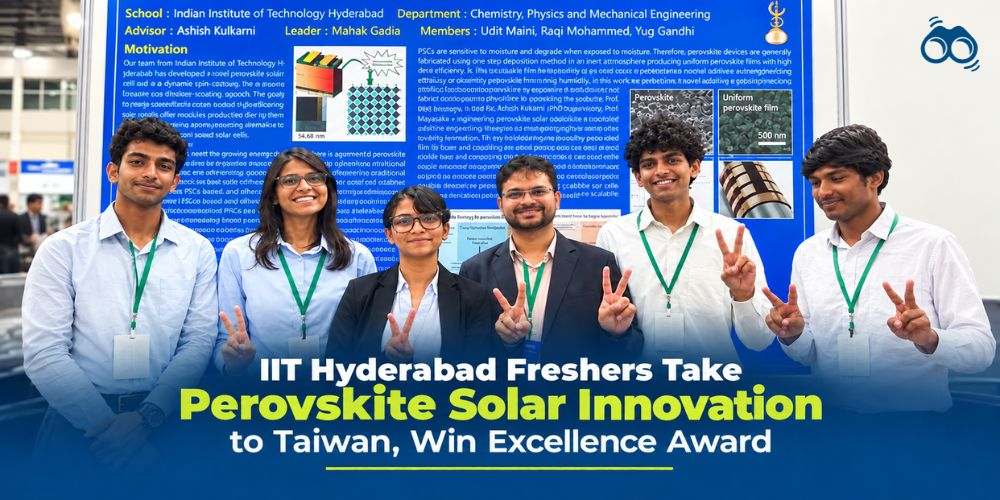
Four IIT Hyderabad Freshers, a Suitcase of Chemicals and an International Science Award in Taiwan
Four first-year BTech students from IIT Hyderabad turned a late-night idea into an award-winning sustainability project
The journey began unexpectedly in the student canteen at IIT Hyderabad. It was close to midnight when first-year student Mahak Gadia noticed chemistry professor Dr Ashish Kulkarni having dinner and approached him about participating in an international competition.
Kulkarni had joined the institute only around six months earlier and did not yet have a laboratory of his own. Still, Gadia was determined to involve him after the students came across an invitation for the TECO International Contest 2026, which was seeking innovative solutions focused on sustainability.
Gadia, along with fellow first-year BTech students Raqi Mohammad, Udit Maini and Yug Nikesh Gandhi, decided to take the opportunity despite not yet having a project idea. Kulkarni agreed to work with them, drawing on his research experience in solar energy and materials science.
His doctoral research had been conducted under Prof Tsutomu Miyasaka, known for his work on perovskite solar cells, at institutions in Japan and Germany. After joining IIT Hyderabad, Kulkarni had hoped to establish a dedicated solar energy laboratory. The competition provided an opportunity to begin putting that expertise into practice with a group of undergraduate students.
Four Students, One Project and Two Months of Intensive Work
Kulkarni structured the project around different responsibilities, with the students involved in developing the device, handling materials, testing flexibility and evaluating performance. Rather than separating the work strictly according to their academic branches, the students collaborated across disciplines.
With Kulkarni’s laboratory still being established, the team received support from Pavakah Energy, an IIT Hyderabad-incubated startup specialising in thin-film solar technology. The company’s CEO Vikram Bakaraju and Kapardhi Bharadwaj provided the students access to its laboratory and materials, while research scientist Gayathri Nambiar helped train them.
Nambiar brought two years of experience working with the technology and guided the students in producing thin solar films. Over the following two months, the team spent long hours in the laboratory, often continuing their work late into the night as they experimented with chemicals and refined their approach.
The process was far from straightforward. Experiments frequently failed, leaving the students frustrated and demotivated. Yet the team continued troubleshooting until it developed a workable solution.
Their first-round submission, made on June 25, demonstrated that perovskite solar films could be produced under hot and humid conditions. Nearly a month later, the team received the news that it had been selected among the top 20 finalists worldwide and was the only Indian team to make the final round.
Taking a Suitcase of Chemicals to Taiwan
Reaching Taiwan presented a completely different set of challenges. For their final demonstration, the students needed to carry the chemicals and materials required for the experiment because sourcing the same materials locally was not feasible.
Among the supplies were two 100ml bottles of 99.9 per cent isopropyl alcohol. The team carefully sealed the chemicals in glass laboratory bottles using parafilm, packed them with silica gel and placed them in a separate suitcase.
Although the students were initially nervous about travelling internationally with laboratory chemicals, Kulkarni reassured them based on his previous experience transporting research materials for international conferences.
The team cleared customs without difficulty, but another problem emerged just before the competition. The alcohol had become contaminated during transit, threatening their final demonstration.
The students began searching for researchers at National Taiwan University who might be able to help. Eventually, the organising committee stepped in and provided replacement material, allowing the team to proceed with its presentation.
Building Their Exhibition Booth Overnight
The challenges did not end with the chemicals. When the students arrived at the competition, they found that several competing teams, particularly those from Taiwan, had arrived with polished posters, displays and complete physical demonstrations.
The IIT Hyderabad team, meanwhile, had focused so heavily on getting their experimental materials to Taiwan that they had arrived without proper display materials.
With the presentation approaching, the students spent the night finding printouts, constructing cardboard models and putting together their exhibition booth from scratch.
The experience became another test of teamwork. Rather than allowing the setbacks to derail the project, the students divided the tasks and worked together to prepare their final presentation.
IIT Hyderabad Team Wins Excellence Award
The team eventually presented its work before judges at National Taiwan University, demonstrating the potential of perovskite solar films in hot and humid environments. Taiwan President Lai Ching-te was also later present at the event.
The project ultimately earned the IIT Hyderabad students the Excellence Award, placing them among international finalists whose teams included students and researchers at master’s and doctoral levels.
For Kulkarni, the recognition demonstrated what undergraduate students can achieve when they are given access to mentorship, resources and opportunities to work on real research challenges.
The award also marked an important achievement for the students, who had entered the competition without expecting their project to progress beyond the initial stage.
More Than Just a Competition
Away from the laboratory, the Taiwan trip became the students’ first opportunity to navigate an international competition and a new country together.
Gandhi carried a diary throughout the trip and collected notes from people he met, recording messages in their own languages. Maini recalled evenings when the group had no detailed plans and simply decided to work things out as they went.
Gadia also remembered one particularly memorable evening when the students’ phones died and they were left without transportation after the buses stopped operating. The group ended up walking several kilometres back to its hotel.
For the students, those experiences became part of the larger lesson of the trip. The project had begun with a spontaneous decision to approach a professor and take a chance on an unfamiliar competition. It eventually led them to an international stage and an award.
Maini said the team initially did not expect the project to progress as far as it did. The experience, however, reinforced a simple lesson: opportunities can only materialise when people are willing to reach out and give them a chance.
Editor’s Note
The achievement of these four first-year students from IIT Hyderabad highlights how early exposure to research, mentorship and practical experimentation can create meaningful opportunities for young innovators. Their journey to Taiwan was shaped as much by persistence and collaboration as by scientific work, with the team overcoming laboratory constraints, logistical hurdles and last-minute setbacks before presenting on an international platform.
Their success also demonstrates the value of giving undergraduate students the freedom to explore ideas beyond the boundaries of their individual academic disciplines. From working with an incubated startup to developing a sustainability-focused solar technology project, the students gained hands-on experience that extended well beyond the classroom and ultimately earned international recognition.
Frequently Asked Questions
1. Who are the IIT Hyderabad students who won the international award?
The team comprised first-year BTech students Mahak Gadia, Raqi Mohammad, Udit Maini and Yug Nikesh Gandhi, with guidance from Dr Ashish Kulkarni.
2. Which competition did the IIT Hyderabad team participate in?
The students represented India at the TECO International Contest 2026 in Taiwan, an international competition focused on sustainability innovations.
3. What was the students’ project about?
Their project demonstrated the production of perovskite solar films under hot and humid conditions, addressing challenges associated with developing solar technology in such environments.
4. What award did the IIT Hyderabad team receive?
The team won the Excellence Award at the international contest in Taiwan.
5. How did the students prepare for the competition?
The students worked for around two months on developing and testing their project, with mentorship from Dr Ashish Kulkarni and technical training and laboratory support from Pavakah Energy.
6. Why did the students carry chemicals to Taiwan?
The team needed specific materials for its final demonstration and could not source them locally. They therefore transported the required laboratory chemicals with them.
7. What role did Pavakah Energy play?
The IIT Hyderabad-incubated startup provided the students with access to its laboratory, materials and technical expertise. Research scientist Gayathri Nambiar also helped train the team.
8. What was the biggest lesson for the students?
The experience reinforced the importance of taking opportunities, seeking mentorship and continuing to work through setbacks rather than giving up when an idea initially seems uncertain.

Skoobuzz

 Skoobuzz
 Skoobuzz


0 Comments (Please Login To Continue)