








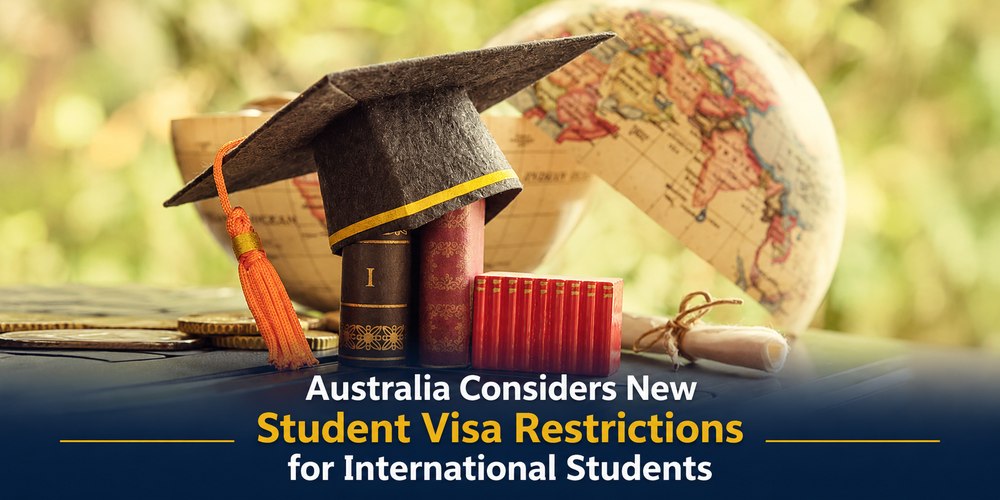
Australia May Tighten Student Visa Rules: What Indian Students Need to Know
Visa rules prompt Indian students to reassess applications, dependents and course choices.
Australia could introduce further restrictions on international students as the government considers changes to its migration and student visa framework, according to recent reports. The developments have triggered concern among prospective students and parents, particularly in India, where Australia remains one of the most popular destinations for international higher education. However, the reported measures need to be understood carefully. As of September 2, 2026, the proposed changes have not been formally announced or implemented as new Australian student visa rules.
The reported developments come against the backdrop of several years of policy tightening in Australia’s international education and migration sectors. The government has been working to manage migration levels, strengthen the integrity of the student visa system and ensure that international students are genuinely coming to Australia to study. For Indian students, this means the latest reports are important to monitor, but they should not be interpreted as an immediate change to existing visa requirements.
What Changes Is Australia Reportedly Considering?
According to a report published by The Australian on August 27, the Albanese government is considering an immigration overhaul that could introduce additional restrictions for international students. The reported measures could include restrictions on lodging Student visa applications from within Australia, tighter limits on which students can bring partners or dependants, stricter rules around changing courses and restrictions on moving from higher education into vocational education and training, commonly known as VET.
These proposals could affect different groups of international students in different ways. Restrictions on changing courses, for example, could have consequences for students who reconsider their academic direction after arriving in Australia. Similarly, tighter rules on moving from university-level education into VET could affect students who use different qualifications to build their education and career pathway.
Potential changes to dependant arrangements could be particularly relevant to married students and those travelling with children. For some international students, the ability to bring family members is an important factor when choosing a study destination. Any changes in this area could therefore influence how prospective students evaluate Australia alongside other international education destinations.
However, the most important point at this stage is that these are reported proposals, not confirmed new laws. Students should distinguish between what the government has already implemented and what is currently being discussed or reported.
Are the New Australia Student Visa Rules Confirmed?
No. As of September 2, 2026, the specific measures reported have not been formally introduced as new student visa requirements. This distinction is particularly important because headlines suggesting that Australia has already “tightened” its student visa rules could create unnecessary uncertainty among applicants.
At the same time, the reports should not be viewed in isolation. Australia has already tightened elements of its international student and migration system over recent years. The government has increasingly emphasised genuine study intentions, documentation, financial circumstances and the integrity of student pathways.
One of the major existing requirements is the Genuine Student (GS) requirement, which is designed to assess whether an applicant genuinely intends to study in Australia and meets the relevant criteria for a Student visa. This has made the quality and consistency of a student’s overall application increasingly important.
The current policy direction suggests that students should approach Australia as an education destination first and build their applications around credible academic and career objectives. Simply selecting a course because it appears to provide a convenient pathway into Australia may become increasingly difficult to justify.
Why the Reported Changes Matter for Indian Students
The potential changes are particularly relevant for Indian students because India is a major source market for Australia’s international education sector. Thousands of Indian students consider Australian universities and other education providers each year, making developments in visa policy an important part of their study-abroad decision-making.
For prospective applicants, the key issue is not necessarily whether Australia will stop welcoming international students. Instead, the emerging policy direction suggests that the government may increasingly focus on who is coming to Australia, what they are studying and whether their study pathway is genuine and coherent.
This could make course selection more important than ever. Students may need to demonstrate a clear connection between their previous academic experience, their proposed course and their future career plans. A student who chooses an unrelated programme without a convincing explanation could potentially face greater scrutiny than someone whose academic progression is clear and well supported.
The reported focus on course changes also means students should conduct more research before applying. Rather than treating their first course as an entry point and planning to decide later, applicants may benefit from understanding the curriculum, career outcomes, qualification level and long-term relevance of their chosen programme before submitting a visa application.
Dependants Could Become an Important Consideration
Another reported area of potential change concerns international students bringing partners and dependants to Australia. Family arrangements are a significant factor for many students, particularly those pursuing postgraduate education or longer-term programmes.
If restrictions are introduced, students may need to consider their family circumstances earlier in the decision-making process. A change to dependent eligibility could influence not only visa planning but also the overall financial calculation involved in studying in Australia.
The reported proposals are also understood to include possible exemptions for certain groups, including postgraduate research students, government-sponsored students and students from Pacific nations. If such exemptions are ultimately adopted, they could indicate that Australia is seeking to differentiate between student categories rather than applying one uniform policy to all international students.
For Indian students, this means that the eventual impact will depend heavily on the final rules and individual circumstances. It would be premature to assume that every student or every type of programme would be affected in the same way.
Australia’s Universities Raise Concerns
The debate over international students is also being closely watched by Australia’s higher education sector. University leaders have raised concerns that significant reductions in international student numbers could have consequences beyond university finances.
Carolyn Evans, Chair of Universities Australia, warned in her State of the Sector address that reducing international student numbers could have broader implications for the higher education system. Her comments reflect concerns about the role international students play in Australia’s universities, research environment and international engagement.
Vicki Thomson, CEO of the Group of Eight, which represents Australia’s leading research-intensive universities, has similarly acknowledged the legitimate debate surrounding migration settings while cautioning against treating all international students and institutions as though they are the same.
Their response highlights a broader policy challenge for Australia. The government is seeking to manage migration and strengthen the integrity of the student visa system, but universities also need to remain internationally competitive. International students contribute to the diversity and global connections of Australian campuses, while research-intensive institutions also compete internationally for students, academics and research talent.
The discussion is therefore unlikely to be simply about whether Australia wants international students. Instead, it is increasingly about which students the country wants to attract and how international education should fit within its wider migration and economic strategy.
Could Australia Still Be Interested in International Students?
The reported proposals do not indicate that Australia is abandoning international education. In fact, the potential exemptions and continued emphasis on attracting high-quality talent suggest a more targeted approach may be emerging.
Australia’s universities remain internationally recognised, and the country continues to offer a substantial higher education system with established pathways for international students. Research students, highly skilled graduates and students entering areas aligned with national priorities may continue to be particularly important to the country’s future international education strategy.
This distinction matters for Indian students. Rather than interpreting tighter immigration controls as a complete closure of the Australian education market, prospective applicants should view the changes as part of a broader shift towards greater scrutiny and policy selectivity.
For students with genuine academic objectives, strong documentation and a clear career plan, Australia could continue to be an attractive option. However, applicants should be prepared for a system in which their academic choices and personal circumstances are examined more closely.
What the Genuine Student Requirement Means
The Genuine Student requirement is already an important part of Australia’s Student visa process and is particularly relevant in the current policy environment. The requirement places greater emphasis on whether an applicant genuinely intends to study and whether the proposed education pathway makes sense in the context of their circumstances.
For Indian students, this means that simply obtaining admission from an Australian institution is not the only consideration. The visa application needs to present a consistent picture of the student’s educational background, chosen programme, financial circumstances and plans.
Students should therefore avoid choosing a course solely because it appears to offer an easier migration pathway. Instead, they should be able to explain why the course is relevant to their previous education and career ambitions and why studying in Australia is appropriate for their circumstances.
Strong documentation is equally important. Financial information should be clear and consistent, while academic records and other supporting documents should accurately reflect the student’s circumstances. Any inconsistencies could create unnecessary questions during the visa assessment process.
What Indian Students Should Do Now
For Indian students who are already considering Australia, the latest reports do not mean that applications should be abandoned. The more practical response is to continue planning while keeping a close watch on official announcements.
Students should begin by researching universities and courses carefully. Course content, qualification level, academic requirements, tuition fees and career relevance should all be considered before making a decision. Students who are uncertain about their academic pathway should resolve those questions before applying rather than relying on the possibility of changing courses after arrival.
Financial planning should also be thorough. Studying overseas involves tuition fees, accommodation, living expenses, insurance, travel and other costs. Students should ensure that their financial circumstances are clearly documented and that their plans are realistic. Applicants should also prepare their Genuine Student case carefully. Their explanation of why they selected Australia, why they chose a particular course and how the programme fits into their future should be consistent with the evidence provided in the application.
Students planning to bring partners or dependants should pay particular attention to any future policy announcements. Similarly, applicants considering a pathway involving multiple courses or a transition between higher education and VET should monitor developments closely.
Should Indian Students Still Choose Australia?
At this stage, there is no reason for Indian students to abandon Australia as a study destination solely because of the reported proposals. The measures have not yet been formally introduced, and the final policy could differ from what has been reported.
However, students should recognise that Australia’s student visa environment is changing. The country appears increasingly focused on ensuring that international education remains closely connected to genuine study, appropriate academic progression and broader migration objectives. This makes Australia a destination that requires careful planning. Students should evaluate universities, courses, costs, visa requirements and future career prospects together rather than making decisions based on one factor alone.
For students who have a genuine academic objective and a well-researched study plan, Australia can remain a viable option. The key is to stay informed and avoid making major decisions based on unconfirmed reports circulating online or through social media and messaging platforms.
What Could Happen Next?
The next important development will be any formal announcement from the Australian Government outlining whether the reported proposals will proceed. If new restrictions are introduced, the details of their implementation, exemptions and effective dates will be particularly important.
The final rules could also distinguish between different levels of education, student categories and visa circumstances. This is why students should wait for official policy information before assuming how they will personally be affected. For the Australian higher education sector, the issue will remain a balancing act. The government has an interest in managing migration and protecting the integrity of the visa system, while universities have an interest in attracting international students and maintaining their global competitiveness.
For Indian students, the immediate priority is therefore preparation rather than panic. A well-researched course choice, credible academic progression, sound financial planning and a strong Genuine Student case can help applicants navigate an increasingly selective international education environment.
Editor’s Note
Australia’s latest student visa debate reflects a larger question facing the country: how can it manage migration pressures while remaining a competitive destination for international education and global talent? For Indian students, the reported proposals are a reminder that Australia’s visa environment is becoming more focused on genuine study, coherent academic pathways and immigration integrity. While no new restrictions have been formally confirmed, students should take the changing policy direction seriously without reacting to speculation. The strongest approach is to make informed course choices, prepare thoroughly and follow official updates before making decisions that could affect their education and future plans.
Frequently Asked Questions
1. Are Australia’s proposed student visa restrictions confirmed?
No. As of September 2, 2026, the measures reported in relation to tighter student visa rules remain proposals under consideration and have not been formally implemented.
2. What changes could Australia make to student visas?
Reported proposals include restrictions on lodging Student visa applications from within Australia, tighter dependant rules, greater restrictions on changing courses and possible limitations on moving from higher education into VET.
3. Will the proposed changes affect Indian students?
They could, depending on the final policy. Students bringing dependants, changing courses or moving between different education sectors could be among those most directly affected if the proposals are introduced.
4. What is Australia’s Genuine Student requirement?
The Genuine Student requirement assesses whether an applicant genuinely intends to study in Australia and meets the relevant criteria for a Student visa. It makes a clear and credible academic plan an important part of the visa application.
5. Should Indian students stop applying to Australian universities?
Not solely because of the reported proposals. Students can continue researching and applying under the rules currently in force, while monitoring official announcements for any future changes.
6. How can students prepare for possible changes?
Students should choose courses carefully, maintain strong financial and academic documentation, ensure their study plans are credible and prepare a well-supported Genuine Student case. Those planning to bring dependents or change courses should also monitor future policy announcements closely.

Skoobuzz


 Skoobuzz
 Skoobuzz

 Skoobuzz


0 Comments (Please Login To Continue)