








University of Birmingham Health and Life Sciences Innovation Campus Showcases Workforce Development
University of Birmingham Hosts Ministerial Launch of Higher Technical Qualification in MedTech
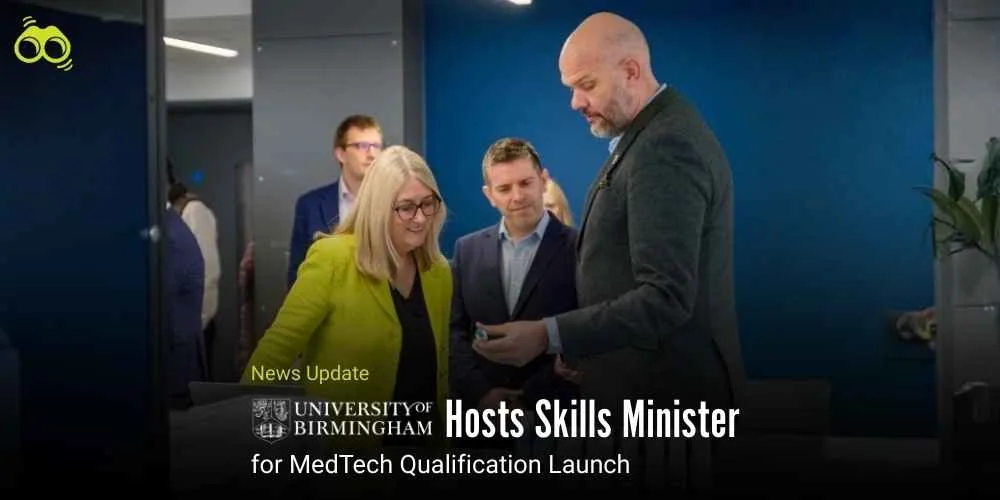
The Minister of State for Skills, Baroness Jacqui Smith, visited the Precision Health Technologies Accelerator Birmingham (PHTA), which is located in the University of Birmingham. This visit marked the launch of a new Higher Technical Qualification initiative, which aimed to bridge the gap in the UK’s MedTech sector. The period the participants spent in the University introduced them to the individuals involved in research and innovation, as well as industry experts involved in the development of the qualification. The degree aims to counter the 145,000‑person shortage that is predicted in the MedTech industry in 2035.
One of the speakers was Prof. Gino Martini, CEO of PHTA, who emphasised that ‘skills are the backbone of any successful innovation ecosystem.’ He appreciated that the city of Birmingham had a world‑leading health and life sciences district and that its full potential could only be realised through an industry‑ready workforce. He also emphasised that such qualifications are essential because they shape the talent pipeline that the region demands and give everyone access to high‑value jobs, and translate innovation and breakthroughs into practical realities for patients and the NHS.
Baroness Smith began her visit by learning about the Innovation Campus at the University of Birmingham and how it is becoming the UK’s largest health and life sciences innovation campus. Professor Martini explained how this district of innovation is supposed to create 10,000 jobs and add £400m GVA over the next 10 years. The Minister also learned how the city of Birmingham and its innovation ecosystem were placing the city at the forefront of a national health innovation testbed.
The Minister visited the MedTech makerspace and prototyping resource facility and saw first‑hand how 3D printing, design skills, and knowledge were being used to help entrepreneurs and spinouts develop the next generation of medical devices. She also met with people from the success stories, such as:
ExGenDx, University of Birmingham spin‑out featuring a rapid analysis system for healthcare and food safety applications.
Healome Therapeutics, a clinical‑stage company developing new eye treatments, after secured £2m investment.
WM5G – showcasing a 5G‑enabled ‘Pill Cam’ for at‑home screening for bowel cancer.
Dr Antonio Fratini of Aston University, talking about his research in medical instrumentation and bio‑sensing devices.
Baroness Smith also visited the University’s Clinical Immunology Service (CIS), where work in the diagnosis of autoimmune disease, blood cancers, immunodeficiency, infection, and allergy was shown by Dr Adrian Shields and his team, with the Minister being given a tour of how CIS at University College London integrates clinical excellence with industry collaboration and practical training to produce the next generation of clinical scientists.
In her opening remarks for the launch of the qualification, Baroness Smith pointed out that there is a MedTech revolution in the healthcare sector that will change healthcare beyond recognition and that the new HTQs will make sure that everyone has the skillset for future employment. The speaker proudly noted that the West Midlands MedTech skills programme is at the forefront in working with employers to provide an employment solution that addresses a real need. The speaker seemed to believe that filling skill gaps will open up opportunities for thousands of individuals, while the NHS will experience the benefits of an innovative solution that will assist with reducing waiting lists.
The visit was recorded as the second ministerial campus tour featured inthe University of Birmingham Health Innovation Campus news within three months, following the visit of Baron Stockwood in October. This highlighted the awareness of the national significance of the work carried out in Birmingham as a point of focus for UK MedTech’s workforce development initiatives and health and life sciences employment growth.
A key area that was emphasised during the visit of the University of Birmingham MedTech Skills Launch Minister was the importance of new higher technical qualifications in medical technology in filling the gap in skills that the UK faces. Through the integration of education on healthcare innovations in the Birmingham campus and collaborations with businesses, the University of Birmingham is developing a pool of workers who will be essential in supporting the NHS while fuelling future growth. This presents opportunities for future workers to register for MedTech Skills qualifications UK.
Editor’s note
This is important as it shows a connection between training and job positions in health technology. A Minister of State for Skills visited the University of Birmingham to mark a new Higher Technical Qualification in MedTech that is going to be available. In short, it is a learning course that teaches people what skills are needed now. The UK has a substantial gap in MedTech skills for 2035. Due to this gap, companies require employees who not only know how to design and test but also manufacture medical equipment and digital technologies. Through collaborations between researchers and companies in the Precision Health Technologies Accelerator (PHTA) and Birmingham Health Innovation Campus, the University is offering a clear skills pipeline. Consequently, this will ensure that trainees acquire adequate skills for the workplace and that companies can easily get potential employees. At the same time, the health and life sciences area of Birmingham is also flourishing. Jobs, investment, and new businesses rely on skills. The makerspace, the prototypes laboratory, and the hands‑on assistance demonstrate how research ideas can travel from the laboratory to the health service. As such, this qualification is not simply an educational programme; it is a link from learning to action. For students and career‑changers, this is very positive. It provides clear paths into high‑value jobs, flexible education and training, and exposure to industry software. For employers, it will provide graduates with relevant skills. For the NHS and healthcare users, this provides a rapid acceleration of innovation, superior diagnostic capabilities, and ultimately a reduction in waiting times.
As per Skoobuzz, the MedTech skills launch at the University of Birmingham demonstrates how all three sectors – education, industry, and government – can pull together for a beneficial purpose. With straightforward, employment‑tested learning, the West Midlands can help lead the way for the UK in terms of health technology skills, benefiting not just the industry but the country as a whole.
FAQs
1. Is the University of Birmingham good for medicine?
It was said that the University of Birmingham is highly regarded for medicine. Commentators explained that its medical school is one of the largest in the UK, with strong teaching, research links, and partnerships with leading hospitals. Rankings have placed it among the country’s top medical schools and within the global top 100 for medicine.
2. Which course is best at the University of Birmingham?
Observers noted that Birmingham is well known for courses such as Medicine, Law, Business, Engineering, and Computer Science. These subjects were described as attracting many students and offering strong graduate prospects.
3. What is Birmingham University famous for?
It was explained that the University of Birmingham is famous for being England’s first civic university, founded in 1900 by Joseph Chamberlain. The institution is also recognised for its Nobel Prize winners, its research excellence, and its diverse student community.
4. What are 5 interesting facts about Birmingham?
Writers highlighted five facts often mentioned about the University:
It was the first civic university in England, open to students from all backgrounds.
Ten Nobel Laureates have been associated with the University.
The campus clock tower, “Old Joe,” is one of the tallest freestanding clock towers in the world.
Birmingham was among the first universities to establish a Department of Drama and Theatre Arts.
The University has a global reach, including a campus in Dubai.
5. Is Birmingham Uni hard to get into?
Reports stated that the University of Birmingham has an acceptance rate of around 13–15%, making it moderately competitive. It was said that applicants need strong academic grades, a well‑written personal statement, and evidence of extracurricular achievements to secure a place.

Skoobuzz
 Skoobuzz
 Skoobuzz
 Skoobuzz



0 Comments (Please Login To Continue)