








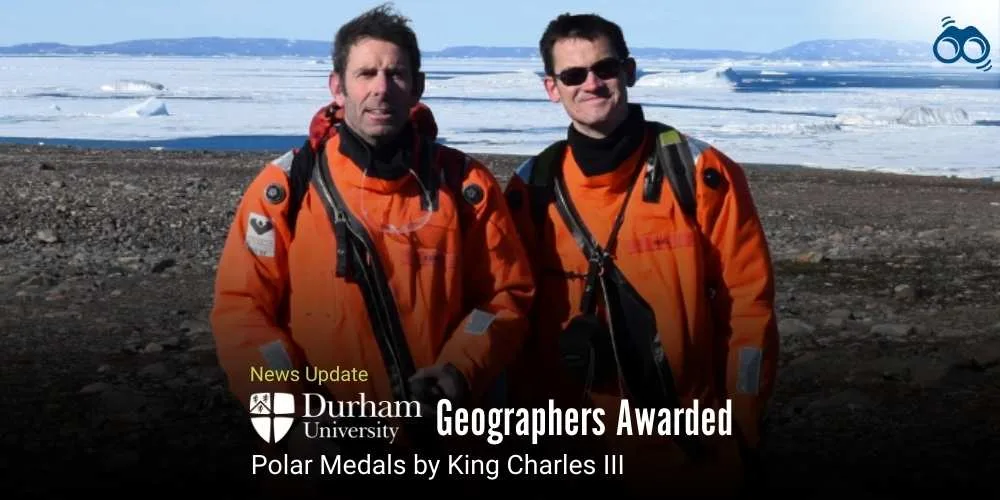
UK Honours for Polar Research Excellence: Durham Geographers Receive Royal Awards
Polar Medal Recipients Announced 2026: Durham Academics Recognised for Excellence in Polar Science
Durham University professors Colm O'Cofaigh and Dave Roberts have been awarded the Polar Medal in the King's honors list 2026. They are both recipients of the polar medals announced in the press release of 2026 as a testimony to their immense contribution to polar science.
Polar Medal-importance
The history and significance of the Polar Medal date back to 1904, when it was first bestowed upon explorers and scientists who worked under extreme conditions in the polar regions. Past recipients are those who embarked on expeditions with Sir Ernest Shackleton, Captain Scott's South Pole team in 1912, and today's explorers, such as Sir Ranulph Fiennes. It is considered one of the most prestigious UK awards for polar research excellence as a hallmark for recognising individuals who further their knowledge of the Arctic and Antarctic.
Professor Colm O'Cofaigh Contributions
Professor O'Cofaigh has been described as an outstanding polar scientist whose research transformed the understanding of the Arctic and Antarctic ice sheets. The work he undertook related to glacial sedimentation, reconstructing past ice sheets from marine and terrestrial records, and the use of geophysical methods concerning their growth and decay.
He has shown how environmental influences such as climate, ocean temperatures, and topography affect ice sheet behaviour. His fieldwork included nearly two years in polar regions and co-leading the UK's first Arctic science cruise on its new icebreaker, the RRS Sir David Attenborough, for which he contributed to developing scientific needs for this investment of £200 million- one of the largest investments in UK polar science capability.
Professor Dave Roberts's Work
Professor Roberts was recognised as one of the world's leaders in glacial geology and had experience spanning decades in polar fieldwork in Greenland and Svalbard. His research provided further advancements into understanding glaciated landscapes by concentrating mostly on the erosional and sedimentary signatures left behind by previous glaciation.
He has pioneered the use of cosmic rays for studying the Greenland Ice Sheet and has connected offshore records with onshore ones to provide a reconstructive history since the Last Glacial Maximum. His studies examined feedback between ice, ocean, and the atmosphere, relating to the broader dynamic behaviour ice streams experience and the larger context of understanding Quaternary glacial evolution.
Wider Recognition
Durham University also mentioned that this time, three of its academics received the Polar Medal recipients UK within 15 years. This underscores its role in the recognition of polar research in Britain. Such royal academic honours are noted by observers not only to celebrate individual achievement but also to increase the status of UK universities in global polar science.
The Durham academics win the Polar Medal in the King's New Year Honours list. England represents a milestone for the Department of Geography. By honouring professors O'Cofaigh and Roberts, King Charles honours polar scientists who have dedicated their lives towards advancing knowledge in hard environments. The impact of these royal honours on polar scientific careers is strong as they inspire future researchers, support international collaboration, and highlight the continuing importance of UK polar research awards.
Editor’s Note:
The Polar Medal award to Professors Colm O'Cofaigh and Dave Roberts represents an occasion of great pride for Durham University and for British polar science. The honours announced in the King's New Year Honours list 2026 represent the ultimate recognition of a lifetime's commitment to research in these most extreme environments. The importance of the recognition falls into several avenues: first, it stresses that polar research is paramount in determining climate change, sea-level rise, and the behaviour of ice sheets. The two professors have shown how careful fieldwork and innovative techniques can further the understanding of the Arctic and Antarctic. Their work links glacial histories of the past with contemporary challenges, thereby providing knowledge urgently needed by the global scientific community. Second, the awards help enhance the reputation of UK universities in international study. The fact that three Durham Polar Medal recipients have been in the last 15 years showcases the Department of Geography as perhaps the most pre-eminent research cenSkoobuzz underlines that the medals are much more than personal accolades; they are an expression of trust in science, a reminder of a long, drawn-out process, and a call to tackle further explorations into the world's most stubborn regions.
FAQs
1. What is the Polar Medal awarded for?
The Polar Medal is awarded for outstanding achievements in polar research, particularly to individuals who have worked for long periods in the harsh climates of the Arctic and Antarctic. It recognises scientific, exploratory, and technical contributions that advance knowledge of the polar regions.
2. Who received the Polar Medal in the UK honours list?
In the King’s New Year Honours list 2026, Professors Colm O’Cofaigh and Dave Roberts of Durham University were named as recipients of the Polar Medal. Their recognition highlights exceptional contributions to glacial geology and polar science.
3. How are Polar Medals awarded each year?
The Polar Medal is awarded by the Sovereign of the United Kingdom. Nominations are reviewed and announced in the London Gazette as part of the New Year Honours or Birthday Honours lists. Historically, until 1968, medals were given to all members of approved polar expeditions, but today they are awarded selectively to those who have made significant contributions over time.
4. Is the Polar Medal part of the King’s honours list?
Yes. The Polar Medal is included in the King’s Honours list and is presented alongside other royal awards. It is a civil honour within the UK honours system, recognising contributions to polar science and exploration.
5. What achievements qualify for a Polar Medal?
Achievements that qualify include:
- Long-term scientific research in polar regions.
- Exploration or technical work under extreme polar conditions.
- Contributions to understanding glaciation, climate change, and polar environments.
- Work that advances international collaboration and knowledge of the Arctic and Antarctic.

Skoobuzz

 Skoobuzz
 Skoobuzz



0 Comments (Please Login To Continue)