








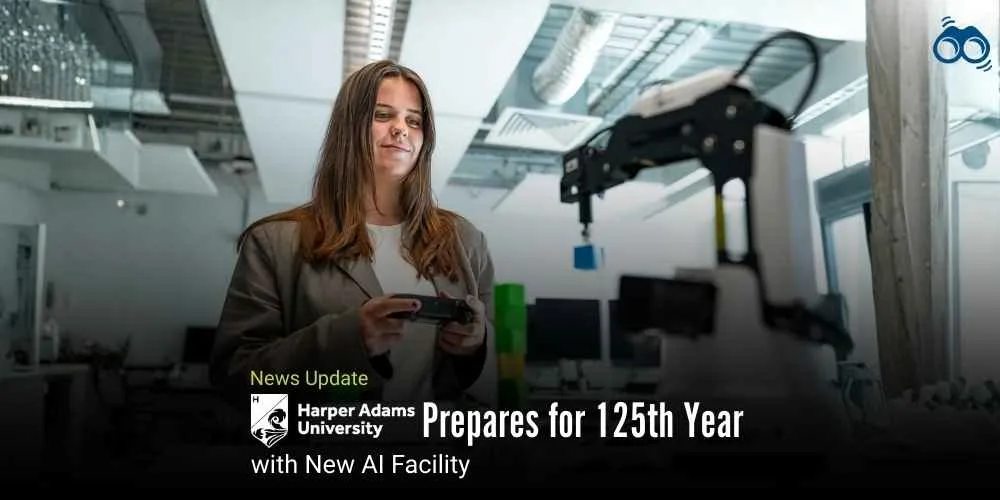
Harper Adams University Launches AI Farming Unit in Telford
UK Agricultural University Harper Adams Opens New AI Unit in Telford for Farming Technology
The unprecedented position of Harper Adams University is the result of growth from very humble origins to become one of the leading forces in the United Kingdom for agricultural innovation and education. It has been over a hundred years since it started, with an ever-expanding presence and a reputation that has been forged through the fusion of tradition with advanced technology. What started as a college with only a few students has today become a bustling community of thousands.
Harper Adams University, based in Edgmond, Shropshire, is making plans to mark the 125th year of its existence in 2026. The college was established in 1901 with only six students and a 178-acre farm donated by Thomas Harper Adams, the landlord of the property. Today, the school is a full-fledged university with over 5,000 students enrolled and has played a significant role in agricultural training over the years, from egg-laying to the training of disabled soldiers and women during the war to take up farming.
Looking to the future, Harper Adams has announced ambitious plans for innovation in agri‑tech teaching and learning. One of the major developments will be the opening of a new AI unit for agricultural technology in Telford, supported by over £500,000 in funding from the Office for Students. It will serve as an agri‑tech research hub within the United Kingdom, with a principal focus on AI in farming, including plant and animal health monitoring, while building on the university's long tradition of agricultural expertise.
This was put into perspective by the Vice-Chancellor, Professor Ken Sloan, who explained how AI could revolutionise agriculture. He began by saying that traditional methods involved farmers physically checking crops to ensure that they were free from insects, but nowadays, cameras can be fitted to machines to scan crops one by one and then compare them to those that are healthy. This, he said, could also be applied to cattle, whereby cameras can analyse changes to how cows walk, sit, and move, which then gives farmers ample time to take corrective measures to ensure that their cattle are healthy. This, it was said, was one of how Harper Adams University was using AI to revolutionise agriculture.
The university underlined that in addition to the new AI centre, it has already invested in agricultural robotics, autonomous tractors and drone research projects. These projects illustrate Harper Adams' commitment to leading technology for sustainable food and farming, where active researchers drive innovation to deliver solutions for real farming. Social media posts underlined that "building on almost 125 years of agricultural expertise, we are using technology to transform the future of food and farming."
As Harper Adams University marks 125 years, it brings together AI research applications in plant and animal health with robotics and autonomous machinery as the newest agricultural innovation at Harper Adams University's Telford unit. The institution declared that these will help solve the economic and environmental challenges the planet is facing, confirming its position as a British university at the forefront of agri‑tech and AI research. As part of its anniversary celebrations, Harper Adams is not only celebrating its past but also shaping the future of food and farming technology.
Editor’s Note:
From that tiny college, it has grown into a huge name in British farming. Nearing what would have been its 125th year, the story is somewhat clear: strong roots in farming and a brave modern step into technology. The history of Harper Adams- training people through war times and carrying out practical farming experiments- claims strong continuity of real-life progress for over a century now.
The new Telford AI unit, with over £500,000 behind it, marks a very powerful development. The leaders say AI could scan crops while quickly diagnosing pest infestations, and it could really monitor animals and initiate early warnings for health issues. This is important as early decisions can help the farmer safeguard against losses in crops and livestock while enhancing welfare.
The university has also invested in robotics, autonomous tractors, and drones. These technologies linked with AI put the idea of precision farming into action- doing the right thing at the right time with data and machines. This is well within the university's culture: take what works in the lab and use it in the field and farm. Students learn using modern technologies while researchers are looking for things that farmers can really use.
As per Skoobuzz, Harper Adams is celebrating its legacy while actively focusing on the future of food and farming. The university is marking its anniversary not merely with a celebration, but by reaffirming its dedication to addressing economic and environmental challenges through smart, straightforward, and impactful technological solutions.
FAQs
1. What is the AI for agriculture innovation initiative?
The AI for Agriculture Innovation (AI4AI) initiative, launched by the World Economic Forum, builds public–private partnerships to accelerate digital agriculture. It aims to equip millions of farmers with advanced tools such as computer vision, robotics, satellite sensing and data-driven platforms. The initiative focuses on making farming more resilient, efficient and sustainable by applying cutting-edge technology to food systems.
2.Which is the best AI for agriculture?
There is no single “best” AI, but several platforms are widely recognised for their impact. Leading examples include Farmonaut, which provides satellite-based crop monitoring, and AI apps for soil analysis, pest prediction, irrigation management and yield forecasting. These tools are valued because they improve precision, reduce waste and help farmers make faster, smarter decisions.
3.How is AI being used in agriculture?
AI is being applied across farming in many ways:
- Crop planning and monitoring – predicting yields and spotting diseases early.
- Soil health analysis – rapid testing of nutrients and conditions.
- Pest and disease control – using predictive models to prevent outbreaks.
- Smart irrigation systems – optimising water use.
Livestock monitoring – cameras and sensors track animal behaviour and health.
- These applications make farming more efficient, sustainable and profitable.
4.Who introduced AI in agriculture?
AI in agriculture dates back several decades. Researchers began experimenting with computer models in the 1980s, using them to optimise cotton yields by simulating irrigation, fertilisation and weed control. Since then, advances in machine learning, robotics and sensor technology have expanded AI’s role, with universities, agri-tech companies and global organisations driving adoption.
5.What is the future scope of AI in agriculture?
The future of AI in agriculture is seen as transformational. Reports suggest AI will enhance crop yields, improve climate resilience, and reduce resource use. Future applications include:
- AI-enabled marketplaces to connect farmers directly with buyers.
- Autonomous machinery for planting and harvesting.
- Climate-smart farming systems to adapt to changing weather.
Data-driven supply chains to cut waste and improve food security.
• • Overall, AI is expected to become central to sustainable food and farming systems worldwide.

Skoobuzz

 Skoobuzz
 Skoobuzz
 Skoobuzz
 Skoobuzz
 Skoobuzz


0 Comments (Please Login To Continue)