








FISU Hosts Beijing Sport University Delegation in Lausanne to Shape Future of Student Sport
Healthy Campus and Talent Training at the Heart of BSU–FISU Cooperation
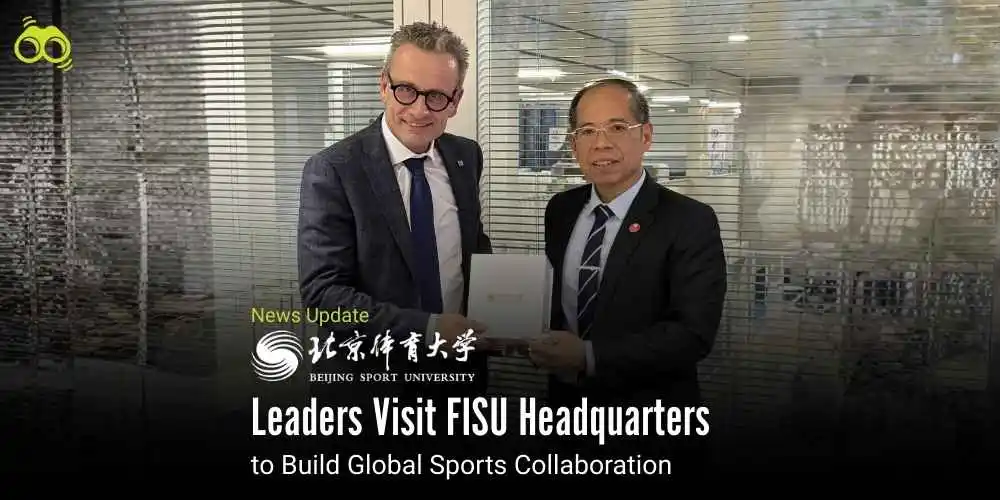
A five-member Beijing Sport University delegation visited to FISU headquarters in Lausanne took place on 15 December 2025. The group, led from the front by Zhang Jian, BSU President, was officially welcomed at the International University Sports Federation Lausanne visit, wherein Secretary General and CEO Matthias Remund, Deputy Secretary General Fernando Parente, Chief Sports Officer Shen Zhen and Education and Development Senior Manager Bertrand Fincoeur were also present.
The meeting was described as a follow-up to the FISU Secretary General's visit to Beijing in June 2025, which laid the groundwork for further discussion. The BSU FISU Healthy Campus Program, upcoming FISU Master Programs and competitions, and tactics for developing talent in university athletics were all reportedly discussed in-depth by both sides. The 33rd Winter Universiade Changchun collaboration received special attention because both sides saw the opportunity to use it as a platform for advancing university sport development globally.
In the evening, FISU President Leonz Eder hosted a reception for the Beijing Sport University delegation. Friendly consultations were held to align on future collaboration priorities. The visit was noted to provide further reinforcement of the long-standing partnership between BSU and FISU, a relationship that will lay a good foundation for further international university sports cooperation and the successful conducting of events.
Overview of Beijing Sport University Delegation Visit to FISU Headquarters
Zhang Jian leads a Beijing Sport University delegation for a strategy meeting at FISU headquarters in Lausanne, 15 December 2025.
Discussion of the Healthy Campus Programme between FISU and BSU; discussion of FISU Master Programmes, talent cultivation, and forthcoming competitions.
The influence of the BSU-FISU partnership on international university sports cooperation, Winter Universiade Changchun 2027, was underlined.
The FISU President Leonz Eder hosts a reception for the Beijing Sport University delegation to align on global sports collaboration priorities.
Importance of the Visit
This instance of China-Switzerland university sports cooperation also underpinned the contribution of FISU to global student sport wellbeing and competitions. In addition, this underlined the role of international university sport partnerships and their reinforcement through regular dialogue. In addition to supporting the Healthy Campus initiative, the Switzerland talks on BSU's global sport partnership confirmed that the partnership would stimulate the growth of Winter Universiade international sporting events.
Editor’s Note:
The recent visit of delegations from Beijing Sport University to FISU headquarters in Lausanne demonstrated the ongoing expansion of international collaboration in university athletics. Following the FISU Secretary General's earlier visit to Beijing in June, this meeting assisted both parties in continuing the conversation. Specific discussions dealt with the Healthy Campus Programme, the future FISU Master Programmes and competitions, and training of young talent. Both parties focused especially on the 33rd Winter Universiade in Changchun and immediately realised this event is an opportunity to boost global university sports development. Attention should also be paid to the fact that the reception by FISU President Leonz Eder allowed for friendly consultations that further consolidated the partnership. The cooperation between BSU and FISU obviously aims at consolidating the local and global community by linking student wellbeing, academic development, and international competition.
Skoobuzz highlights that this visit transcended mere formal discussions. It centred on cultivating trust, exchanging ideas, and strategically planning the future trajectory of University Sport. The collaborative spirit demonstrated by the BSU–FISU partnership exemplifies how institutions can work together to expand global opportunities for students and athletes.
FAQs
1.Why is Lausanne called the Olympic Capital?
Lausanne was officially designated the Olympic Capital in 1994 because it has been home to the International Olympic Committee (IOC) headquarters since 1915. Baron Pierre de Coubertin moved the IOC to Lausanne during the First World War, seeing it as a safe and independent environment for the Olympic spirit. Today, the city hosts more than 50 international sports federations, making it the recognised centre of global sport governance.
2.What is the full form of FISU?
The full form of FISU is the International University Sports Federation (in French: Fédération Internationale du Sport Universitaire). It was founded in 1949 and is responsible for organising and governing worldwide sports competitions for student-athletes, including the Summer and Winter Universiades.
3.What is India’s rank in FISU?
At the FISU World University Games 2025 in Rhine-Ruhr, Germany, India finished 20th in the medal standings. Indian athletes won a total of 12 medals – 2 gold, 5 silver, and 5 bronze. This marked a strong performance, although India’s best-ever result came earlier in Chengdu 2023, when the team ranked 7th with 26 medals.
4.How will the BSU–FISU partnership support the Winter Universiade Changchun 2027?
The partnership between Beijing Sport University (BSU) and FISU is expected to strengthen preparations for the 33rd Winter Universiade in Changchun, scheduled for January 2027. Their cooperation focuses on talent cultivation, academic exchange, and student well-being initiatives such as the Healthy Campus Programme. By aligning on these priorities, BSU and FISU aim to ensure the event promotes both sporting excellence and international collaboration.
5.What is the FISU Healthy Campus Programme?
The FISU Healthy Campus Programme is a global initiative designed to improve the well-being of students and campus communities. It provides universities with systematic guidelines and toolkits to promote healthy lifestyles, mental health, and social responsibility. As of 2023, more than 130 universities across 40 countries had joined the programme, with many achieving certification for best practices in student health and wellbeing.

Skoobuzz

 Skoobuzz
 Skoobuzz

 Skoobuzz
 Skoobuzz


0 Comments (Please Login To Continue)