








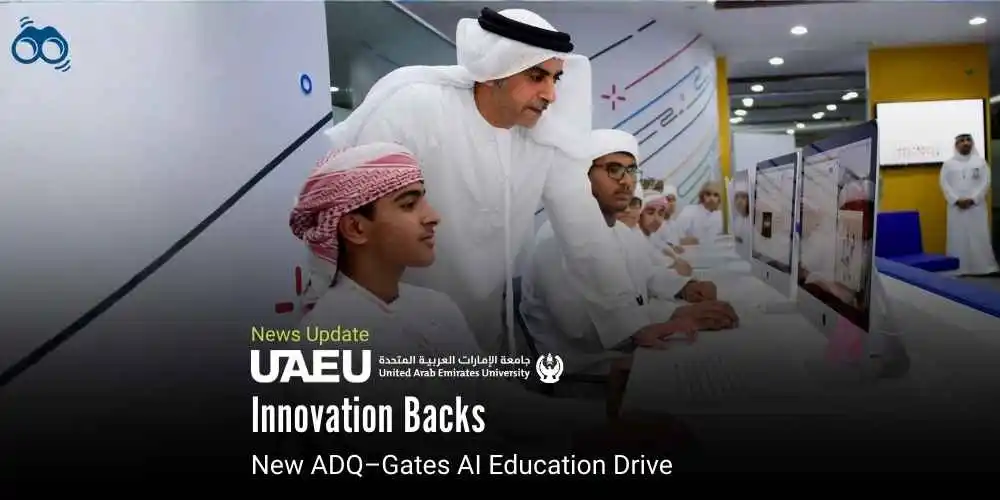
New EdTech and AI Fund to Scale Proven Learning Solutions Across Sub‑Saharan Africa
ADQ–Gates Foundation Education Systems Partnership Targets Early Literacy and Numeracy in Africa
Abu Dhabi Development Holding Company (ADQ), a sovereign investor and the Gates Foundation, a global philanthropic organisation, both have demonstrated commitment toward building and establishing infrastructure and supporting inclusive growth. ADQ has diversified its investment extensively across energy, logistics, healthcare, and sustainable manufacturing. The Gates Foundation has focused its investments on creating opportunities for every human being, anywhere around the globe, to access education and healthcare. They will now pool resourceful experience together and put it toward strengthening education systems in Africa via artificial intelligence (AI) and education technology (EdTech).
Partnership Overview
The Gates Foundation and ADQ education partnership was announced during Abu Dhabi Finance Week, which happened to coincide with a visit by Bill Gates to the UAE. The four-year venture will accelerate the appropriate adoption of AI in education and increase the EdTech solutions designed to improve learning results for children across sub-Saharan Africa. This joint investment of USD40 million, with ADQ contributing up to USD20 million, will target responsible AI use in education, ethical adoption, and national-level approaches to scale proven tools.
Combating Learning Poverty
By 2050, one in three young people in the world would be Africans, yet currently, in nine out of ten cases, children would not be able to read or understand even a simple statement, or maths problems, by the age of ten; this is the challenge the partnership is addressing by promoting early-grade literacy and numeracy improvement, teacher empowerment, and capacity building for Global South education systems. Foundation skills have been stipulated as crucial for long-term competitiveness and inclusive growth.
Flagship Programmes
The above initiative will have two flagship programs. The AI-for-Education initiative, launched in 2022, develops real-world models of learning with AI and offers expert counsel to the governments of the Global South. The EdTech and AI Fund, which will be established next year, will leverage proven EdTech solutions to scale within African schools. Co-founded by ADQ and the Gates Foundation, it will be the first fund created to expand proven interventions to the national level in improving foundational learning.
Challenges and Opportunities
Generative AI now provides unique chances to improve more structured pedagogy, along with data-driven decision tools for foundational learning. It remains limited in impact evidence, and funding continues to be inadequate. More than 93 per cent of EdTech products in low- and middle-income nations are untested for proof-of-learning outcomes. Only two per cent of global EdTech venture capital was committed to the sub-Saharan region. At the moment, around four per cent of children in the region share consistent access to EdTech. The partnership between the Gates Foundation and ADQ will narrow the gap caused by applying ethical artificial intelligence in education and scaling proven solutions.
Global Momentum
Earlier in 2025, the Gates Foundation committed USD 240 million to its Global Education Programme to assist 15 million children in sub-Saharan Africa and India. Nurtured by this momentum, the UAE is leveraging its strengths in innovation and technical deployment to accelerate AI integration in education. ADQ leaders underscored the fact that their investments historically focused on assets, while increasingly important for national development, are now learning systems and smart technologies. Perhaps he stated the most visible potential of transforming learning and opening opportunities through AI while gearing up the UAE to support innovations in the education sector.
Future Outlook
The commitment of this partnership is timely in conjunction with the African Union Summit commitments to end learning poverty by 2035. Advances in AI-enabled learning and digital infrastructure, expanding local capabilities, and enhancing collaboration all contribute to a better foundation for change. This Gates Foundation education systems partnership with ADQ will likely accelerate progress, strengthening education systems in sub-Saharan Africa and creating a more inclusive future for millions of young people.
Editor's Note :
The alliance created between ADQ and the Gates Foundation is clearly to drive global collaboration in addressing some of the most urgent educational challenges today. The two organisations have positioned themselves in very inclusive growth and infrastructure development spheres, and now tie their strengths together in an approach aimed at supporting African education systems. The initiative is focused on how artificial intelligence (AI) and education technology (EdTech) would contribute to achieving improved learning outcomes for millions of schoolchildren across sub-Saharan Africa. It is a huge task: currently, nine out of ten children in the area are not able to read or solve basic maths problems by the age of ten. This partnership, therefore, seeks to fill that gap through initiatives that promote early-grade literacy and numeracy and empower teachers, as well as build capacity for education systems in the Global South. The joint investment of USD 40 million by the parties will also expand the adoption of ethical AI and scale proven EdTech solutions, ensuring that interventions are both responsible and effective. The AI-for-Education initiative presents practical models and guidance to governments, which will be complemented by the EdTech and AI Fund scaling tested solutions throughout African schools. These two initiatives, taken together, are a very timely answer to the commitments made at the African Union Summit to end learning poverty by 2035. The UAE's role in applying its strengths in innovation and technical deployment further enhances the momentum for reform.
This partnership represents more than just a financial investment; it is an empowering commitment focused on building stronger education systems and expanding opportunities for Africa's youth. The responsible integration of AI and scalable EdTech will enable the initiative to create the contexts under which children learn the foundational skills they need to thrive. Skoobuzz mentions that this collaboration serves as a reminder that inclusion and opportunity must come with action, and education is the central pillar on which a more equal and prosperous future must be built.
FAQs
1.What is the Gates Foundation doing in Africa?
The Gates Foundation is working to strengthen education systems across sub‑Saharan Africa. In partnership with ADQ, it has launched a four‑year programme worth USD 40 million to expand the responsible use of artificial intelligence (AI) and education technology (EdTech). The initiative focuses on improving early‑grade literacy and numeracy, empowering teachers, and scaling proven digital learning tools to help millions of children achieve better outcomes.
2.What did Bill Gates say about Africa?
Bill Gates emphasised that AI has enormous potential to transform learning and expand opportunity. He explained that the partnership with ADQ would apply these tools responsibly and scale approaches already showing results. Gates also praised the UAE’s leadership in using innovation to expand opportunity, noting that the collaboration would help children in Africa develop the foundational skills that shape their futures
3.How big is the EdTech market in Africa?
The African EdTech market is growing rapidly. Reports suggest the e‑learning sector reached a value of over USD 4 billion in 2025 and is projected to grow at nearly 19 per cent annually, potentially reaching USD 23 billion by 2035. Despite this growth, only two per cent of global EdTech venture capital currently flows into sub‑Saharan Africa, and just four per cent of children in the region consistently use EdTechiAfrica.
4.Which African country is leading in AI?
Several countries are advancing AI adoption, but Egypt is currently recognised as the leading African nation in AI readiness, with strong government plans to train professionals and establish AI companies by 2030. South Africa and Nigeria are also prominent, using AI in fintech, healthcare, and agriculture, while Rwanda and Ghana are leveraging AI for governance and digital transformation.
5.What is the richest country in Africa?
The richest country in Africa depends on how wealth is measured. By GDP per capita, Seychelles is ranked the wealthiest, driven by tourism and financial services. However, by total GDP size, Nigeria remains Africa’s largest economy due to its oil resources and population.

Skoobuzz
 Skoobuzz
 Skoobuzz



0 Comments (Please Login To Continue)