








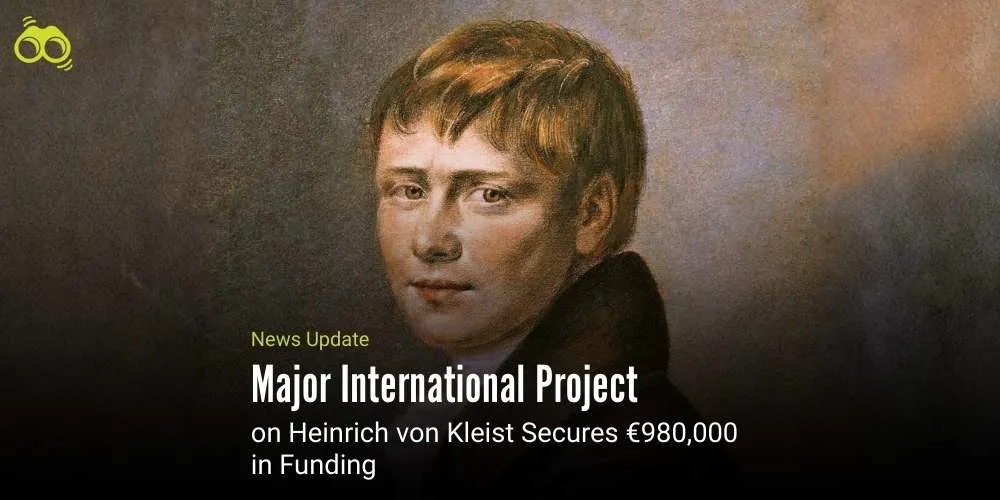
New Order of Things Project to Map Kleist’s Epistolary and Journalistic Networks in Napoleonic Europe
AHRC and DFG Fund €980,000 Kleist Network Study, 2026–2029
At the dawn of the 1800s, the German writer Heinrich von Kleist (1777-1811) was experiencing the hardships brought forth by Napoleonic Europe, and he expressed them through the idea of "a new order of things." The political and cultural upheavals for which Kleist has received these words were expressed through journalism and copious correspondence. Kleist founded and edited journals such as Phöbus (1808), the planned Germania (1809), and Berlin's first daily newspaper, the Berliner Abendblätter (1810-11).
Alongside these, he built very extensive networks across politics, the military, economics, communication, and the arts, leaving a veritable treasure of epistolary correspondence and journalistic networks in Napoleonic Germany. Against this historical background, it had been announced that an international research project entitled "A New Order of Things: Social and Cultural Transition in the Epistolary and Journalistic Networks of Heinrich von Kleist "would be partly directed by Prof. Seán Allan (St Andrews/Bonn), Dr. Elke Dubbels (Osnabrück), Dr. Elystan Griffiths (Birmingham), and Dr. Christian Moser (Bonn/St Andrews).
As announced by the organisers, the UK-Germany funded humanities research 2026 would run from February 2026 through three years and funded by the Arts and Humanities Research Council (AHRC) in partnership with the German Research Foundation (DFG), with a combined budget of €980,000, to support two postdoctoral positions, one in the UK and the other in Germany, and culminate in a major international conference in July 2027 at the University of Birmingham. Heinrich von Kleists network research. The Kleist project in History and Journalism Studies would map his epistolary and journalistic networks in the following five areas: politics, military, economics, communication and travel, and visual arts.
The team explained that this European cultural networks research would highlight how Kleist used existing networks and built new ones, linking public journalism, private letters, and semi-public spaces such as salons. Scope and methodology, timely had become an investigation because of recent discoveries that the five unknown letters to Joseph von Buol-Berenberg and the new Innsbruck archives were noted.
The researchers stressed that what is needed is a new methodological approach that centres less on the individual and more on network analysis in terms of the historical perspectives of 19th-century literature. Through placing Kleist into wide creative and intellectual networks, the project hopes to refine modern concepts of authorship around 1800, hence moving away from the figure of the one genius. The project was said to issue a co-authored monograph, Vernetzte Kreativität. Heinrich von Kleist und das napoleonische Europa, and a journal article. The University of Birmingham launched the New Order of Things project on Heinrich von Kleist 2026-2029 and would also host the international conference in July 2027, bringing scholars together from law, music, theatre, philosophy, and science.
This event would lead to an edited volume. As part of the cross-border humanities research collaboration UK-Germany, the team planned to celebrate Kleist's 250th birthday in 2027 with open-access translations of selected journalism and correspondence, which will be highlighted at a hybrid public event in Birmingham and in articles aimed at the general public. The Birmingham AHRC DFG-funded project would allow scholars to apply for post-doc positions in the Kleist network project Birmingham 2026, to work with the Birmingham-Bonn humanities research team on European cultural history, and to attend the international conference on Kleist networks in July 2027 at the University of Birmingham.
Observers said that the project would strengthen the University of Birmingham's research UK-Germany collaboration and Bonn, Germany, humanities network project Europe and show the impact of the European Napoleonic era on cultural and social transition. Nonetheless, the organisers indicated that the AHRC and DFG are the central funding bodies facilitating this international initiative in the humanities, and the project will help to enhance awareness of the importance of Kleist in 19th-century European literature and journalism.
Editor’s Note:
This announcement is a very important milestone for European cultural history. At the centre of the project is the German author Heinrich von Kleist, whose life and works mirrored those turbulent Napoleonic years in Europe. His journalism and wide-ranging correspondence created networks that linked politics with the military, economics with communication, and the arts. These networks are now being revisited through a new international research project jointly funded by the Arts and Humanities Research Council (AHRC) and the German Research Foundation (DFG). The significance of the research offers this novel perspective: instead of focusing on Kleist alone, it will investigate the wider epistolary and journalistic networks that shaped his creativity. This makes it possible for scholars to think about the border crossings of ideas, the interplay between public and private communication, and the cultural and social transformations that were taking place in early nineteenth-century Europe. Recent archival discoveries, including hitherto unknown letters, make this work particularly urgent. Beyond sponsoring postdoctoral positions in the UK and Germany, and hosting a major international conference at the University of Birmingham in July 2027, the project is also generating opportunities for collaboration and cross-disciplinary dialogue. Outputs ranging from a co-authored monograph to open-access translations will ensure greater accessibility of Kleist-related work both to scholars as well as to the general public.
Skoobuzz highlights that this UK-Germany collaboration in the humanities deepens knowledge of history and literature and fosters new research. Highlighting Kleist's networks, the project will benefit scholarship by emphasising the lasting impact of cultural exchange on Europe's past and future.
FAQs
1.What is the New Order of Things project by the University of Birmingham?
The New Order of Things project is a major international research collaboration led by scholars from the University of Birmingham, St Andrews, Bonn, and Osnabrück. It focuses on the German writer Heinrich von Kleist and explores his journalism and correspondence networks during the Napoleonic era. The project will run from 2026 to 2029 and aims to show how Kleist’s work reflected wider social and cultural changes in Europe.
2.Why is Heinrich von Kleist’s network being studied now?
Kleist’s networks are being studied now because new archival discoveries have recently come to light, including previously unknown letters and materials in Innsbruck. These sources give scholars fresh opportunities to understand how Kleist connected politics, the military, economics, communication, and the arts. The research is timely as it coincides with the 250th anniversary of Kleist’s birth in 2027, making it an ideal moment to reassess his importance.
3.How will the Birmingham-Bonn research project change understanding of German cultural history?
The project will change understanding by moving away from the idea of the lone genius and instead focusing on creative and intellectual networks. By mapping Kleist’s epistolary and journalistic connections, scholars will gain a clearer picture of how ideas travelled and how cultural transitions took place in early 19th-century Europe. This approach will refine modern views of authorship and highlight the role of networks in shaping German cultural history.
4.Which universities and organisations fund the Kleist research project?
The project is jointly funded by the Arts and Humanities Research Council (AHRC) in the UK and the German Research Foundation (DFG). It is co-delivered by the University of Birmingham, the University of St Andrews, the University of Bonn, and the University of Osnabrück. Together, these institutions are supporting a three-year programme with a budget of €980,000.
5.When will the international Kleist conference take place in Birmingham?
The organisers have announced that the international Kleist conference will take place in July 2027 at the University of Birmingham. The event will bring together scholars from different fields such as law, music, theatre, philosophy, and science, and will lead to the publication of an edited volume.

Skoobuzz

 Skoobuzz
 Skoobuzz
 Skoobuzz
 Skoobuzz
 Skoobuzz


0 Comments (Please Login To Continue)