








BRICS Nations Adopt New Education Roadmap With Focus on AI, Skills and Research
Ministers adopt a joint roadmap covering AI, skills, research, academic mobility and inclusive education.
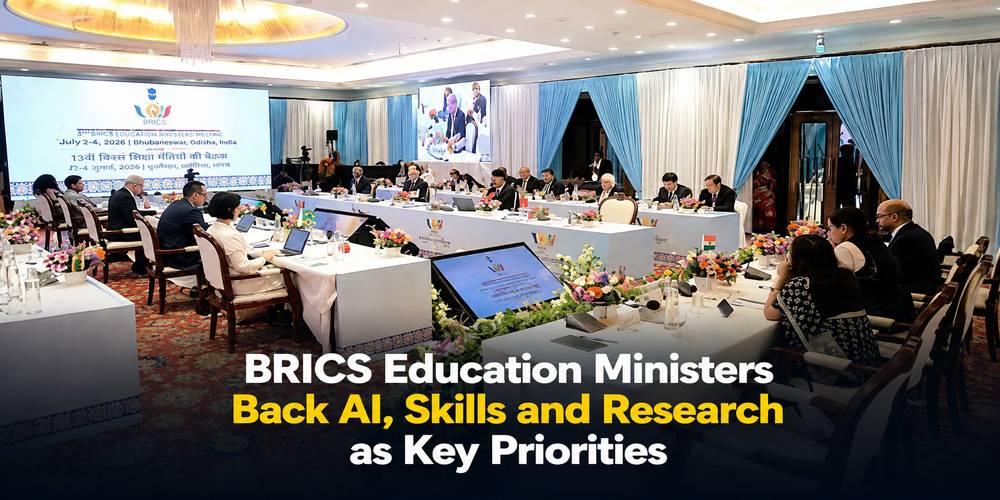
Education ministers from the BRICS grouping have agreed on a new roadmap aimed at making education systems more inclusive, innovative and future-ready, with artificial intelligence, skills development, research and academic mobility emerging as major areas of cooperation.
The agreement was reached at the 13th BRICS Education Ministers’ Meeting in Bhubaneswar, where ministers adopted a joint declaration outlining areas in which member countries intend to strengthen collaboration. The roadmap comes as education systems worldwide face rapid changes driven by artificial intelligence, evolving employment requirements and increasing demand for international research and academic collaboration.
Chairing the meeting, Union Education Minister Pralhad Joshi said education systems must continue to evolve in response to the aspirations of future generations while remaining grounded in human values. Referring to India's BRICS Chairship theme — “Building for Resilience, Innovation, Cooperation and Sustainability” — he emphasised that learners, teachers, researchers and young people should remain at the centre of education policymaking.
Five Key Priorities Shape the BRICS Education Agenda
The joint declaration identifies five broad areas of cooperation, covering education from the foundational years through higher education, research and international collaboration.
1. Strengthening Early Childhood Education and Foundational Learning
The priority focuses on improving access to Early Childhood Care and Education (ECCE) and strengthening Foundational Literacy and Numeracy (FLN). BRICS nations will work towards more inclusive approaches to early education while exploring the use of age-appropriate digital learning tools.
The emphasis on foundational education is significant as countries increasingly adopt advanced technologies in classrooms. While AI and digital tools are transforming learning, strong literacy, numeracy and early childhood development remain essential building blocks for students to benefit from those technologies.
The approach also reflects a broader understanding that future-ready education must begin with strong foundations rather than focusing exclusively on advanced technical skills.
2. Expanding Technical and Vocational Education and Skills
The second priority centres on technical and vocational education and training (TVET). BRICS countries will strengthen cooperation through the BRICS TVET Cooperation Alliance, creating greater scope for knowledge-sharing and collaboration around vocational education. India has also proposed an International Skill Gap Study, which interested BRICS countries can participate in voluntarily.
The proposed study could help participating nations identify emerging workforce requirements and understand where existing education and training systems may not be keeping pace with industry demand. As artificial intelligence, automation and digital technologies reshape employment, identifying these skill gaps will become increasingly important for preparing young people for changing careers.
3. Promoting Research, Innovation and Start-Up Ecosystems
The third priority focuses on strengthening research, innovation and entrepreneurship across BRICS countries. Member nations agreed to encourage joint research projects, support innovation-driven entrepreneurship and strengthen start-up ecosystems. Artificial intelligence will also play an important role within this area, with the declaration supporting its safe, ethical and human-centred use in education.
The focus on responsible AI is particularly relevant as educational institutions increasingly experiment with AI-powered learning tools, research applications and digital platforms. The objective is not simply to accelerate technological adoption, but to ensure that innovation remains aligned with human needs and ethical considerations.
4. Making Academic Mobility and Qualification Recognition Easier
The fourth priority addresses academic mobility, with BRICS nations continuing discussions around a proposed Memorandum of Understanding on Mutual Recognition of Qualifications (MRQ). If implemented, the framework could make it easier for students and professionals to have their qualifications recognised across BRICS countries.
Greater recognition of academic and professional credentials could help reduce barriers for students seeking to study abroad and for professionals looking to pursue opportunities in other member nations. The declaration also supports several initiatives designed to strengthen connections between higher education institutions, including:
- Faculty exchange programmes
- Scholarship programmes, particularly in STEM fields
- The BRICS Rectors’ Forum
- Exploratory work towards a BRICS University Global Ranking and Evaluation System
Together, these initiatives could create stronger networks between universities, researchers and students across BRICS.
5. Strengthening Collaboration on Traditional and Indigenous Knowledge
The fifth priority brings a distinctly different dimension to the education roadmap by focusing on traditional and indigenous knowledge systems. India proposed guiding principles for strengthening academic collaboration in this area.
The declaration welcomed the initiative and suggested that the BRICS Network University explore the possibility of establishing a new international thematic group dedicated to traditional and indigenous knowledge. The proposal seeks to create greater academic recognition and collaboration around knowledge systems that have developed across generations, potentially connecting them with contemporary research and higher education.
AI Becomes a Shared Education Priority
Artificial intelligence runs through several elements of the new BRICS agenda. Rather than treating AI solely as a technical subject, the declaration places it within a broader conversation around education, employment, research and responsible innovation.
The emphasis on safe, ethical and human-centred AI suggests that member countries recognise the need to prepare students not only to use emerging technologies but also to understand their implications.
For educators, this could mean adapting teaching methods and curricula. For students, it could mean developing AI literacy alongside traditional academic and professional skills. The broader challenge will be ensuring that technological adoption does not deepen existing educational inequalities.
BRICS Looks to Build Stronger Academic Connections
Academic mobility is another major component of the roadmap. The proposed mutual recognition framework could eventually make it easier for qualifications earned in one BRICS country to be recognised in another, potentially opening new opportunities for students, researchers and professionals.
Combined with scholarships, faculty exchanges and university partnerships, such measures could strengthen the movement of knowledge and talent across BRICS. For higher education institutions, deeper collaboration could also create opportunities for joint research and international programmes.
India Highlights Traditional Knowledge
India's proposal on traditional and indigenous knowledge adds another layer to the BRICS education agenda. At a time when education policy is increasingly focused on AI, digital learning and future skills, the proposal highlights the importance of preserving and academically engaging with knowledge systems rooted in local communities and cultures.
If taken forward through the BRICS Network University, it could provide a platform for researchers from member countries to explore traditional knowledge through an international academic framework.
Countries Participate in Bhubaneswar Meeting
Delegations from Brazil, Russia, China, South Africa, Indonesia, Iran, Ethiopia and the United Arab Emirates attended the meeting alongside India. The wide-ranging agenda reflects the growing role of education within BRICS cooperation.
From early childhood learning and foundational literacy to AI, vocational training, research, university collaboration and traditional knowledge, the declaration attempts to create a broad framework for education cooperation across different stages of learning.
What the Roadmap Could Mean for Students
For students, the significance of the declaration will ultimately depend on how these commitments translate into tangible opportunities. Greater academic mobility could make international study more accessible. New scholarship and faculty exchange programmes could strengthen international exposure, while joint research initiatives could give students and researchers more opportunities to collaborate across borders.
At the same time, stronger vocational education and skill-gap research could help align education more closely with changing employment requirements. The biggest challenge will be moving from policy commitments to implementation. A declaration can establish priorities, but its real impact will be determined by the programmes, funding, partnerships and opportunities that emerge from it.
A Future-Ready Education Agenda
The new BRICS roadmap arrives at a time when education is being reshaped by several forces at once. Artificial intelligence is changing the workplace. Employers are demanding new combinations of technical and soft skills. Universities are becoming increasingly international, while research is relying more heavily on cross-border collaboration.
Against this backdrop, cooperation among BRICS nations could allow countries to exchange ideas and develop approaches to common challenges. The roadmap also recognises that preparing students for the future requires more than teaching them how to operate new technologies.
They need strong foundational skills, relevant vocational training, research opportunities, international exposure and the ability to think critically about the technologies shaping their lives.
Looking Ahead to the BRICS Summit
The education ministers' declaration comes ahead of the 18th BRICS Summit, which is scheduled to take place in New Delhi on September 12–13, 2026. Education is expected to remain an important part of the broader BRICS cooperation agenda as member countries look at ways to strengthen their economies, research capabilities and human capital.
The Bhubaneswar declaration provides a framework for that cooperation. The next step will be turning its priorities into programmes that can reach learners, educators and researchers across member countries.
Why This Matters
The future of education is no longer defined by one question — such as whether students have access to technology. It is increasingly about whether education systems can combine technology with critical thinking, skills with creativity, and global opportunities with inclusion.
The BRICS roadmap attempts to bring these different pieces together. Its success will ultimately depend on whether students experience the benefits directly: better learning opportunities, stronger skills, greater access to research, easier academic mobility and a deeper understanding of the technologies shaping their future.
Editor’s Note
Education policy is often written in the language of declarations and frameworks. But the people most affected by those decisions rarely experience education in those terms. A student experiences it as a classroom. A teacher experiences it as a curriculum. A researcher experiences it as access to funding, collaboration and knowledge. A young graduate experiences it as the difference between feeling prepared for the future and feeling left behind by it. That is why the BRICS education declaration deserves attention beyond its list of priorities.
AI may be one of the defining technologies of this generation, but simply putting AI into classrooms will not make education future-ready. A student who can use an AI tool but cannot question its output is not necessarily better prepared for the future. Similarly, creating opportunities for international academic mobility matters only when those opportunities are accessible beyond a privileged few.
And while the emphasis on skills is necessary, education should not become entirely driven by the question of “What job will this prepare you for?” Some of the most valuable outcomes of education — curiosity, judgement, imagination and the ability to think independently — are difficult to measure on a skills checklist.
The most interesting aspect of this BRICS roadmap may therefore be its attempt to hold seemingly different priorities together: AI and human values, global mobility and inclusion, innovation and traditional knowledge, technical skills and foundational education.
The real test will be whether those ideas remain connected when they move from policy documents into classrooms. The future of education should not simply be about creating students who can adapt to a changing world. It should be about giving them the knowledge and agency to decide what that changing world becomes.
Frequently Asked Questions
1. What did BRICS education ministers agree on?
BRICS education ministers adopted a joint declaration focused on AI, skills development, research, innovation, academic mobility and inclusive education.
2. Where was the BRICS Education Ministers’ Meeting held?
The 13th BRICS Education Ministers’ Meeting was held in Bhubaneswar, Odisha.
3. What are the five key priorities in the BRICS education roadmap?
The five broad priorities are:
- Early Childhood Care and Education and Foundational Literacy and Numeracy
- Technical and vocational education and skills development
- Research, innovation and start-up ecosystems
- Academic mobility and mutual recognition of qualifications
- Collaboration on traditional and indigenous knowledge systems
4. What role will AI play in the BRICS education agenda?
BRICS nations have agreed to promote the safe, ethical and human-centred use of artificial intelligence in education, alongside broader cooperation in skills, research and innovation.
5. What is the BRICS TVET Cooperation Alliance?
It is a framework for strengthening cooperation between BRICS countries in technical and vocational education and training.
6. What is the proposed International Skill Gap Study?
India proposed an International Skill Gap Study that interested BRICS countries can voluntarily participate in. It is intended to help identify changing workforce requirements and emerging skill gaps.
7. Could BRICS students benefit from easier qualification recognition?
Potentially. BRICS ministers agreed to continue discussions on a Mutual Recognition of Qualifications framework, which could make it easier for qualifications to be recognised across participating countries if implemented.
8. What academic mobility initiatives are included?
The roadmap supports faculty exchanges, STEM-focused scholarships, the BRICS Rectors’ Forum and exploration of a BRICS University Global Ranking and Evaluation System.
9. What did India propose on traditional knowledge?
India proposed guiding principles for academic cooperation around traditional and indigenous knowledge systems. The BRICS Network University may explore creating a new international thematic group in this area.
10. Which countries attended the meeting?
Delegates from Brazil, Russia, China, South Africa, Indonesia, Iran, Ethiopia and the UAE attended alongside India.
11. When is the next BRICS Summit?
The 18th BRICS Summit is scheduled for September 12–13, 2026, in New Delhi.

Skoobuzz
 Skoobuzz
 Skoobuzz
 Skoobuzz


0 Comments (Please Login To Continue)