








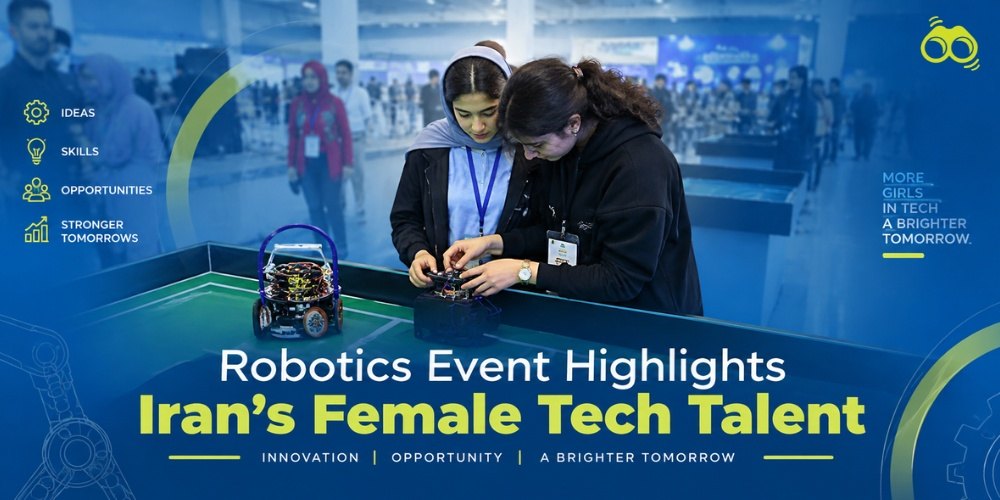
Iranian Girls Showcase Robotics Ambitions at Tehran Competition
RoboCup IranOpen brings together young programmers and engineers as students build autonomous football-playing robots
A robotics competition in Tehran has highlighted the growing interest among Iranian girls in engineering, coding and emerging technologies, with teenage participants competing alongside boys in an autonomous robot football event. The RoboCup IranOpen, now in its 20th edition, brought together around 2,000 participants across 400 teams, according to organisers.
The competition was held at Tehran's Grand Mosalla, a religious complex where halls normally used for prayer were transformed into arenas for technology demonstrations. Participants included children as young as 10, with several teenage girls taking leading roles in designing, programming and operating the robots.
Young Girls Take the Lead in Robotics
Among the participants was 15-year-old Elina Rezvanian, who has already developed an interest in pursuing robotics at university and competing internationally. Rezvanian and four female classmates spent two years designing the robots they brought to the competition. Their work required coding as well as an understanding of the hardware and components needed to make the machines operate independently.
During the matches, the girls gathered around a table-sized football field as their four-wheel robots competed to control a small ball. The matches were played over two 10-minute halves, with a young female referee overseeing the games and helping resolve technical disputes.
For Rezvanian, the competition represents a step towards her longer-term ambitions in technology. She told AFP that she hopes to study robotics at university and participate in international competitions.
How the Autonomous Robots Work
The football-playing machines do not rely on remote controls or direct human intervention once the matches begin. Instead, their movements are determined by programmed instructions and onboard components.
Farhan Daemi, a 24-year-old referee and longtime robotics enthusiast, explained that some robots use sensors to identify infrared light emitted by the ball. More advanced machines use cameras and image-processing algorithms to locate the ball and respond to its position. This combination of hardware and software allows the robots to make decisions and move around the playing field autonomously.
Robotics as Part of Iran's Technology Push
The competition takes place against a challenging economic backdrop for Iran, where years of international sanctions have affected development and contributed to difficulties in retaining skilled professionals.
Despite these constraints, the country continues to develop expertise in areas including robotics, artificial intelligence and drones. School and interschool competitions are among the avenues being used to introduce young people to technology and identify future talent.
Iran is estimated to train more than 200,000 engineers annually, although the country also faces significant levels of skilled migration abroad. The RoboCup event provides students with an opportunity to apply classroom knowledge to practical engineering challenges while competing with other young teams.
Girls Compete Alongside Boys
The event also created an unusual setting for girls and boys to compete directly against one another in a country where schools are not coeducational. For the female participants, the competition provides an opportunity to demonstrate technical skills in programming, engineering and robotics while working as part of student teams.
Avina Maleki, another teenage participant, expressed hope that more girls would enter robotics competitions in the future. She also said she would like to see girls perform better than boys in the field.
Recognition for Emerging Talent
The competition also offers a potential pathway for young participants to gain recognition for their technical abilities. Iran's National Elites Foundation, a government organisation that supports young talent, is one institution that aspiring engineers hope will recognise promising students.
For participants, competitions such as RoboCup offer more than a chance to win matches. They let students gain practical experience in programming, robotics, teamwork, and problem-solving while meeting peers with similar interests.
Preparing the Next Generation of Engineers
The 20th edition of Iran's annual RoboCup demonstrates how technology competitions can bring together young learners around practical applications of engineering and computer science.
The participation of girls such as Rezvanian and Maleki also highlights the ambitions of young female students interested in pursuing technology-related education and careers. As Iran continues to invest in fields such as AI, robotics and drones, competitions at the school level are providing students with opportunities to experiment with these technologies and consider their potential academic and professional futures.
Editor's Note
Student robotics competitions offer a useful window into how young people engage with emerging technologies beyond conventional classroom learning. Building an autonomous football-playing robot requires students to combine programming, electronics, problem-solving and teamwork in a single project.
The participation of Iranian girls is particularly notable because it shows how individual students are developing ambitions in fields such as robotics and engineering. Their experiences also underline the role that competitions, practical projects and peer learning can play in encouraging young people to explore technology as a future area of study.
Frequently Asked Questions
1. What is the RoboCup IranOpen?
The RoboCup IranOpen is an annual robotics competition in Iran where student teams compete in different robotics challenges, including autonomous football.
2. Where was the 2026 RoboCup IranOpen held?
The event was held at the Grand Mosalla religious complex in Tehran.
3. How many participants took part in this year's competition?
According to organisers, the 20th edition included around 2,000 participants divided into 400 teams.
4. How young were some of the participants?
Participants were as young as 10 years old.
5. How do the robots play football without remote controls?
The robots operate autonomously using programmed instructions, electronic components and sensors or cameras that allow them to identify and respond to the ball.
6. What technology do the robots use to identify the ball?
Some robots use sensors to detect infrared light from the ball, while more advanced models use cameras and image-processing algorithms.
7. Who is Elina Rezvanian?
Elina Rezvanian is a 15-year-old Iranian student who participated in the competition and hopes to study robotics at university and compete internationally.
8. How long did Rezvanian's team work on its robots?
Rezvanian and four female classmates spent two years designing their robots.
9. What areas of technology is Iran investing in?
The article identifies robotics, artificial intelligence and drones as areas receiving attention, alongside programmes aimed at developing future technical talent.

Skoobuzz

 Skoobuzz
 Skoobuzz
 Skoobuzz




0 Comments (Please Login To Continue)