








Benefits of CARE Scholarship for Canadian Applicants to Sciences Po Paris
CARE Program Canada–France Partnership Funds Graduate Climate Studies at Sciences Po PSIA
Within the Climate Adaptation, Resilience, and Empowerment (CARE) program, students are selected from Canada to pursue their studies at the Paris School of International Affairs (PSIA), Sciences Po. The acceptance of the students into either the Environmental Policy Master's program at Sciences Po PSIA or the International Energy Transitions Master's program at Sciences Po is a prerequisite for acceptance into either of the two programs. The primary objective of the Canada–France partnership of the CARE program is to enhance cross-cultural cooperation and build the next generation of leaders for global climate action.
Analysts noted the presence of three Canadian partner universities in the program: the University of Toronto, the University of Guelph, and the University of British Columbia. The CARE Scholarships provided by Sciences Po are said to help cover students' tuition and living expenses, thereby allowing Canadian students the opportunity to pursue graduate studies in environmental policy in Europe and engage in cross‑cultural climate leadership education.
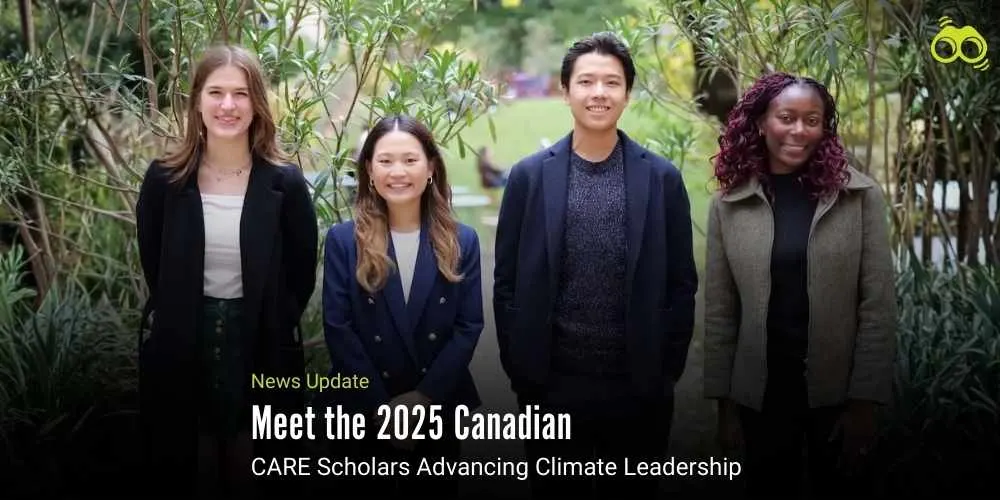
Meet the 2025 Canadian CARE Scholars at Sciences Po PSIA.
Four students were introduced as members of the 2025 cohort, namely Adenieke Lewis‑Gibb, Hannah Forsythe, Paris Liu, and Ryan Cheng, who each talked a bit about their motivation to enter the program and their early experiences at Sciences Po.
Before this, Adenieke Lewis-Gibb had worked within the intersection of science and policy; hence, she had expressed her intention to solidify her academic grasp of climate issues, directing her focus toward marine governance, natural resource management, and inclusive policy. Growing up in Toronto, her love for ecology developed with her later working in the public sector in projects that dealt with a Circular economy and Natural resources. She hopes to use her skills internationally upon finishing her environmental policy master's program in Paris, France, for Canadians.
Hannah Forsythe was said to have studied International Relations at the University of British Columbia before joining Sciences Po. She grew up in the Alps and witnessed the effects of climate change on mountain regions, which inspired her interest in environmental protection. She explained that she valued the international environment at PSIA and the practical skills taught by experts. She hoped to translate her passion for mountain protection into policymaking after graduation.
Paris Liu was reported to have graduated with a civil engineering degree from McMaster University. She shared her travails in connecting engineering, climate change, and policy, mainly to design resilient solutions for housing and infrastructure. She also remembers that her interest in environmental stewardship was fuelled during childhood visits to Qingdao, China. While appreciating learning by engagement with industry practitioners and diverse content at Sciences Po, she hopes to develop technical knowledge to enter climate policy with a keen interest in climate financing for infrastructure.
Ryan Cheng was said to be pursuing dual degrees in the International Energy Transitions Master's at Sciences Po and the Master of International Affairs at Columbia University. He had worked as a management consultant at the Boston Consulting Group, advising energy and mining clients. His undergraduate studies were at the Ivey Business School in Canada. Sustainability remains his passion, stemming from experiences in Canada and Australia. He valued the international perspective at Sciences Po and wished to work on energy, infrastructure, and economic development, especially in emerging economies.
Benefits of CARE Scholarship for Canadian Applicants to Sciences Po
Commentators cited that the CARE Program at Sciences Po for environmental policy and energy transition masters is funding Canadian students, with tuition and living costs covered. The scholarship is seen as an investment in climate policy education under the CARE Program while serving to strengthen the Canada–France exchange.
CARE Scholarship Sciences Po Paris for Canadians is considered a unique opportunity for those interested in sustainability and biodiversity graduate scholarships, international energy transition master's degrees in Europe, and graduate environmental policy master's in Paris, France for Canadians.
The overview of the CARE Program at Sciences Po and partner Canadian universities shows how the initiative is building a bridge between Canada and France. By supporting Canadian students in environmental masters in France, the programme is helping to create future leaders in climate adaptation, resilience, and empowerment.
To sum up, the details about the 2025 Canadian CARE Scholars cohort at Sciences Po underline the role of private funding and international collaboration in shaping global climate leadership.
Editor’s Note:
The CARE Scholarship Sciences Po has become a key pathway through which Canadian students pursue advanced studies in climate and energy. Under the Canada-France CARE Program partnership, selected students are admitted to either the Sciences Po PSIA Environmental Policy Master's or the Master's in International Energy Transitions. Thus, the initiative provides not only for tuition and living costs but also for the establishment of academic ties between Canada and France, ensuring that young scholars acquire the tools to address the pressing challenges of their time. The cohort of 2025 begins with Adenieke Lewis-Gibb, Hannah Forsythe, Paris Liu, and Ryan Cheng, who come from diverse academic and professional backgrounds. Each of those students has exhibited a tremendous commitment to environmental sustainability in varying fields that include policy, engineering, or the energy transition. Their stories exemplify how Canadian students are utilising the CARE Scholarship Sciences Po Paris to bridge their value systems with academic acumen, while, at the same time, profiting from the international milieu and practical training that PSIA affords. With an interest in the scholarship serving more than financial support, the programme is considered to be one avenue for educating cross-cultural climate leaders. It links Canadian universities to Sciences Po to promote collaboration, innovation, and the exchange of ideas. It also reflects the increasing importance of graduate studies in environmental policy for Canadians in Europe, thus opening avenues for engagement in global debates on sustainability, biodiversity, and energy transitions.
Skoobuzz underlines that the CARE Scholarship is transforming many Canadian students into future leaders in climate adaptation and resilience. By sponsoring their education and promoting international collaboration, the programme ensures that these scholars will be pivotal in fashioning sustainable solutions, both within Canada and globally.
FAQs
1. What is the CARE Scholarship at Sciences Po?
The CARE Scholarship at Sciences Po is part of the Climate Adaptation, Resilience, and Empowerment programme. It funds Canadian students to study at the Paris School of International Affairs (PSIA), supporting graduate education in climate and energy fields while promoting collaboration between Canada and France.
2. Who can apply to the CARE Program at Sciences Po?
Only Canadian students admitted to either the Master's in Environmental Policy or the Master's in International Energy Transitions at Sciences Po PSIA are eligible. Applicants must also be enrolled at one of the partner universities: the University of Toronto, the University of Guelph, or the University of British Columbia.
3. How to apply for a CARE Scholarship for Canadian students 2025–26?
Students must first apply and gain admission to one of the eligible master's programmes at Sciences Po PSIA. Once admitted, they can submit their application for the CARE Scholarship, usually through their home university in Canada, which coordinates with the CARE programme.
4. Does the CARE Scholarship include living costs and travel to Paris?
Yes. The scholarship covers tuition fees and also provides support for living costs in Paris. In some cases, it may also contribute towards travel expenses, ensuring that Canadian students can fully take part in their studies abroad.
5. Which master's programmes at Sciences Po are eligible under the CARE Program?
The CARE programme applies to two specific degrees at Sciences Po PSIA:
- The Master's in Environmental Policy
- The Master's in International Energy Transitions

Skoobuzz


 Skoobuzz


0 Comments (Please Login To Continue)