








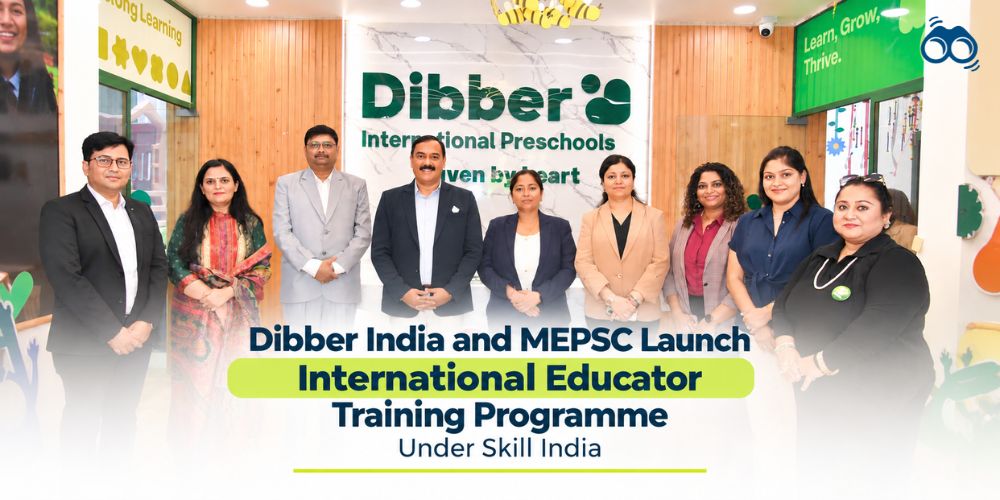
Dibber India and MEPSC Partner Under Skill India to Launch International Educator Training Programme
New programme aims to strengthen early childhood education through structured skilling and practical internships
India’s approach to early childhood education is undergoing a shift, with greater emphasis being placed on play-based learning, exploration, meaningful experiences and developmentally appropriate teaching. As these approaches become increasingly important, the preparation of educators is also emerging as a key part of strengthening the country’s early years education ecosystem.
Against this backdrop, Dibber India and the Management & Entrepreneurship and Professional Skills Council (MEPSC) have formalised a partnership to launch the Dibber International Educator Training Program (DIETP) under the Government of India’s Skill India mission.
The programme brings together Dibber’s experience in early childhood education with MEPSC’s role in India’s structured skill development ecosystem. It is designed to prepare educators with a combination of academic knowledge, practical classroom experience, professional skills and exposure to international approaches to early years education.
The partnership was formalised in the presence of Dibber Group founders Hans Jacob Sundby and Randi Lauvland Sundby, Chief Pedagogy and Quality Officer Trude Moen Sydtangen, Dibber country leadership and representatives from MEPSC, including Lagnajit Mohanty, CEO of Dibber India, and Col. Anil Kumar Pokhriyal (Retd.), CEO of MEPSC.
Programme Connects International Early Years Expertise With Skill Development
The newly launched programme is intended to respond to the growing need for professionally prepared educators in preschool and daycare settings. Rather than focusing only on theoretical knowledge of child development, DIETP combines structured learning with practical application, allowing participants to gain experience in translating educational principles into classroom environments.
The programme draws on more than 40 years of Dibber’s experience in early childhood education. Selected sessions will be led by members of Dibber’s global team, giving participants exposure to international perspectives on early years education. These sessions will be complemented by workshops conducted by industry experts and practical classroom experience.
The structure is intended to create a stronger connection between what educators learn during training and what they are expected to apply when working with young children. Participants will develop knowledge and competencies related to preschool and daycare environments while also gaining exposure to professional expectations within the sector.
Practical Training and Internships Form a Core Component
One of the central features of DIETP is its focus on combining theoretical education with structured practical internships. Participants will have access to real classroom environments, allowing them to observe and participate in practical aspects of early childhood education. This experience is intended to help aspiring educators develop confidence in applying classroom strategies, managing interactions and responding to the needs of young learners.
The emphasis on practical learning also reflects the broader objective of developing educators who are classroom-ready rather than relying exclusively on qualification-based learning. For early childhood educators, this distinction can be particularly important because teaching young children involves responding to curiosity, behaviour, communication and developmental needs in real time. Practical exposure can therefore provide a setting in which participants can begin applying their learning while developing professional judgement.
AI and Future-Ready Skills Included in Training
DIETP also incorporates artificial intelligence and future-ready skills into its training model. Participants will receive practical guidance on using AI for areas such as classroom planning, documentation, communication, creative learning and the personalisation of learning pathways. The programme positions AI as a tool that educators can use to support aspects of their work rather than as a substitute for the human role at the centre of early childhood education.
The inclusion of AI reflects the changing nature of education and the increasing presence of digital tools in administrative and learning environments. For educators, familiarity with emerging technologies can complement traditional teaching skills while helping them manage certain classroom and planning responsibilities more efficiently. Alongside technology-related skills, the programme also includes training in classroom management, leadership and stakeholder communication, providing participants with a broader set of professional capabilities.
Certification Aligned With Skill India Standards
Another component of the programme is its industry-recognised certification. Participants can receive certification at NSQF Level 4 through MEPSC, aligned with Skill India workforce standards for preschool educators across early years settings.
The certification component is intended to provide participants with a structured recognition of the competencies developed through the programme. By connecting the training with the national skills ecosystem, the initiative seeks to strengthen the professionalisation of early childhood education as a career pathway.
The programme also includes opportunities for stipend support during training, described as an “earn-while-you-learn” component. This is intended to make participation more accessible while allowing enrolled candidates to receive financial support during their training period.
Focus on Women’s Employability and Career Development
Women’s skilling and employability form another central element of the initiative. The programme aims to create employment opportunities within early childhood education and develop the sector as a professional career pathway for women entering or returning to the workforce. By combining formal training, practical experience, certification and financial support, the initiative seeks to reduce some of the barriers that can prevent aspiring educators from entering structured employment.
The emphasis is particularly relevant to early childhood education, where professional development and formal recognition can help move the sector beyond an informal care model towards a more structured and skilled profession.
Dibber Says Educator Quality Is Central to Child Development
Hans Jacob Sundby, Founder of Dibber Group, said the quality of education is closely connected to the quality of the educators who work with children.
“By investing in our educators, we are investing in the future of every child,” Sundby said.
He added that DIETP is intended to equip educators with the knowledge, confidence and values needed to reach more children and contribute to their early development. The emphasis reflects the programme’s broader philosophy that improving early childhood education requires investment not only in curriculum and infrastructure, but also in the people responsible for creating children's earliest learning experiences.
Dibber India Highlights the Need for Future-Ready Educators
Lagnajit Mohanty, CEO of Dibber India, described the agreement with MEPSC as an important development for strengthening the professional capabilities of the early childhood workforce. According to Mohanty, the programme brings together AI capabilities, leadership skills, hands-on internships and stipend support to help aspiring educators develop into confident professionals.
He said the initiative is intended to contribute to building a cadre of educators capable of delivering high-quality learning experiences while responding to changing requirements within the education sector.
The combination of international early childhood expertise and India’s national skilling framework is also intended to give participants exposure to both global perspectives and structured professional development.
MEPSC Stresses Continuous Professional Development
Col. Anil Kumar Pokhriyal, CEO of MEPSC, highlighted the importance of the early years in a child’s cognitive, emotional, social and physical development. He noted that the quality of early childhood education depends not only on infrastructure but also on the competence, professionalism and continuous development of educators.
Pokhriyal said the collaboration would reinforce the importance of new-age skills among preschool educators and contribute to the professional development of the early childhood workforce.
The partnership therefore places educator development at the centre of efforts to strengthen early childhood education, recognising that curriculum and infrastructure need to be supported by educators who have the skills and professional preparation to implement them effectively.
International and Indian Education Leaders Attend Launch
The launch brought together representatives from Dibber’s international leadership and India operations, reflecting the global and domestic dimensions of the initiative. Among those present were Dibber Group founders Hans Jacob Sundby and Randi Lauvland Sundby, Trude Moen Sydtangen, Chief Pedagogy and Quality Officer; Adam Därnemyr, Country Head of Dibber Norway; Johannes Stiigh from Sweden; and Anu-Elina Hintsa from Finland.
From India, the event included Lagnajit Mohanty, CEO of Dibber India, and Deepa Pillai, Head of Academics, Dibber India, along with Col. Anil Kumar Pokhriyal (Retd.), CEO of MEPSC, and Santosh Kumar Saha, AVP, MEPSC.
The participation of leadership from different Dibber markets underscores the programme’s international orientation while its partnership with MEPSC connects the initiative to India’s national skills development framework.
Dibber Brings Nordic Early Childhood Education Experience
Founded in Norway by educators Hans Jacob Sundby and Randi Sundby, Dibber is an early childhood education provider operating across Scandinavia, Europe, the Middle East and Asia. The organisation serves more than 40,000 children, according to the information provided by the organisation, and its educational approach is rooted in Nordic values and early learning frameworks.
Dibber’s stated mission is to help children feel valued while providing learning experiences based on evidence and child development principles. Its collaboration with MEPSC brings this international experience into a structured educator-training programme designed for the Indian context.
MEPSC Supports Skill Development Across India
The Management & Entrepreneurship and Professional Skills Council (MEPSC) is an industry-led, non-profit sector skill council operating under the Ministry of Skill Development and Entrepreneurship (MSDE) and the National Skill Development Corporation (NSDC).
MEPSC works to standardise competencies, support skills development and promote sustainable employment across sectors. It is also an Awarding Body recognised by the National Council for Vocational Education and Training (NCVET), India's skills regulator. Through the partnership with Dibber, MEPSC is bringing its skills-development framework into the early childhood education space, with DIETP combining vocational certification with practical training and international exposure.
Editor’s Note
The earliest years of a child’s education are often discussed through the lens of curriculum: what should children learn, how should classrooms look and which teaching methods best support development? But beneath all of those questions is a quieter one: who is standing in the classroom, and are they equipped to understand what a young child actually needs? A beautifully designed curriculum can only go as far as the educator bringing it to life. For a child, learning is shaped not just by activities and lesson plans, but by the adult who notices their curiosity, responds to their questions, understands their behaviour and creates enough safety for them to explore.
That is what makes educator preparation such an important part of the conversation around early childhood education. The Dibber India–MEPSC partnership places practical training, professional development, technology skills and certification alongside the more traditional academic components of educator preparation. Its focus on internships and classroom experience is particularly relevant because confidence cannot always be taught theoretically; it has to be developed through observation, practice and reflection. At the same time, the inclusion of AI and future-ready skills raises an important question for the sector: how can technology make educators more capable without making early childhood education less human? The answer will ultimately depend on whether innovation remains in service of the child and the educator rather than becoming an objective in itself.
Frequently Asked Questions
1. What is the Dibber International Educator Training Program?
The Dibber International Educator Training Program (DIETP) is an educator-training initiative launched through a partnership between Dibber India and MEPSC under the Skill India ecosystem. It combines early childhood education training with practical internships, professional development and industry-oriented skills.
2. Who is the programme intended for?
The programme is designed for individuals preparing to work as preschool and daycare educators, with an emphasis on developing classroom-ready and professionally equipped early years educators.
3. Is the programme connected to Skill India?
Yes. The programme has been launched in partnership with MEPSC under the Government of India’s Skill India mission and includes NSQF Level 4 certification through MEPSC.
4. What does the training programme include?
The programme includes early childhood education, practical internships, classroom management, leadership and communication skills, AI applications, professional development and industry-oriented training.
5. Does DIETP include practical classroom experience?
Yes. Structured internships provide participants with access to real classroom environments, allowing them to connect theoretical learning with practical experience.
6. How does AI feature in the educator training?
Participants receive practical training on using AI for areas including classroom planning, documentation, communication, creative learning and personalised learning pathways.
7. Does the programme offer financial support?
The programme includes an earn-while-you-learn component, under which enrolled candidates may receive stipends during their training period.
8. What certification is associated with DIETP?
The programme provides NSQF Level 4 certification through MEPSC, aligned with Skill India workforce standards for preschool educators.
9. How does the programme support women’s employability?
Women’s skilling and employability are identified as central objectives of the initiative. The programme seeks to create structured career opportunities in early childhood education for women entering or returning to the workforce.

Skoobuzz


 Skoobuzz
 Skoobuzz



0 Comments (Please Login To Continue)