








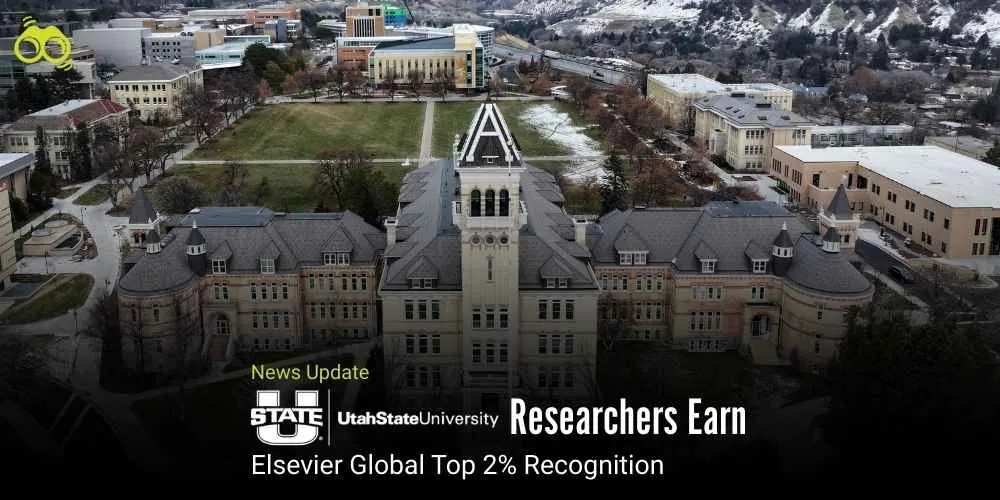
USU Strengthens Global Reputation with Eight Scholars in Top 100,000 Worldwide
Emma Eccles Jones College of Education Faculty Recognised Among World’s Leading Researchers
Elsevier Research, a major research and technology company, has ranked Utah State University highly for international research performance. This recognition follows the naming of eight faculty members from the Emma Eccles Jones College of Education and Human Services among the top two per cent of scholars worldwide in 2024. Their inclusion places them within the top 100,000 global researchers in education and human services, strengthening the college’s global standing.
The rankings were based on Elsevier’s analysis of publicly available citation data, which reflects how often a researcher’s work is cited and used by scholars worldwide. Researchers were assessed within their own disciplines and sub‑fields to ensure fair comparisons. Multiple indicators were combined to measure both individual academic output and collaborative research, underlining Utah State University’s position in global research rankings. Consequently, the Emma Eccles Jones College of Education’s global research ranking was described as a clear marker of sustained academic influence.
College leadership noted that the recognition represented the breadth of research impact across education sciences, psychology, human development, health, kinesiology, and speech and hearing sciences. The achievements were said to reflect a strong research culture and to contribute significantly to the profile of USU faculty in education and human services. Elsevier recognises scholars whose work ranks among the most influential globally or within a defined area of study, reinforcing Utah State University’s reputation.
The eight recognised scholars represent diverse yet interconnected disciplines. David F. Feldon, from instructional technology and learning sciences, was noted for his work on learning mechanisms in higher education and equitable expertise development in STEM. His mixed‑methods research and recent Routledge publication were cited as key contributions to educational measurement and methodology.
In human development and family studies, Aryn M. Dotterer was acknowledged for research into parental involvement and protective factors supporting racial and ethnic minority adolescents. Her leadership of federally funded GEAR UP programmes was reported to align academic research with access and equity goals in postsecondary education. Alan L. Smith, endowed dean and professor of kinesiology and health science, was highlighted as a leader in research on sport, physical activity, and youth psychological development. His work on peer relationships, motivation, and mental health outcomes was described as influential within health and kinesiology.
Within psychology, several scholars were recognised for global influence. Amy L. Odum’s research into behavioural processes and her leadership roles in major psychological associations were noted, alongside her Lifetime Achievement Award in 2024. Karl R. White was identified as a leading figure in early childhood hearing assessment, with decades of work shaping public health systems and international policy in speech and hearing sciences.
Michael E. Levin and Michael P. Twohig were both recognised for their extensive work on Acceptance and Commitment Therapy. Their collaborative and individual research, including numerous clinical trials, publications, and books, positioned them among the most productive and cited ACT researchers worldwide. Tyler L. Renshaw was also included for his contributions to school psychology, particularly in advancing mental health assessment and services in K–12 settings, alongside his role as editor‑in‑chief of a leading academic journal.
Collectively, the recognition confirmed that eight USU College of Education and Human Services faculty members ranked in the top two per cent of global researchers in 2024. This illustrates how Utah State University’s influential research continues to shape global academic conversations. Observers noted that the achievement also strengthened the university’s global research ranking, particularly in education sciences, human development and family studies, psychology, and allied health fields.
The announcement further highlighted broader institutional interest, as prospective students and researchers increasingly seek to explore USU researcher profiles and publications, graduate programmes at the college, and education research opportunities at Utah State University. It was suggested that such global rankings play an important role in shaping academic reputation, influencing collaboration, funding, and admissions interest. Overall, the recognition reinforces Utah State University’s position as a public research institution with growing global visibility, while demonstrating how high‑impact scholarship within the College of Education and Human Services continues to contribute to educational practice, human development, and societal well‑being in the United States and beyond.
Editor’s Note:
Utah State University has been acknowledged by Elsevier Research, an international research and technology corporation, for its global impact. Eight faculty members at the Emma Eccles Jones College of Education and Human Services have been ranked in the top two per cent of researchers in 2024. This places them among the top 100,000 researchers in their respective fields of education and human services. The ranking is based on citation data, which shows how often a researcher’s work is used by others. The fact that academics were assessed within their own disciplines is particularly significant, making this recognition a great honour. It is a clear indication of positive influence within each field. The eight academics represent diverse areas, including education sciences, psychology, human development, health sciences, kinesiology, and speech and hearing sciences. Their research interests range from learning in higher education and parental involvement to behavioural processes, hearing assessment, therapy models, and school psychology. This demonstrates the breadth and diversity of research at Utah State University.
This recognition not only enhances the university’s position on the global stage but also highlights the contributions of its faculty members to academic discourse worldwide. It signals a strong and supportive research environment. Skoobuzz notes that the success of these eight scholars reflects the growing recognition of Utah State University as a public research institution.
FAQs
1.How competitive is USU admissions?
Admissions at Utah State University are not highly competitive. The acceptance rate is usually above ninety per cent, which means that most applicants who meet the basic requirements are offered a place. Students are expected to have a solid academic record, and while test scores such as the SAT or ACT can be submitted, they are not compulsory as USU follows a test‑optional policy.
2.Is USU a good university?
Yes, USU is widely recognised as a good university. It is ranked among the leading public universities in the United States and is known for its strong research culture. The university has particular strengths in education, agriculture, engineering, psychology, and health sciences. In addition, it offers good value for money, with affordable tuition fees and strong student support services.
3.Is USU public or private?
Utah State University is a public institution. It was founded in 1888 as a land‑grant university and is part of the Utah System of Higher Education. Being public means that it receives state funding and offers lower tuition fees for Utah residents.
4.What are the most popular majors at USU?
The most popular majors at USU include economics, psychology, mechanical engineering, exercise science, elementary education, communication sciences and disorders, and business administration. These programmes attract large numbers of students because they combine academic strength with clear career pathways.
5. What is the average tuition at USU?
Tuition at USU is considered affordable compared with many other American universities. For Utah residents, the average annual tuition is around $8,500. For non‑residents, the cost is higher, at about $25,000 per year. This difference reflects the public funding model, which supports lower fees for in‑state students.
6.Does USU offer online degree programmes?
Yes, USU provides a wide range of online degree programmes. These include undergraduate and postgraduate courses, allowing students from across Utah and around the world to study flexibly. Online learning is supported by strong digital resources and teaching expertise.
7.What is student life like at USU?
Student life at USU is lively and diverse. There are more than two hundred clubs and organisations, as well as Division I athletics. Students can also take part in research projects, internships, and study abroad opportunities. The campus environment is welcoming, with a strong focus on community and wellbeing.
8.What scholarships are available at USU?
USU offers many scholarships to support students. These include merit‑based awards for academic achievement, need‑based support for those with financial challenges, and special scholarships for first‑generation students. International students may also apply for tuition waivers and departmental funding.

Skoobuzz

 Skoobuzz

 Skoobuzz

 Skoobuzz


0 Comments (Please Login To Continue)