








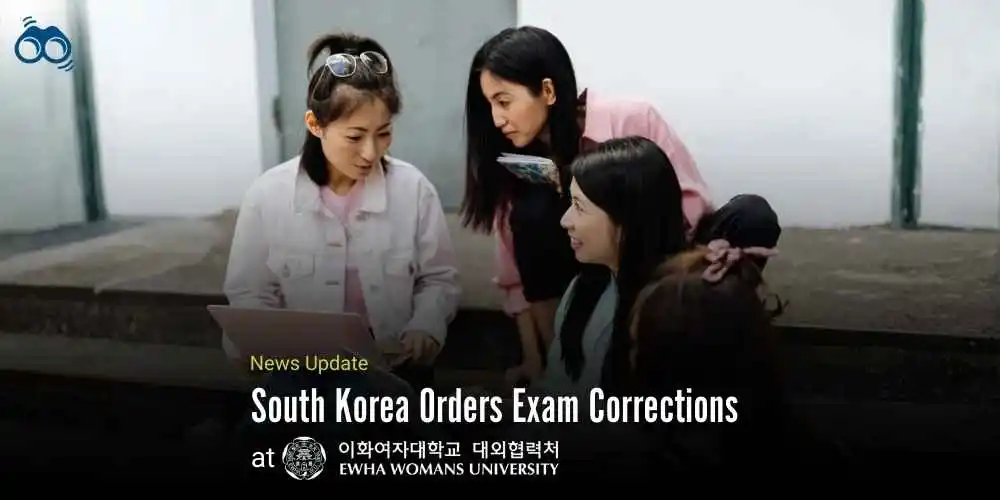
South Korea University Exam Content Correction: Ministry Warns of Recruitment Suspension Penalties
Universities Cited for College-Level Exam Content Beyond High School Curriculum in South Korea
The Ministry of Education of the Republic of Korea has mandated further corrections to the 2025 entrance examinations for several universities. This decision was prompted by the inclusion of material that was outside the standard high school curriculum. The incident has fueled discussions in Korea concerning university admissions, fair testing practices, and the appropriate standards for exam content, particularly regarding advanced learning.
Universities Cited for College-Level Exam Content
Five universities are at the centre of the latest South Korean university exam content controversy: Ewha Womans University, Daegu Catholic University, Suwon Women's University, Woosuk University, and the Korean Military Academy (Army, Navy, Air Force, and Nursing). Each was found to have exam questions that exceeded the standardisation of exam relevance to the high school curriculum.
The University noted criticism regarding the calculus essay exam for natural sciences, specifically that questions resembled those from U.S. university textbooks. This content reportedly forced students to learn advanced material beyond the high school curriculum. Similarly, the Military Academies faced curriculum conformity issues after two questions in their first-round English selection exam were deemed to be outside the approved scope.
Other cases involved a life science question at Daegu Catholic University, five English questions at Suwon Women's University, and two chemistry questions at Woosuk University. Together, these explain why South Korean universities were cited for college-level exam content in 2025.
Enforcement of Academic Standards
Under the Normalisation of Public Education Act, the Ministry of Education issues correction orders when universities break exam rules. The institutions must also provide an account of measures they would take to prevent recurrence. But if they fail to implement these measures and receive correction orders for two consecutive years, punishment is meted out in the form of recruitment suspension or a loss of portions of their admission quota. This demonstrates the great seriousness with which the Ministry of Education undertakes enforcement mechanisms of academic standards, as well as the importance of the review of university exam content in Korea.
The Ministry does not disclose the exact questions, arguing that doing so might encourage private tutoring and widen inequality. Nevertheless, an analysis of the South Korean university testing controversy highlights a tension between assuring fairness and preparing students for higher education.
Impact on Students and Policy
The impact of college-level exam content on student preparedness in Korea is significant. Students may feel pressured to study advanced material outside the curriculum, increasing reliance on private education. This undermines the principle that entrance exams should reflect the high school syllabus. With the serious charge of exceeding the high school curriculum, the cases of Ewha and the Military Academies illustrate how universities stand to disadvantage students who depend entirely on school-oriented modes of teaching. It also raises questions about the implementation of policy in higher education in Korea and whether examiners are adequately trained to avoid such errors.
Looking Ahead
This incident provides an overview of exam content compliance in Korean higher education. It demonstrates that while universities seek to assess abilities, they must do so within the boundaries of the high school curriculum. The Ministry's resolve to enforce compliance more stringently has been made known, and Ewha has announced improvements to verification processes from admissions for 2026 onward. For policy-makers, educators, and students, it serves as a reminder that the issue of pitting college-level exams against high school curricula in Korea is a real issue, and fairness in its conduct protects students and upholds the trust via this system.
Editor’s Note:
The South Korean Ministry of Education's claim was so strong that it ordered exam content correction among five institutions. What matters is the fact that all university entrance exams are expected to reflect curricula from high schools. Questions that go beyond that level, especially, place a certain group of students who rely solely on school teaching at an unreasonable disadvantage, not to mention giving those with access to pay the added benefits of private tutoring. Fair testing should be and is dependent on having defined boundaries and enforcement of those lines consistently. The cases of Ewha Womans University and the Military Academies show just how easily exams can stray into the territory of college-level material. One calculus question lifted from the many sources of higher education, or some English questions exceeding the approved scope, can seem minor. However, the message it sends is that students must prepare beyond the syllabus or else risk losing out. This pressure sells in the private education market and greatly adds to inequalities, which the ministry rightly resists. The corrective orders of the ministry concern universities, as they may lead to the suspension of hiring. Tighten quality management, prepare examiners well, and assess the validity of questions in relation to the curriculum. It is preferable not to disclose the offending items to avoid coaching. But it would boost trust if such wrongs were described and how they would be fixed. The move on the part of Ewha that is said to strengthen pre-education and verification for 2026 is, indeed, a good step, and others should follow.
The clear balance going forward: test higher-order thinking without exceeding the high school syllabus. There is no reason universities can't construct fair, reasoning-in-testing questions that don't deal with extra content. Skoobuzz mentions that clear guidance, routine auditing and shared best practice will raise standards and keep students protected. Fairness in admissions, after all, is not optional-it is the cornerstone of public confidence.
FAQs
1. Which is the hardest exam in South Korea?
The College Scholastic Ability Test (CSAT), known locally as Suneung, is widely regarded as the hardest exam in South Korea. It is the national university entrance test, lasting almost nine hours, and covers subjects such as Korean, mathematics, English, social studies, and sciences. The exam is so important that flights are grounded during the English listening section to avoid noise, and workplaces adjust schedules to support students.
2. Can I get a 100% scholarship in South Korea?
Yes, international students can apply for full scholarships in South Korea. The most well‑known is the Global Korea Scholarship (GKS), which covers tuition fees, living expenses, airfare, and medical insurance. Many universities, including Seoul National University and Korea University, also offer merit‑based or need‑based scholarships that can cover 100% of tuition.
3. Is Korea University difficult?
Korea University, one of the country’s top institutions, is considered academically demanding. Admission is highly competitive, with strong emphasis on CSAT scores and school records. Once admitted, students face rigorous coursework, especially in fields such as law, business, and engineering. The university is part of the “SKY” group (Seoul National, Korea, Yonsei), which represents the most prestigious and challenging universities in South Korea.
4. How are university exam standards enforced in South Korea?
University exam standards are enforced by the Ministry of Education under the Normalisation of Public Education Act. If a university includes questions beyond the high school curriculum in its entrance exams, the ministry issues correction orders. Institutions must then show how they will prevent recurrence. If they fail for two consecutive years, they face penalties such as suspension of student recruitment or reduction of admission quotas.
5. What was the controversy over Ewha Womans University's exam content?
The Ewha Womans University exam policy controversy arose in 2025 when one calculus question in its natural sciences essay exam was found to resemble material from a U.S. university textbook. The Ministry of Education ruled that the question exceeded the high school curriculum, potentially forcing students into advanced study. Ewha later announced stricter verification processes for its 2026 admissions to avoid similar issues.

Skoobuzz
 Skoobuzz

 Skoobuzz



0 Comments (Please Login To Continue)