








Exeter Graduate’s FluoroGlow Tool Could Transform Drinking Water Safety
University‑Driven Innovation Tackles Waterborne Parasites in UK Communities
Access to clean water is a basic necessity, yet a contaminated water supply creates diseases and suffering for millions of people worldwide. The UK is also facing similar challenges, as water pollution has become a fast-emerging issue there, harming microorganisms so much that they threaten communities. From relatively mild stomach upsets to severe-life-threatening infections from waterborne diseases make rapid and reliable testing is very relevant.
The water contamination detection technology designed by a University of Exeter graduate has gained recognition at the national level. It showcases the trajectory of UK universities championing innovations in environmental health through various rigorous master's programs with a commitment to community benefit. An aspect of this innovation, fastly detecting pathogens such as Cryptosporidium from drinking water, underscores the contribution of environmental health research towards antimicrobial measures, assuring clean water supplies.
FluoroGlow Device
At only 21 years old, Kathryn Thomas is a graduate in Medical Science who has developed the FluoroGlow water safety device. The instrument was meant to detect Cryptosporidium in drinking water, a parasite that could cause serious illness, particularly among children and other vulnerable groups. Ordinary practice required slow confirmation in a laboratory; the idea behind this portable prototype of a water contamination detector is to relay quick results in the field at the water source.
Currently only in prototype, the device has attracted media attention nationwide. She did some more of her studies in microbiology, then worked in an engineering company, gaining the technical know-how and confidence to bring the project further. Of major interest motivating her was the widespread Cryptosporidium outbreak in Brixham, Devon, when residents were advised to boil water or use bottled water.
Award Recognition
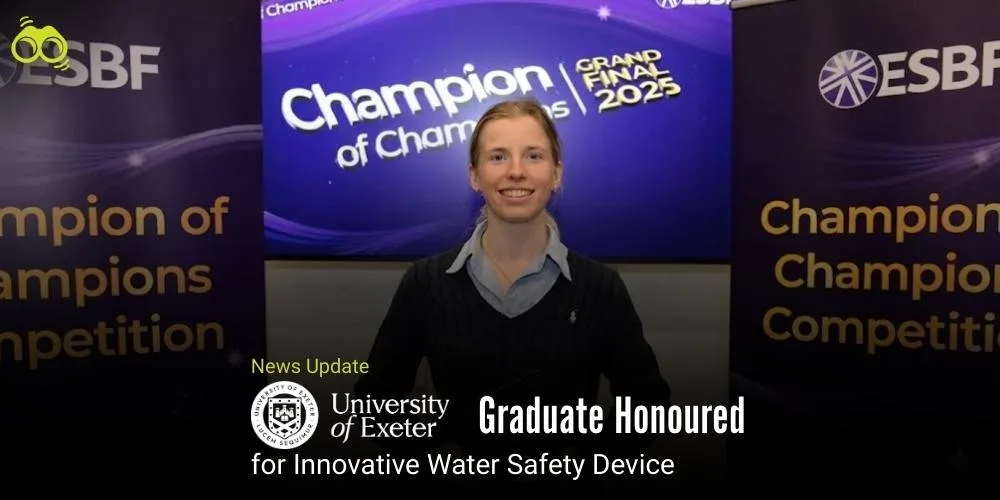
Kathryn's invention received the Exeter University Graduate Award in the finals of the ESBF Champions of Champions event, where she was also named a runner-up in the national innovation award for water safety. There were nine teams nationally competing for the award from 50 UK universities.
She indicated that the award gave credence to the pursuit of her idea, and the competition inspired others and allowed her to get feedback and come closer to realising the vision of FluoroGlow as a life-saving product.
Support and Mentoring
The winners of the competition will receive mentoring from business leaders from the Sainsbury Management Fellows network, CV support packages and funding for entrepreneurial activities. The event, hosted by Rob Bell, a TV presenter and engineer, marked the culmination of a year of enterprise competitions in UK universities.
According to Amber Strong, ELEVATE ESBF Competition Lead at Exeter, Kathryn's success illustrates the creative and entrepreneurial spirit fostered by the university. Besides, she mentioned this award solidified Exeter's position in water safety research in UK universities by 2025 and its support for students developing award-winning water safety innovations in UK universities.
Public Health Impact
Presented here is an overview of the FluoroGlow device and its health benefits. In this context, innovation in water testing can lead to better health for the community. By timely detection, outbreaks could be stopped, families saved, and confidence instilled in the community concerning drinking water.
According to experts, new water contamination detection innovation carries profound ramifications for public health. In reducing the risk posed by waterborne parasites, faster and easier-to-use testing ultimately furthers the protection of public health. This United Kingdom clean water safety device Exeter project demonstrates how a University of Exeter graduate invented a water contamination detection device that could transform water safety. The FluoroGlow tool to detect Cryptosporidium in UK water supply is not yet commercially available, but further testing is planned.
The innovation shows the importance investors play in testing innovations in water quality for encouraging organisations to partner with Exeter for water safety solutions, as well as to support both university-based water security and public health projects.
Editor’s Note:
The story of FluoroGlow, created by University of Exeter graduate Kathryn Thomas, deserves careful reflection because it touches on one of the most pressing public health issues: water contamination. Unsafe drinking water continues to cause outbreaks of disease, even in developed countries, and parasites such as Cryptosporidium are notoriously difficult to detect quickly. Traditional laboratory tests are slow, meaning communities often only learn about contamination after illness has already spread. Conventional laboratory tests only answer an existing question slowly, and as a result, many communities learn about the contamination only after the illness has struck. With rapid water quality testing technology provisioned at the source, FluoroGlow allows authorities to respond to outbreaks before they worsen. This is no mere technical advancement but rather a public health assurance. The faster the detection, the less the number of families exposed, the number of ill children, and the greater the confidence in the safety of what we often take for granted, like our tap water. Equally essential is the nurturing of such ideas by universities. Kathryn's journey shows how higher education provides the knowledge base, mentoring, and enterprise programs that empower young graduates to convert classroom learning into real-world solutions. The backing of the University of Exeter through both Elevate and the ESBF competition demonstrates how institutions can spur innovation while developing the confidence of students to take on global challenges. FluoroGlow is still at the prototype stage, yet gaining the UK national innovation award for excellence in water safety recognises it as being both credible and feasible. Combining scientific knowledge with entrepreneurial spirit shows the power of FluoroGlow and emphasises how the universities are shaping tomorrow's problem-solvers.
If further developed, Skoobuzz highlights that the device could become a key mechanism for public health protection against waterborne parasites, showing how ideas born in universities can build momentum for the benefit of the wider community.
FAQs
1. What are the innovations in water treatment technologies?
Recent innovations in water treatment include membrane filtration, UV disinfection, nanotechnology, and advanced oxidation processes. These methods improve the removal of harmful microorganisms, heavy metals, and chemical pollutants. Portable devices and smart sensors are also emerging, allowing faster and more reliable testing of water quality at the source.
2. How can water contamination be solved?
Water contamination can be reduced through a mix of preventive and treatment measures. Preventive steps include protecting water sources from industrial waste, agricultural runoff, and sewage. Treatment solutions involve filtration, chlorination, UV light, and rapid pathogen detection devices. Community awareness and strong regulation also play a key role in keeping drinking water safe.
3. What are the innovations in water conservation?
Innovations in water conservation include smart irrigation systems, rainwater harvesting, greywater recycling, and leak‑detection sensors. These technologies help reduce wastage, reuse water safely, and manage supplies more efficiently. Universities and research centres are also developing low‑cost conservation tools that communities can adopt to save water in everyday life.
4. Can technology help to clean up polluted water?
Yes, technology is central to cleaning polluted water. Modern solutions include bioremediation using microbes, nanomaterials that absorb toxins, and portable purification devices. Large‑scale innovations such as desalination plants and advanced wastewater treatment systems are already in use. At the community level, rapid water quality testing technology helps detect contamination early, making clean‑up faster and more effective.

Skoobuzz



 Skoobuzz

 Skoobuzz


0 Comments (Please Login To Continue)