








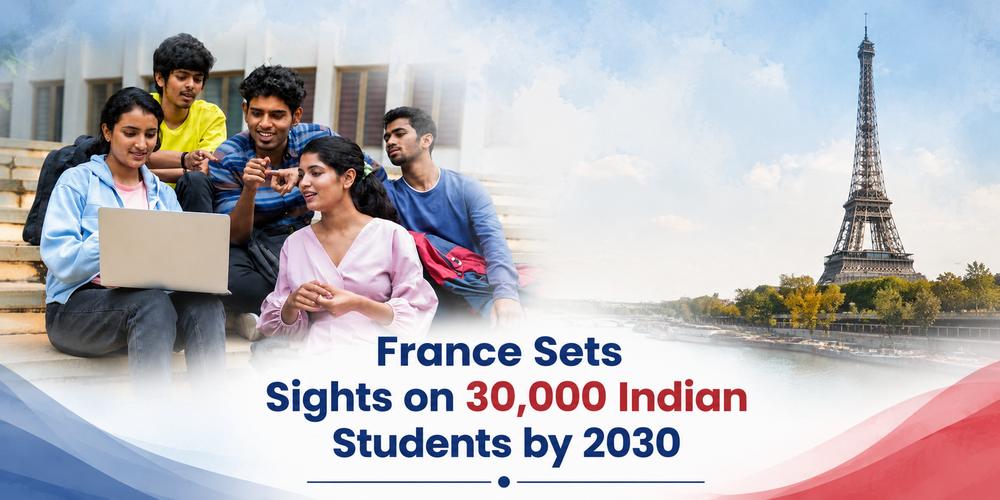
France Targets 30,000 Indian Students by 2030
France Eyes Major Growth in Indian Student Enrolments
France has set an ambitious target of welcoming 30,000 Indian students by 2030, signalling its intent to strengthen its position in India’s rapidly evolving overseas education market. The target comes as international student mobility from India has moderated from recent highs and students increasingly consider destinations beyond traditional choices such as the US, UK, Canada and Australia.
France believes it can attract a larger share of Indian students by combining comparatively affordable higher education with career opportunities and stronger cooperation with India in areas including artificial intelligence (AI), technology and innovation.
According to Campus France, the French government agency responsible for promoting higher education and supporting international students, around 9,100 Indian students enrolled in French higher education during the 2024–25 academic year. India has also moved from 13th to 11th among the countries sending students to France. Including exchange students and those enrolled in short-term programmes, the number of Indian students in France was estimated at approximately 12,000 in 2025.
Education Becomes Central to France-India Partnership
France’s student recruitment ambitions are closely linked to the broader strategic relationship between France and India. During Prime Minister Narendra Modi’s visit to France in June 2026, the two countries signed 19 agreements covering areas such as innovation, AI and technology. They also launched the India-France Innovation Roadmap 2030 and established a joint India-France AI Working Group.
Student mobility and higher education are increasingly becoming part of this wider bilateral agenda. For France, attracting Indian students is therefore not simply an education strategy but also a way to strengthen long-term academic, technological and economic connections.
French Universities Expand Their Reach in India
France is increasing its visibility among Indian students through initiatives such as the Choose France Tour, scheduled for October. More than 50 French universities and higher education institutions are expected to participate. The institutions include engineering schools such as CentraleSupélec, Mines Paris-PSL and IMT Atlantique; business schools including ESSEC, ESCP and EDHEC; and public universities such as Université Paris-Saclay and Université Grenoble Alpes.
France is also broadening its recruitment pitch beyond conventional engineering and science programmes. The Desibel initiative, launched by the French Embassy and the French Institute in India, focuses on creative and emerging sectors including animation, gaming, visual effects, comics and immersive technology. By promoting these fields, France is seeking to appeal to a broader pool of Indian talent while creating links between students, French institutions, industry professionals and international creative networks.
Why France Could Appeal to Indian Students
France’s strategy comes at a time when Indian students are reassessing the advantages and challenges associated with traditional study destinations. Tighter visa policies, higher tuition costs and changes to post-study work arrangements in several major English-speaking destinations have encouraged students to explore alternative countries. France offers one important advantage: tuition fees at many public universities are comparatively lower than those charged by institutions in other major destinations.
However, affordability alone may not be enough to persuade students. Professor NV Varghese, visiting professor at IIT Bombay and founder-director of the Centre for Policy Research in Higher Education, noted that students are primarily concerned with what happens after graduation. Access to employment and meaningful post-study opportunities can be more influential than visa availability alone.
This presents both an opportunity and a challenge for France. While the country can offer relatively affordable education, students may still compare its employment prospects with those of established destinations.
Language and Employment Remain Key Challenges
The French language remains one of the most significant considerations for Indian students. Although universities are expanding their English-taught offerings, French remains important for everyday life and employment. France currently offers more than 1,600 programmes taught in English, allowing international students to pursue degrees without initially studying entirely in French.
Universities also provide opportunities for students to learn French alongside their academic programmes. Still, language skills can influence employability, particularly for graduates seeking to remain in France after completing their studies. Varghese also pointed to another challenge: French degrees may not yet have the same perceived value among Indian students as qualifications from more established study destinations.
Graduate employment is another concern. France’s own labour-market conditions could affect international students’ willingness to choose the country, particularly if they view access to jobs as uncertain.
Post-Study Work Options Strengthen France’s Appeal
Career opportunities could nevertheless become a major selling point for France. Indian students who complete a master’s degree in France can apply for a two-year post-study work permit, providing additional time to search for employment after graduation.
Special visa arrangements for alumni also facilitate travel across Europe, potentially giving graduates access to opportunities beyond France’s domestic labour market. This broader European dimension could strengthen France’s proposition for Indian students who want international career exposure rather than limiting their plans to a single country. However, France will need to demonstrate that these opportunities translate into real employment prospects if it wants to substantially increase Indian enrolments.
Can France Reach 30,000 Indian Students?
Moving from approximately 12,000 Indian students across all study categories in 2025 to 30,000 by 2030 represents a significant expansion. The goal is therefore likely to depend on more than promotional campaigns.
France may need to increase scholarships, make admissions easier to navigate, strengthen English-medium programmes and improve communication around employment pathways. Greater awareness among Indian students and education counsellors will also be essential.
The country will also have to compete against destinations with decades of experience attracting Indian students and significant English-language advantages. At the same time, France has an opportunity created by the diversification of international student mobility. As students become more cost-conscious and evaluate destinations according to career outcomes, a country offering affordable education, European mobility and post-study pathways could become increasingly attractive.
India at the Centre of the Global Talent Competition
France’s ambition reflects a much larger global competition for international students and skilled talent. Varghese described this competition as a “battle for brains”, highlighting how countries increasingly depend on international talent to support technological development and economic growth.
The US has historically benefited from attracting scientific and technological talent from around the world. Changes to immigration policies and growing competition could create openings for countries such as France to attract a larger share of that talent. India is particularly important in this competition because of the scale of its higher education system, which serves around 45 million students.
Even a small proportion of this population represents millions of potential students and future skilled professionals. For France and other countries seeking international talent, India will therefore remain one of the world's most strategically important student markets.
Editor’s Note
France’s target of attracting 30,000 Indian students by 2030 is ambitious, but it arrives at a strategically important moment. The global study-abroad landscape is changing. Indian students are no longer evaluating destinations solely on institutional reputation or the possibility of obtaining a visa. Affordability, employability, post-study work rights, language accessibility and long-term career prospects are increasingly interconnected factors in destination choice.
France has several advantages that could work in its favour. Its public universities can offer comparatively affordable education, its institutions are expanding English-taught programmes, and its location provides students with access to the wider European employment and mobility landscape. Yet the 30,000 target should not be viewed simply as a recruitment challenge. France must convince students that studying there can lead to a viable professional future.
The language barrier, perceptions around the value of French qualifications and employment conditions could limit growth if they are not addressed alongside recruitment efforts. Promotional tours can increase awareness, but sustainable growth will ultimately depend on the student experience and outcomes after graduation.
The deeper significance of France’s strategy lies in its connection with the wider India-France partnership. With cooperation expanding across AI, innovation and technology, Indian students could increasingly become part of a broader talent pipeline linking education with research, industry and economic development.
If France can successfully connect affordable education with credible career pathways, its 30,000-student ambition may become more than a recruitment target. It could mark a meaningful shift in the geography of Indian international education.
Frequently Asked Questions
1. How many Indian students currently study in France?
Around 9,100 Indian students enrolled in French higher education during the 2024–25 academic year. Including exchange and short-term students, the total was estimated at about 12,000 in 2025.
2. What is France’s target for Indian students?
France aims to attract 30,000 Indian students by 2030.
3. Why is France trying to attract more Indian students?
France wants to strengthen its international education sector while deepening its broader partnership with India in areas such as AI, technology, innovation and research.
4. Is education in France affordable for Indian students?
Many French public universities have comparatively lower tuition fees than universities in several traditional study destinations, although costs vary by institution, programme and student status.
5. Can Indian students work in France after graduation?
Indian students who complete a master’s degree in France can apply for a two-year post-study work permit, subject to applicable rules and eligibility requirements.
6. Are English-taught programmes available in France?
Yes. France has more than 1,600 programmes taught in English, although learning French can be beneficial for daily life and employment.
7. Which French universities are seeking Indian students?
Institutions participating in France’s recruitment efforts include CentraleSupélec, Mines Paris-PSL, IMT Atlantique, ESSEC, ESCP, EDHEC, Université Paris-Saclay and Université Grenoble Alpes.
8. Could France become a bigger study-abroad destination for Indian students?
France has the potential to increase its appeal, particularly through affordable education, European mobility and post-study opportunities. However, reaching 30,000 Indian students by 2030 will depend heavily on employment outcomes, language accessibility, scholarships and student awareness.

Skoobuzz


 Skoobuzz
 Skoobuzz

 Skoobuzz


0 Comments (Please Login To Continue)