








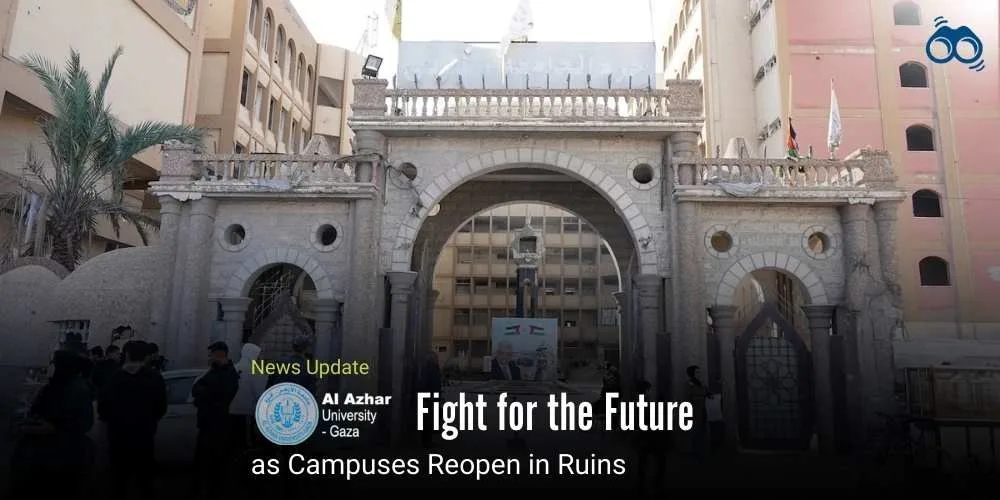
Students Show Remarkable Resilience as Higher Education Slowly Rebuilds
Al-Azhar University Leads Return to Campus as Education Restarts in Gaza
It has become a story of resilience, describing the reopening of Gaza universities after two years of devastation caused by war 2025. Higher education in Gaza collapsed almost entirely, with the finding of the Palestinian Ministry of Education: more than 100 university buildings destroyed and hundreds of staff killed. Yet the reopening of institutions such as Al-Azhar University Gaza and resumption of classes at the Islamic University of Gaza signal that education remains central to rebuilding society.
Campus reopening is also about restoring lessons; rather, it's securing the future of thousands of youngsters. Analysts have called it such a commencement of post-war recovery of higher education in Gaza, where damaged structures are being rebuilt and hastily improvised classrooms keeping learning alive. The aim is clear: the Gaza war's impact on universities should not be able to erase an entire generation's chance at education, and tell the world that Gaza's students are determined that they will continue with their studies under the most remarkable challenges.
Rebuilding Institutions
Before the war, there were a total of 17 higher-educational institutions in Gaza. Most of them, such as Al-Azhar's new campus in Al Zahra with its five colleges, were left in ruins. According to Dr. Muhammad Shubeir, Vice President of Al-Azhar, their necessity and duty require opening up. He said that the staff continued teaching during this period of the war even from dangerous areas through satellite internet. As soon as conditions permitted, the university turned to restore in-person learning despite losses with an estimated total of above $40 million.
Shubeir put emphasis on the fact that Al-Azhar was an academic institution rather than a participant in a conflict. He also reminded all parties that targeting education violates international law. Besides, the message of the university to the world still remains the same: the people of Gaza want life, peace, and dignity.
Students Return to Their Campus
Students described the reopening as both inspiring and overwhelming. Pharmacy student Mira Al-Agha explained that her motivation came from believing education was the only sustainable path forward. She said that all staff were working insistently, step by step, even with inadequate containment. Major obstacles were called transportation expenses and unavailability of study spaces.
Dentistry student Abdul Rahman Amer admitted to having disillusioned his hopes by seeing the destruction. But his flames were rekindled with temporary structures. He explained that dental materials are expensive and hard to find, yet insisted he would not give up, as finishing his studies was the only way forward.Again, and in a more broader context regarding the Gaza student returning to campus for Syria in 2025, education is seen not only as knowing but as survival and resilience.
Wider Context
Also part of the reopening of the post-conflict Palestine universities is the Islamic University of Gaza classes that resume. Analysts described the resumption of higher education in Gaza Strip as a reminder that rebuilding Gaza must begin with securing the future of students.Nothing showed the monumental destruction and willingness to rebuild more than this. The reopening of the Gaza University was a story in itself regarding Al-Azhar Islamic University Gaza continuing to survive.
The overall view of the extent of damage to the higher-education infrastructure of Gaza confirmed the loss in its scale; however, the timeline and related challenges of recovery of Gaza universities also portrayed determination. International observers suggested that the world should support rebuilding Gaza universities, donate to Gaza higher-education reconstruction fund, and follow Gaza university reopening updates.
In simple terms, these details of Gaza universities reopening 2025 proved that, even amid ruins, education remained the foundation of hope and recovery in the Middle East Gaza education news December 2025.
Editor’s Note:
It is a deeply inspiring story of courage and hope. After two years of armed conflict, Gaza's universities began to reopen by rehabilitating damaged buildings, setting up temporary classrooms and laboratories, and online connection where possible. Many times, faculty and students returned to classes before full repairs were completed, teaching and learning in makeshift places while reconstruction continued. To begin with, the re-establishment of the universities is a testimony to their determination. They repaired where they could, set up emergency teaching equipment, then brought in satellite teaching and online teaching where appropriate, all the while relying on local and international help. Also, staff have worked through hardships and conditions while students have returned despite shortages and increased costs. Similarly, this reopening sends a clear message to others: education is a foundation for healing. Where schools and universities first return, communities first begin to heal. The Gaza case tells governments, donors, and universities everywhere that protecting and reconstructing education must be a priority after conflict. Students will help one another out, and, forthwith, be flexible and ingenious to fulfil exercises on their parts helpfully, many of them will attend lessons in temporary classrooms, there will be sharing of materials, and blended learning will come in when internet access permits. Universities should give all-inclusive mental health support, flexible ways to study, as well as tackling their courses through practical training that allows them to keep learning toward rebuilding their futures.
To be sure, however, while this renewal is hopeful by itself, the scale of destruction clearly calls for long-term assistance.The better the support the international community and local authorities render to rebuilding, the better prospects for learning, working, and rebuilding the society in store for Gaza's youth. Skoobuzz underlines that reopening Gaza universities is a lesson in resilience and a call to protect education in times of crises.
FAQs
1. Which is the best university in Gaza?
There is no single official ranking, but Al-Azhar University – Gaza and the Islamic University of Gaza (IUG) are generally regarded as the leading universities. Both are well known for strong teaching, research, and professional programmes in fields such as medicine, engineering, and science.
2. Which Gaza university reopened first after the war?
Reports suggest that Al-Azhar University – Gaza was among the first to reopen, with staff returning quickly and setting up temporary classrooms so that students could resume learning as soon as conditions allowed.
3. Does Gaza have good education?
Yes. Despite difficult conditions, Gaza has a long tradition of valuing education. Its universities have produced doctors, engineers, teachers, and researchers. However, repeated conflicts, restrictions on movement, and damage to facilities have made it harder for students and staff to maintain normal academic standards.
4. What was the damage to Gaza’s universities from the war?
The destruction was extremely severe. More than 100 university buildings were damaged or destroyed, large amounts of equipment were lost, and hundreds of academic and administrative staff were reported killed. Many campuses were left in ruins, and the cost of rebuilding is estimated to be tens of millions of dollars.
5. Has there ever been a university in Gaza?
Yes. Gaza has had universities for decades. The Islamic University of Gaza was founded in 1978, and Al-Azhar University – Gaza was established in 1991. Since then, several more higher-education institutions have been created, supporting thousands of students every year.

Skoobuzz



 Skoobuzz

 Skoobuzz


0 Comments (Please Login To Continue)