








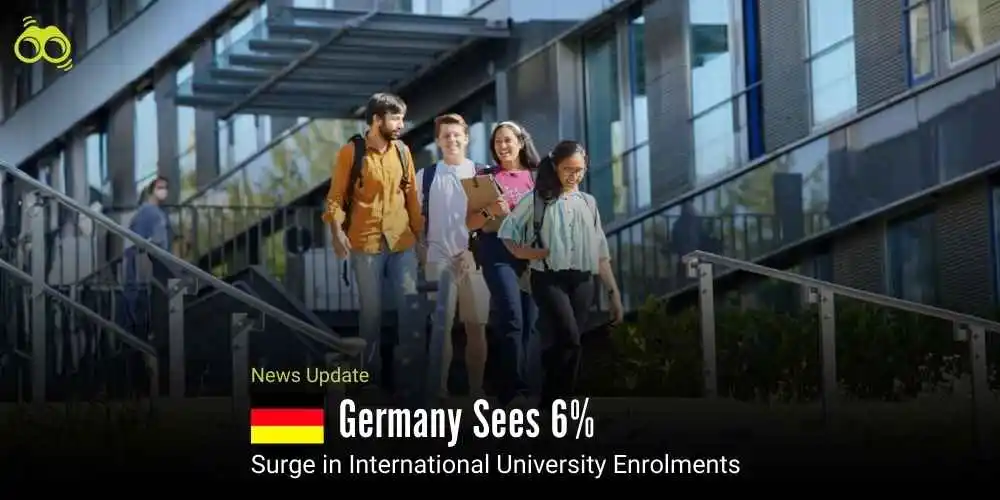
DAAD Wissenschaft Weltoffen 2025 Report Highlights Asia‑Pacific’s Impact on German Universities
India Remains Largest Source Market for Germany International Students in 2025
Germany has confirmed its position among the world's major study destinations; international student enrollments in 2025 reached over 402,000. Though slightly below DAAD's forecast of 405,000 for the winter semester 2024/25, the rise is almost a 6% increase in international enrollments to Germany, propelled by a record intake of 116,600 undergraduate students. The DAAD Wissenschaft Weltoffen 2025 international student statistics show that the largest source region is Asia-Pacific, with 33% of new enrollments. Then came North Africa and the Middle East, representing 19%, while Western Europe accounted for 15%. The experts informed that political developments, intensified promotion by DAAD, and skill-focused programs aided in the surge of international students into German universities.
India has once again emerged as the largest source market for Germany's international students, with just under 59,000 enrolled, a 20% upsurge from last year. China remained the second-largest contributor, with roughly 38,600 students, although that was a 7% drop from preceding years. Stakeholders noted that the impact of Asia-Pacific enrollments has been quite substantial in bolstering the growth of international students in Germany.
Visa Processes and Academic Verification
In 2022, Germany set up the APS (Akademische Prüfstelle) certificate procedure for verifying academic credentials in India. Even though slow at the beginning, the German Embassy later announced that due to augmented staffing and optimised procedures, most applications were processed in a matter of days. Officials further warned against undue reliance on private agents by Indian students as visa rejection rates hovered around 25%. Records revealed that by August 2025, APS had cleared more than 110,000 applications. Observers opined that simplifications, improved visa processes, and policy changes have increased Germany's appeal to all international students considering study abroad in Germany.
Academic Opportunities and Programmes
The Wissenschaft Weltoffen report on DAAD international enrolments has suggested that universities in Germany offer almost 2,400 English-language programs, including 420 bachelor's and 1,930 master's degrees. Most international students in Germany study engineering (43%) or economics, law, and social sciences (25%). The dropout rates among international students were slightly higher than German students but lower than previous estimates, with bachelor rates being 16% and master rates 9%.
University leaders asserted that lowered dropout rates were a positive sign, as it is vital to Germany's competitiveness that academic success and entry into professional life happen. With Germany's international student statistics 2025 revealing strong growth, the institutions are also putting emphasis on career centres, entrepreneurship, and language support for students entering the labour market.
Challenges and Housing Issues
Nonetheless, despite favourable enrolment figures, challenges persist. Research cautioned that Germany could find itself short of 768,000 skilled workers by 2028, while only one-third of international students felt that they had been adequately prepared for starting a career in Germany. German learning was still emphasised by experts as an important criterion for long-term employment. International students have been affected by housing shortages. A study came out that Germany was missing over 700,000 apartments, and increasing rents in university towns were biting hard on self-financed students. Stakeholders clarified that accommodation continued to be a major issue, with councils unable to meet demand.
The rising number of international students in Germany are evidence that the country continues to draw talent from across the globe. Asia-Pacific and Indian markets have played a central role in this growth, propelled by Germany's record first-year intake, which saw international student growth at almost 6% in the winter semester 2024/25. The DAAD Germany international education report states that the universities are now strengthening partnerships, increasing English-language programmes, and supporting career development.
While the issues of housing and labour market integration remain, the analysis of first-year enrolments driving growth in Germany shows that the country's higher education system is becoming more internationalised, diverse, and competitive. The ability of Germany to combine academic opportunity with responsible policy will remain a key determinant in solidifying its status as a global student mobility front-runner.
Editor’s Note:
The latest statistics about international student enrolments reflected that the German landscape continues to attract young global talent. With more than 402,000 international students and doctoral candidates moving to Germany in 2025, it is showcased that German universities are becoming prime non-English speaking destinations for higher education. The historic uptake of first-year students reaching 116,600 has, once again, reinforced the growing attractiveness of the German educational system. These data, at the same time, indicated some interesting facts, as India again emerged as the largest source market with almost 59,000 students; in contrast, China's enrollment ratio showed a decline. Asia-Pacific now captures the largest share of new students, signalling the changing patterns of global mobility. Factors considered here are DAAD's active promotion, skills-based programs, and the free-tuition reputation of the country for English-taught courses. However, challenges remain, as students still face visa processes, a lack of career support and housing facilities. In spite of this, declining dropout rates and expansion of English-taught programmes, many students feel unprepared for integration into the German labour market. Language is also creating challenges, and to smooth the process, universities are trying to provide language support alongside the academic training. The growth in Germany's international student population presents a mix of opportunities and responsibilities. While German universities are gaining diversity and internationality, they must also ensure they provide adequate support to these students.
Skoobuzz believes that this support will be vital for Germany's future as a centre for science, innovation, and sustained growth, enabling international students to contribute to addressing forthcoming demographic shifts and skilled-worker shortages.
FAQs
1.How many international students are in Germany in 2025?
Germany enrolled around 402,000 international students in the winter semester 2024/25, according to DAAD’s Wissenschaft Weltoffen 2025 report. This marks a 6% rise compared to the previous year, with a record 116,600 first‑year enrolments.
2.When should I apply for the summer intake in Germany in 2025?
For the summer intake in Germany 2025, applications usually open in September/October 2024 and close by January 2025. Classes begin in March or April. The summer intake offers fewer courses than the winter intake, especially at master’s level, but it allows students to start earlier.
3.What is the new law in Germany in 2025?
In 2025, Germany introduced a new military service law. It created a dual system: voluntary service with better benefits, and the option of needs‑based conscription if recruitment falls short. All 18‑year‑olds must now complete a questionnaire and health screening, while participation remains voluntary for women.
4.Which university in Germany has a 100% acceptance rate?
IU International University of Applied Sciences in Germany is known for having a 100% acceptance rate for qualified international students. Other universities, such as the University of Cologne and the University of Stuttgart, also have high acceptance rates (around 70%).
5.Which intake is best for Germany?
The winter intake (October start) is generally considered the best. It offers the largest number of courses, especially at bachelor’s and master’s levels, and has more places available. The summer intake (March/April start) is smaller, with fewer programmes, but it can be useful for students who want to begin sooner.

Skoobuzz

 Skoobuzz

 Skoobuzz
 Skoobuzz
 Skoobuzz


0 Comments (Please Login To Continue)