








UK Universities Join Forces on Scalable Long‑Duration Energy Storage Systems
Manchester EPSRC Critical Mass Programme Grant Funds Pioneering Energy Transition Innovation
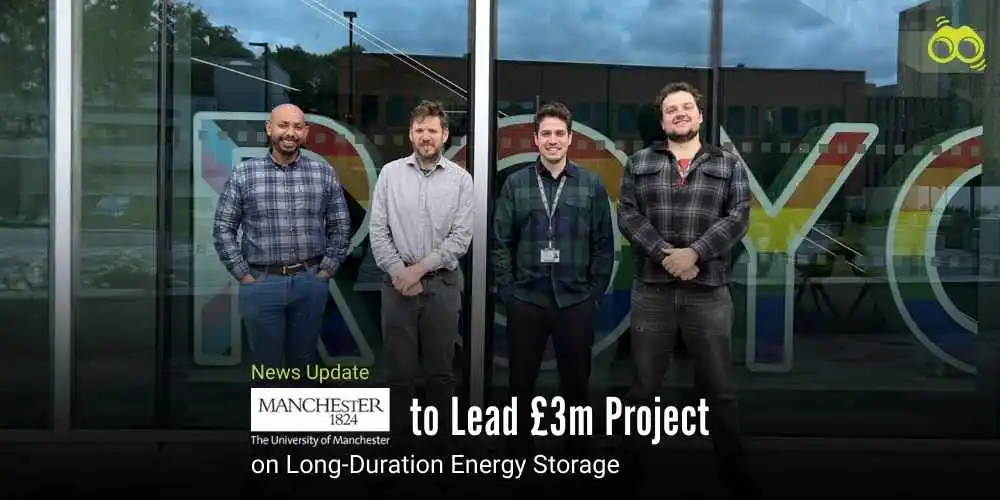
The UK has taken a significant step forward in renewable energy innovation with a major £3 million project, which the University of Manchester will utilise. This project, GPStore long-duration energy storage technology, has been awarded funding via the EPSRC Critical Mass Programme Grant. Under the leadership of Professor Yasser Mahmoudi Larimi, the project is a collaboration of leading universities, such as Birmingham, Liverpool, Cranfield, and Imperial College London, along with industry partners.
The collaboration will work toward a pioneering energy storage system that would store excess renewable electricity for anything from hours to weeks to months. By addressing the issues of cost, scalability, and sustainability, GPStore is set to play an important role in strengthening the UK energy grid and aiding the country on its journey toward net zero. University leaders stated this is an important step towards the establishment of UK renewable energy storage research collaboration; they mentioned GPStore was to address cost, scalability, and sustainability barriers and be integral to the University of Manchester's energy transition innovation project.
How GPStore Technology Works
The new system operates quite differently from the current short- and medium-duration storage technologies. Specialists explained that GPStore technology captures surplus renewable electricity and stores it in aboveground insulated tanks for long-term use as high-temperature heat, using solid particles. When energy is demanded, the stored thermal energy transforms back into electricity.
The method is expected to ease demand management not only day by day but also across seasons and will directly assist the grid in making up for summer into winter. Observers noted that the influence of long-duration storage on renewable grid stability and net-zero transition in the UK could be huge since the country would need around 100 terawatt hours of storage by 2050.
Collaboration Across UK Universities and Industry
Bringing together 13 academics across 5 universities alongside 16 industry and policy partners – such as EDF Energy, UK Power Networks, Fraser-Nash Consultancy and Manchester City Council – was explained to stakeholders. The University of Manchester and the UK universities consortium on scalable energy storage systems will boost the UK’s capacity in clean energy innovation.
The wider long-duration energy storage initiative in the UK now adopts this approach. It is to provide solutions that integrate renewable power in a scalable manner. The consortium aims to overcome the limitations of pumped hydro, compressed air, and flow batteries that are often viewed as facing challenges in terms of geographical and cost issues by targeting thermal energy storage solutions, as well as aboveground insulated particle heat storage technology.
Editor’s Note:
The £3 million GPStore energy storage project at Manchester illustrates how UK universities and industry partners come together to deliver scalable clean power storage. The project is funded by the EPSRC Energy Transition Project UK, which clearly demonstrates the benefits of long-duration storage for renewable energy grids. These benefits offer resilience and affordability. Leading this Manchester renewable energy storage innovation will make a contribution to the UK's net-zero ambitions through the University of Manchester, further improving the research landscape for scalable energy solutions. The project demonstrates very clearly the difference between short- and long-duration energy storage and shows how thermal particle storage will be integrated into energy systems, emphasising the importance of collaboration in tackling global energy challenges This project brings together leading universities and industry partners, proving that, working together, collaboration can bring about innovation in renewable energy. Unlike current short-term storage options, GPStore really opens a door to the future for the storage of surplus electricity over hours, weeks, or even months. By transforming renewable power into high-temperature heat and storing it in solid particles, converting it back to electricity when needed, this technology will make the power grid more stable and resilient. It is addressing precisely the three major barriers – cost, scale, and sustainability- to a diversified energy supply. This collaborative project illustrates the strength of UK research partnerships. With Manchester working closely with Birmingham, Liverpool, Cranfield, Imperial College London and major industry players, the consortium designs solutions to break through existing technology limitations. Long-duration storage has been observed to be very crucial for Britain’s target of achieving a total storage capacity of about 100 terawatt hours by 2050.
GPStore is beyond research, but GPStore is empirical in the sense that this development is leading to reliable, secure, and clean energy. Skoobuzz underlines that the combination of empirical academic knowledge with industrial partnership development enables the University of Manchester and its partners to influence the course of energy transition in the UK while also ensuring that the UK's global footing in innovation is strengthened.
FAQs
1.What is the long-duration energy storage scheme?
A long‑duration energy storage scheme is a project or system designed to store surplus renewable electricity for extended periods. Unlike short‑term batteries, it can hold energy for hours, days, or even months, making it available when demand is high or when renewable generation is low.
2.How long is long‑duration energy storage?
Long‑duration energy storage usually refers to technologies that can store electricity for more than 4–6 hours. In advanced systems, energy can be stored for weeks or even across seasons, helping to balance supply and demand in the power grid.
3.What is the best long‑term energy storage?
There is no single “best” option, as different technologies suit different needs. Pumped hydro and compressed air are proven methods, but they face geographical limits. Newer solutions, such as thermal particle storage and flow batteries, are seen as promising because they are more scalable and sustainable.
4.What is a long‑term energy storage system?
A long‑term energy storage system is an infrastructure that captures excess renewable electricity and keeps it for later use. It may store energy as heat, compressed air, or chemical reactions, before converting it back into electricity when required. These systems are vital for ensuring grid stability and supporting renewable integration.
5.What is long‑duration energy storage in the UK?
In the UK, long‑duration energy storage refers to national projects and research aimed at supporting the transition to net zero. The country is expected to need up to 100 terawatt‑hours of such storage by 2050. Current initiatives, such as the University of Manchester’s GPStore project, are exploring scalable solutions to make renewable energy reliable and affordable.

Skoobuzz


 Skoobuzz

 Skoobuzz



0 Comments (Please Login To Continue)