








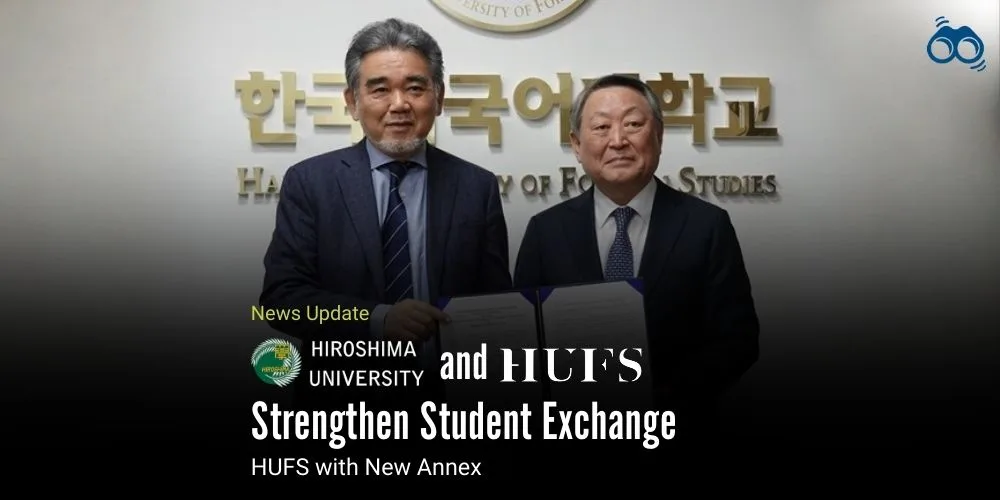
How Hiroshima University and HUFS Expanded Student Exchange in 2025
HU–HUFS Student Exchange Partnership Grows Under CAMPUS Asia Plus Programme
On 21st November 2025, delegates from Hiroshima University visited Hankuk University of Foreign Studies in Seoul, Korea, for the signing of an annexe to the current exchange agreement between Hiroshima University and Hankuk University. It was said this step aimed to further broaden the HU–HUFS student exchange partnership more systematically and actively.
This collaboration began in 2021 with the selection of HU for the Inter‑University Exchange Project under the CAMPUS Asia Plus Programme of the Ministry of Education, leading to more than 20 student exchanges involving summer schools and other study-abroad programmes. Commentators reviewed the way in which Hiroshima University and Hankuk University of Foreign Studies had expanded their previously established cooperation to increase student exchange further in 2025, as the most recent framework within which Japanese–Korean university cooperation took place.
HUFS leaders welcomed the HU delegation on their visit and presented the university’s achievements as an international institution. They described how HUFS teaches over 45 languages, providing strong language education and area studies in a multicultural environment across all of its global campuses. Officials also pointed out initiatives such as welcoming 2,000 international students a year, reforms in AI, and interdisciplinary education. Analysts highlighted which language and area study programmes HUFS offers under the HU partnership, showing the role HUFS plays in global student mobility.
Meanwhile, HU presented its efforts towards internationalisation. The delegation introduced the manga Taking a Tour with Hiroko‑san Through Hiroshima University, published in Korean, English, Chinese, Indonesian, and Vietnamese. This was said to be part of HU’s strategy to share its history and research achievements with the wider world. HU also explained its research clusters in semiconductors, digital manufacturing, regenerative medicine, and genome editing. Additionally, HU introduced the University Presidents for Peace Conference, which brings leaders from across the globe to Hiroshima to discuss peace and the role of universities.
Commentators stressed what the annexe of the HU–HUFS agreement means for Japan–Korea higher education collaboration. Cooperation in the educational and research sectors is anticipated to grow significantly under the new framework. This annexe aims to further the scope of international student exchange between Japan and Korea, building avenues for cultural and academic exchanges between the two countries.
The international exchange agreement with HUFS made in 2025 marks the emergence of a new stage in Japan–Korea student mobility. It represents a larger role that the CAMPUS Asia Plus Programme for Japan–Korea universities plays in promoting Asia–Europe university mobility programmes and demonstrates the benefits of studying abroad under formal exchange agreements. Students can begin applying to Hiroshima University student exchange programmes in 2026 through the HUFS–HU exchange, and in addition to area studies, explore other opportunities at HUFS through the HU exchange, which will continue to benefit future generations.
Editor’s Note:
The signing of the exchange agreement between Hiroshima University and Hankuk University marks a significant academic step towards strengthening relations between Japan and Korea. By signing this annexe, the two universities have signalled their intent to build a structured and active partnership to support students and staff in gaining international exposure. Under the CAMPUS Asia Plus Programme, the two institutions have already sent more than 20 students on exchange since 2021. The new stage further complements their engagement under the HU–HUFS student exchange partnership, offering broader study‑abroad and cultural learning opportunities. This agreement also aligns with the broader mission of universities to promote peace and share knowledge globally. By educating and researching culture, Hiroshima University and HUFS will strengthen Japan–Korea university collaboration and build a model showing how higher education can support internationalisation.
Skoobuzz highlights that the annexe signed in 2025 demonstrates the value of exchange agreements. It guarantees that future generations of students will benefit from Hiroshima University’s global student mobility while also reinforcing the role of universities in building bridges across nations.
FAQs
1. Which universities have signed new exchange agreements in 2025?
Reports stated that Hiroshima University (HU) in Japan and Hankuk University of Foreign Studies (HUFS) in Korea signed an annexe in November 2025. This agreement was described as a way to strengthen their existing partnership and expand student exchange more actively.
2. What does the annexe between Hiroshima University and HUFS allow for students?
Observers explained that the annexe would make student exchange more systematic. It allows students from both universities to take part in study‑abroad programmes, summer schools, and cultural exchanges under a formal framework.
3. How many international students visit HUFS through Japan–Korea exchange programmes?
HUFS representatives mentioned that the university hosts around 2,000 international students every year. This includes participants from Japan–Korea exchange programmes such as the partnership with Hiroshima University.
4. What benefits do students get from the HU–HUFS exchange agreement?
Commentators noted that students benefit by gaining access to language and area study programmes at HUFS, while HU students can also join academic and cultural activities in Korea. The exchange helps students build international experience, improve language skills, and understand different cultures.
5. Is Hiroshima University expanding its global exchange network in 2025?
Analysts confirmed that Hiroshima University is indeed expanding its global exchange network. The university introduced initiatives such as multilingual manga to promote its history, research clusters in advanced fields, and the University Presidents for Peace Conference. These efforts were said to strengthen HU’s role in global student mobility and international cooperation.

Skoobuzz
 Skoobuzz

 Skoobuzz


0 Comments (Please Login To Continue)