








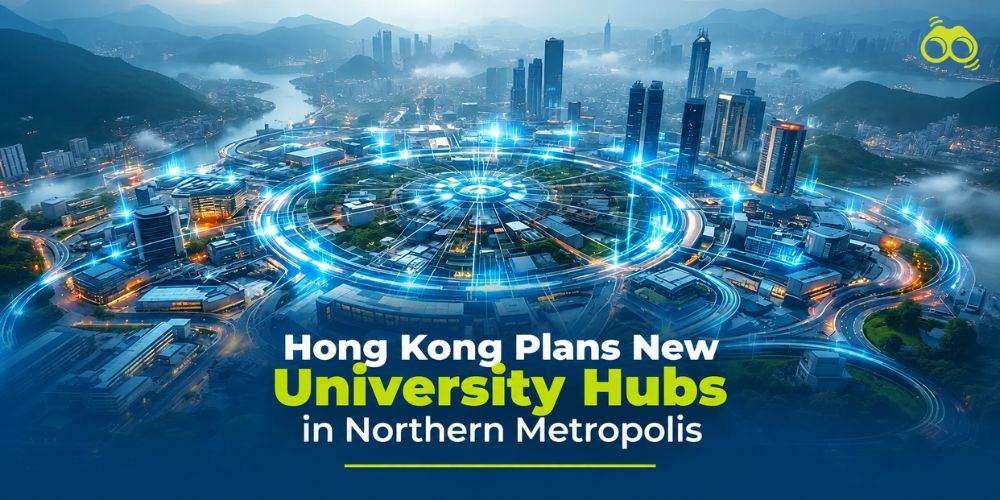
Hong Kong’s Northern Metropolis to Expand University Capacity and Drive Innovation
Major development area will create new space for universities, research facilities and industry partnerships
Hong Kong is planning to use the Northern Metropolis, a major development zone in the northern part of the city, to expand higher education capacity and strengthen connections between universities, international partners and industry. The initiative forms part of wider efforts to position the area as a new economic and innovation hub while creating additional space for the city’s universities.
The development comes as Hong Kong seeks to increase its international higher education capacity and strengthen the contribution of universities to economic growth. Plans for the Northern Metropolis include new university campuses, research facilities and partnerships with private-sector organisations, linking higher education more closely with innovation, technology and emerging industries.
Northern Metropolis Becomes Part of Hong Kong’s Five-Year Development Plan
The development of university infrastructure in the Northern Metropolis has been incorporated into Hong Kong’s first Five-Year Plan for Economic and Social Development, covering the period from 2026 to 2030. The plan outlines the creation of university towns alongside innovation, technology, industrial and residential infrastructure.
Hong Kong Chief Executive John Lee described the plan as an “action agenda” intended to help the city respond to national and international opportunities. It sets out priorities for Hong Kong’s economic and social development over the next five years, including efforts to strengthen innovation and develop high-quality talent.
The Northern Metropolis is expected to play a central role in these ambitions, with universities being encouraged to use the new space not simply to increase campus capacity but also to develop stronger links with research institutions, businesses and international partners.
Universities to Collaborate With Industry and International Partners
James Tang, secretary general of Hong Kong’s University Grants Committee, said the development would provide universities with additional space while creating opportunities for collaboration with partners in Hong Kong, mainland China and overseas.
According to Tang, the vision is to establish joint programmes, collaborative projects and research facilities involving universities and external partners. The proposed model would move beyond simply expanding existing campuses by creating environments where academic institutions can interact more closely with different stakeholders.
The approach is also intended to connect university research with the private sector, potentially allowing research activities, innovation projects and industry needs to interact more directly. This could create new opportunities for universities to contribute to emerging technologies and for companies to engage with academic expertise and research infrastructure.
Three University Towns Planned for Northern Metropolis
The Five-Year Plan identifies three proposed university towns in San Tin, Hung Shui Kiu and Ta Kwu Ling, each expected to have a different academic and development focus. San Tin University Town is planned as a centre for areas including medicine, life and health technology, artificial intelligence, robotics, microelectronics and other emerging industries. Its focus is intended to connect higher education and research with sectors considered important to Hong Kong’s future innovation economy.
Hung Shui Kiu is expected to focus on smart manufacturing and the development of international talent, while Ta Kwu Ling will incorporate arts alongside blue-green development. Together, the three university towns are intended to contribute to a broader ecosystem combining education, technology, industry, talent development and urban planning.
The plans reflect an effort to create academic environments that are integrated into wider economic and urban development rather than operating as standalone university campuses.
Northern Metropolis to Strengthen Greater Bay Area Connections
The Northern Metropolis also has an important geographical advantage because of its location near the mainland China border. The area is close to Shenzhen and is connected to the wider Greater Bay Area through seven land-based boundary control points.
This positioning could support increased cross-border cooperation in areas such as research, innovation and technology. Universities located within the Northern Metropolis could potentially develop closer connections with institutions, businesses and research organisations across the border, strengthening Hong Kong’s participation in the wider regional innovation ecosystem.
The development is therefore being positioned not only as a domestic expansion of university infrastructure but also as a platform for deeper regional and international engagement.
Hong Kong Targets International Talent and Education Growth
The wider Northern Metropolis is eventually expected to accommodate approximately 2.5 million residents and provide around 650,000 jobs. Its development is part of a broader strategy to strengthen Hong Kong as an international centre for innovation and technology while attracting high-calibre talent.
The Five-Year Plan also emphasises closer integration between education, technology and talent development, alongside efforts to strengthen the “Study in Hong Kong” brand. The goal is to reinforce Hong Kong’s position as a destination for international students and researchers while expanding opportunities for collaboration between local institutions and global partners.
The push comes as international students already account for around one-quarter of university enrolments in Hong Kong. Policymakers seek to build on this international profile by expanding capacity, attracting more overseas students, and deepening partnerships with institutions and organisations worldwide.
Northern Metropolis Could Reshape Hong Kong’s Higher Education Landscape
The planned university towns represent a significant expansion of the physical and strategic space available to Hong Kong’s higher education sector. By combining universities with research infrastructure, technology companies, industry partners and residential development, the Northern Metropolis is intended to create an integrated environment for education and innovation.
For Hong Kong’s universities, the development could provide opportunities to establish new programmes, research facilities and international partnerships while strengthening links with industry. The initiative also places higher education within the city’s broader plans for economic development, technology advancement and international talent attraction.
As the 2026–2030 Five-Year Plan progresses, the Northern Metropolis is expected to become an increasingly important part of Hong Kong’s strategy to expand its education capacity and strengthen its role as an international hub for higher education, innovation and talent.
Editor’s Note
Hong Kong’s plans for the Northern Metropolis highlight how higher education is increasingly being incorporated into wider urban and economic development strategies. Rather than focusing solely on increasing university space, the proposed university towns aim to bring together academic institutions, research, technology, industry and international partners within a connected ecosystem.
The initiative could also have implications for Hong Kong’s international education strategy. With overseas students already representing a significant share of university enrolments, additional capacity and stronger global partnerships could support the city’s efforts to attract international students and researchers while connecting them to the wider innovation economy.
Frequently Asked Questions
1. What is Hong Kong’s Northern Metropolis?
The Northern Metropolis is a major development area in northern Hong Kong being planned as a new economic, technology and innovation hub.
2. How will the Northern Metropolis support universities?
The development is expected to provide additional space for university campuses, research facilities, joint programmes and industry partnerships.
3. How many university towns are planned?
Three university towns are planned in San Tin, Hung Shui Kiu and Ta Kwu Ling.
4. What will San Tin University Town focus on?
San Tin is expected to focus on medicine, life and health technology, AI, robotics, microelectronics and emerging industries.
5. What is planned for Hung Shui Kiu?
Hung Shui Kiu is expected to focus on smart manufacturing and international talent.
6. What is planned for Ta Kwu Ling?
Ta Kwu Ling is planned to incorporate arts and blue-green development.
7. How many people could eventually live in the Northern Metropolis?
The wider development is expected to accommodate approximately 2.5 million residents and provide around 650,000 jobs.
8. Why is the location important for international education?
The Northern Metropolis is close to Shenzhen and the Greater Bay Area, providing opportunities for greater cross-border cooperation in education, research, innovation and technology.
9. How does the development relate to Hong Kong’s international education strategy?
This initiative supports expanding higher education capacity, strengthening the “Study in Hong Kong” brand, and attracting more international students and high-calibre talent.

Skoobuzz

 Skoobuzz
 Skoobuzz



0 Comments (Please Login To Continue)