








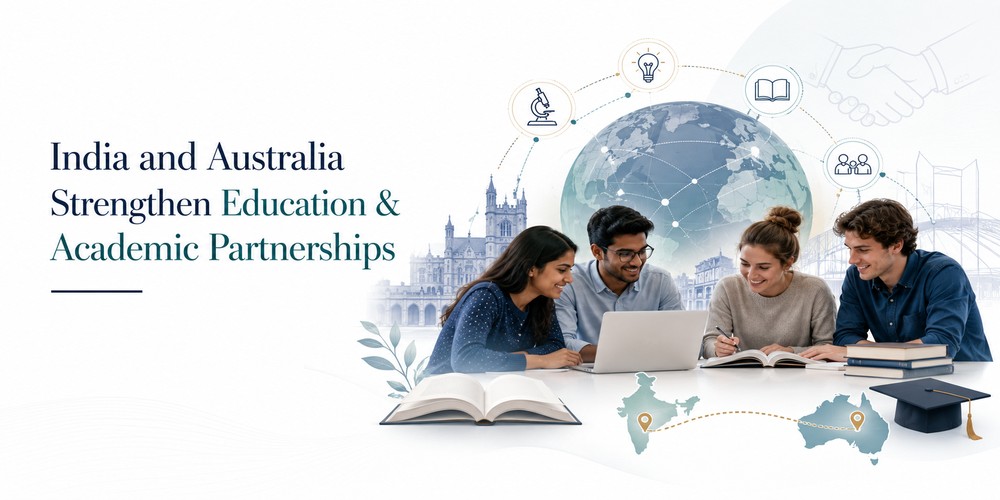
India and Australia Explore New Opportunities in Higher Education and Skills Development
The discussions aimed to deepen education ties and expand academic collaboration.
India and Australia have reaffirmed their commitment to strengthening educational collaboration, with senior leaders discussing new opportunities to expand academic partnerships, skills development and student engagement between the two countries.
The discussions took place during a meeting between India's High Commissioner to Australia, Nagesh Singh, and Australia's Minister for Education, Jason Clare, with a focus on education as a key pillar of the growing India–Australia Comprehensive Strategic Partnership.
Education at the Centre of Bilateral Relations
During the meeting, both sides exchanged views on strengthening cooperation across higher education, academic partnerships and skills development.
The dialogue also focused on enhancing people-to-people connections by encouraging greater collaboration between educational institutions and expanding opportunities for students and researchers.
According to the High Commission of India in Australia, education remains a central pillar in advancing bilateral relations between the two nations.
A Broader Strategic Partnership
The education discussions form part of a series of high-level engagements aimed at strengthening cooperation across multiple sectors.
In recent meetings, High Commissioner Nagesh Singh also met:
- Ted O'Brien, Australia's Shadow Minister for Foreign Affairs, to discuss expanding bilateral cooperation across shared strategic priorities.
- Chris Bowen, Australia's Minister for Climate Change and Energy, to explore collaboration in clean energy, renewable technologies and sustainable development.
- Milton Dick, Speaker of the Australian House of Representatives, to strengthen parliamentary exchanges and democratic cooperation.
These engagements reflect the broadening scope of the India–Australia Comprehensive Strategic Partnership beyond education alone.
Building on Recent Diplomatic Momentum
The latest discussions follow the 17th India–Australia Foreign Ministers' Framework Dialogue, held earlier this year between India's External Affairs Minister S. Jaishankar and Australian Foreign Minister Penny Wong.
The ministers reviewed progress across several priority areas, including:
- Higher education
- Economic cooperation
- Renewable and nuclear energy
- Defence and maritime security
- Science and technology
- Cybersecurity
- Critical minerals
- Space collaboration
- Sports
They also exchanged views on developments in the Indo-Pacific region and other global issues, reaffirming the strength of bilateral relations.
Why It Matters
India and Australia continue to expand educational collaboration through institutional partnerships, research initiatives and skills-focused programmes.
As both countries seek to strengthen innovation, workforce development and international student engagement, education remains one of the most important foundations of their growing strategic relationship.
Editor's Note
Education has emerged as one of the strongest pillars of the India–Australia relationship over the past decade. From student mobility and university collaborations to joint research and skills development, both countries have steadily expanded opportunities for academic exchange.
These latest discussions signal a continued commitment to building a globally connected education ecosystem that benefits students, universities and industries alike. As demand grows for international partnerships and future-ready skills, deeper cooperation between India and Australia could create new pathways for research, innovation and employability across both nations.
FAQs
1. What was discussed during the India–Australia education meeting?
Officials discussed expanding academic partnerships, higher education collaboration, skills development and strengthening people-to-people ties through education.
2. Who represented India and Australia?
The discussions were held between India's High Commissioner to Australia, Nagesh Singh, and Australia's Minister for Education, Jason Clare.
3. Why is education important to the India–Australia partnership?
Education is considered a key pillar of the Comprehensive Strategic Partnership, supporting student mobility, university collaboration, research, innovation and workforce development.
4. What other areas are India and Australia collaborating on?
The two countries are also strengthening cooperation in clean energy, climate action, defence, science and technology, cybersecurity, critical minerals, maritime security and space.
5. How do these discussions benefit students?
Greater collaboration can create more opportunities for international study, research partnerships, academic exchanges and skills-based learning between Indian and Australian institutions.

Skoobuzz
 Skoobuzz

 Skoobuzz



0 Comments (Please Login To Continue)