








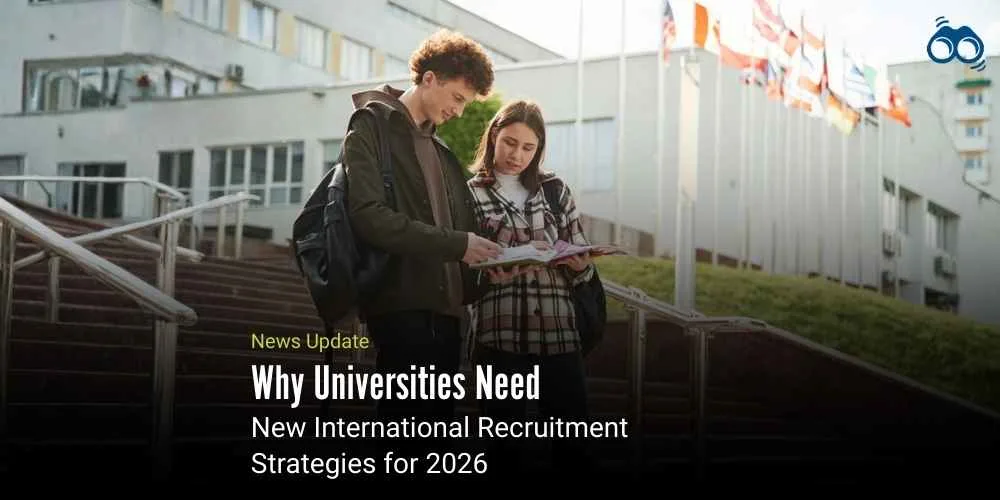
International Student Recruitment Market Changes Put UK Universities Under Pressure
Global Competition Challenges the UK’s Position in International Higher Education
The international education sector has remained under very dynamic circumstances, with universities globally under increasing pressure and competition. Rising tuition fees, government policies, and student expectations have never presented recruitment policies with such complexities before.
Observers have noted that the international student recruitment higher education sector in the UK has experienced a year of upheaval. The UK had a reputation for many years as a safe option based on reputation, language, and quality institutions. However, over the past year, it is evident that the higher education recruitment landscape shift is a reality, and the UK is not operating from a position of automatic strength.
Financial Pressures and Student Perspectives
Commentators have noted that the news of an international student levy caused shock waves in the sector. Even if it had not meant a direct cost to universities, it had spread very quickly in the sense that students were being asked to pay more for higher education in terms of higher tuition fees, higher living costs, exchange rate fluctuations, and visa charges. Research had emerged in the form of "Emerging Futures 8," and among the first five reasons why students rejected an offer were tuition fees too high, living costs too high, and visa fees too high.
What this means is that the psychology of choice is now different. While in previous years studying in the UK would have been an aspirational goal, it is now a transactional debate where students ask if it is really all worth it in the end. Commentators noted that countries such as Germany and France have come to market with emerging destinations for international students with low tuition, English-speaking programs, and work opportunities available post-study.
Compliance & Recruitment Caution
Another pressure point is described in the Basic Compliance Assessment (or BCA) framework. Although this framework aims to protect quality, it is not ambitious in terms of recruitment. The institutions with higher refusal levels have tightened their strategies and focus less on risk and experimentation. As a consequence, fewer new market explorations, more conserved agent affiliations, and less flexibility in offers have emerged. A very conservative setting emerged, despite existing demand.
Fragmented Demand and Global Competition
Experts have observed a non-collapsing yet fragmented demand for education in the UK. Students have simultaneously applied to various destinations. Only 12 per cent have applied to just one country. Activity in the USA, Canada, and Australia recruitment shows a competitive market, where Australia leads over the UK presently. But aggressive expansion has come from France and Germany, with other nations in Asia and Africa developing recruitment marketing campaigns. The above is indicated to be in accordance with international trends in student mobility and a developing trend in higher education recruitment in Europe.
What Universities Must Do in 2026
As reported by specialists, the UK government can neither give in to other countries over this matter but rather adjust. The new approaches in international education strategies ought to cover the following:
Meaningfully diversifying markets, rather than just on paper.
Invest in authentic support for students.
Enhancing construction industry pipelines and employability opportunities.
Enhancing relationships with agents as partnerships.
Engaging in international education marketing with authentic value stories.
Adopting international recruitment online engagement, AI solutions, and CRM systems for personalised recruitment.
These are considered best practices for higher education institutions in this evolving global recruitment environment. The influence of AI and digitalisation in international student recruitment is also forecast to increase, with institutions using technology to personalise and better manage recruitment.
Conclusion
The scan of the international market for higher education recruitment in 2025 highlights that it is no longer automatic that the UK will be considered the first choice. The most important factors under which the future of higher education recruitment will be shaped in the international higher education market are financial imperatives, regulatory requirements, and increasing rivalry from new markets. Experts emphasised that in this new competitive global market, higher education will be shaped based on how institutions respond to emerging demands.
Editor’s Note:
The international education sector has had a shake-up in the past year. Institutions are being squeezed by cost pressures, increased regulations, and competition. Students are thinking in different ways, too. They are making comparisons in terms of cost, added value, and opportunities after studies in a more considered way, and leaving multiple country options open for a longer time. The recruitment situation in the UK has become very fluid. The debate over the levy is an additional factor in the feeling that education in this country is becoming increasingly costly, on top of tuition fees, living expenses, and visa requirements. And, at the same time, because of increased requirements with regard to complying with things such as the BCA, institutions have become increasingly tentative, especially in situations where rejection levels have increased. While demand is not at an all-time low, it is fragmented. Places such as Germany, France have moved very quickly with lower tuition fees, increased English-speaking programs, and clearer pathways to work, and Australia is very strong in this market at present, but it is a global competition in which value becomes a consideration in addition to reputation. Higher education must diversify markets in a meaningful way, rather than in promises. They must invest in authentic, student-centric support and in industry connections which deliver jobs Agent relationships must be considered over a sustained timescale, with a focus on quality. Strong messages of distinct value must be delivered via more nuanced, evidence-driven marketing. Technology, AI, and good CRM systems can assist in personalising communication and raising conversion.
Skoobuzz mentions that winners in 2026 will be those who respond quickly, speak clearly, and provide trusted outcomes.
FAQs
1.How much does it cost to recruit a student?
Recruiting a student is not cheap. Universities spend money on marketing, advertising, events, and agent commissions. Reports suggest that the cost can run into hundreds or even thousands of pounds per student, depending on how competitive the market is.
2.How much do universities pay agents for international students?
UK universities rely heavily on education agents. Together, they spend around £500 million a year on agent commissions. Some institutions pay millions annually, with fees often reaching several thousand pounds per student recruited.
3.How much does a recruitment agency charge?
Recruitment agencies in the UK usually charge either a fixed fee or a percentage of the first year’s salary for permanent placements. In education and other sectors, this can mean several thousand pounds per hire, depending on the role.
4.How much are international student fees?
International student tuition fees in the UK vary widely. For undergraduate courses, they start at around £11,750 per year and can rise to £45,000 per year for medical or specialist degrees. Postgraduate fees are often similar, though some courses may be slightly lower.
5.Which country has the lowest fees for international students?
Germany and Norway are often highlighted as the cheapest destinations. Public universities in these countries charge little or no tuition fees, though students must still cover living costs. This makes them highly attractive compared to the UK, USA, or Australia.

Skoobuzz



 Skoobuzz

 Skoobuzz


0 Comments (Please Login To Continue)