








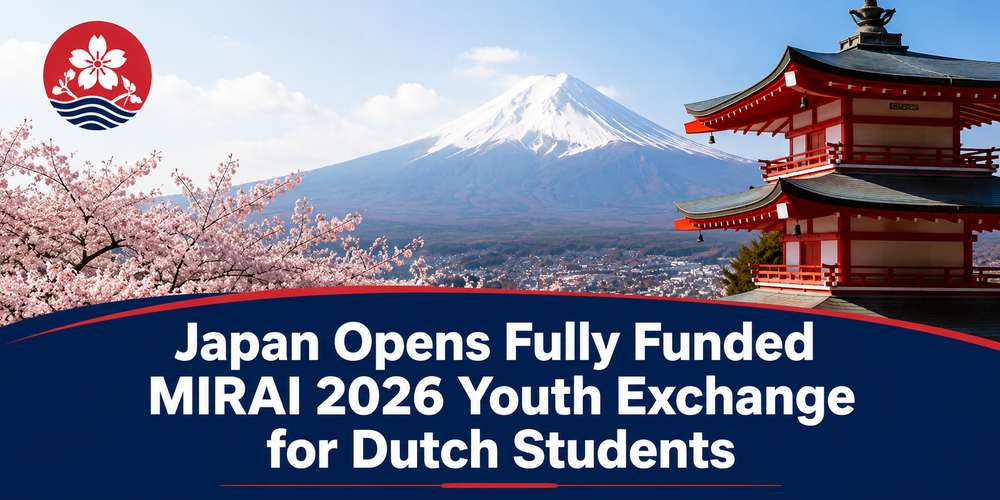
Japan’s MIRAI 2026 Offers Fully Funded Youth Exchange for Dutch Students
Students can join Japan’s fully funded MIRAI 2026 exchange focused on diplomacy, science and technology.
The MIRAI Program 2026 is offering eligible undergraduate and graduate students from the Netherlands an opportunity to participate in a fully funded short-term youth exchange in Japan. Designed to strengthen mutual understanding and long-term cooperation between Japan and participating countries, the programme combines online preparation with a seven-day academic and cultural exchange in Japan.
The initiative provides students with exposure to Japan's society, culture, education, diplomacy, security policy, science and technology while creating opportunities to interact with Japanese students, academics, researchers, policymakers and other experts. Selected participants will receive financial support covering major programme-related costs, including international flights, accommodation, meals and official activities.
Applications for the 2026 programme are open until August 31, 2026, allowing eligible Dutch students to apply for one of two thematic tracks: Diplomacy and Security Policy or Science and Technology. The programme is designed not simply as an overseas visit, but as an immersive international exchange that encourages participants to learn, discuss, collaborate and share their understanding of Japan after returning home.
What Is the MIRAI Program?
The MIRAI Program is an international youth exchange initiative focused on strengthening friendship, mutual understanding and cooperation between Japan and participating countries. Through academic discussions, cultural experiences and direct interaction with Japanese communities, the programme gives young people an opportunity to develop a more nuanced understanding of Japan and its role in the international community.
For Dutch students participating in the 2026 edition, the programme will combine online activities before the Japan visit with an intensive seven-day programme conducted in person. The exchange will bring together students with shared interests in areas ranging from international relations and public policy to scientific research and technological innovation.
The programme also encourages participants to engage directly with Japanese students and professionals rather than experiencing the country only as visitors. Through lectures, discussions, institutional visits, workshops and cultural activities, participants can explore how Japan approaches issues that are relevant to their academic interests and future careers.
MIRAI Program 2026: Key Details
Programme Detail | Information |
Host country | Japan |
Eligible applicants | Dutch undergraduate and graduate students |
Deadline | August 31, 2026 |
Format | Online pre-exchange + in-person programme |
In-person duration | Seven days |
Funding | Fully funded |
Flights | Covered |
Accommodation | Covered |
Meals | Covered |
Programme expenses | Covered |
Diplomacy & Security Policy | December 2–8, 2026 |
Science & Technology | January 20–26, 2027 |
Online pre-exchange | Mandatory |
Two Thematic Tracks for Dutch Students
Dutch applicants can select from two thematic groups depending on their academic interests and professional goals. The tracks are designed to give participants a more focused understanding of Japan through discussions with experts, institutional visits and interactions with Japanese students.
Diplomacy and Security Policy
The Diplomacy and Security Policy group is designed for students interested in international relations, foreign policy, security, regional cooperation and Japan's role in global affairs. Participants can explore how Japan engages with other countries and responds to changing regional and international challenges.
The programme provides an opportunity to examine Japanese diplomacy and security policy while considering broader questions around international cooperation. Discussions and activities can also help students understand the relationship between Japan and Europe and explore areas where international collaboration may develop further.
Students may gain exposure to topics including Japanese foreign policy, regional security, international relations and global cooperation. The in-person component for this group is scheduled for December 2–8, 2026.
Science and Technology
The Science and Technology group focuses on Japan's scientific research, technological development and innovation ecosystem. Students interested in STEM, research, technology policy and international academic cooperation can explore how Japan approaches scientific advancement and technological innovation.
Participants will have opportunities to engage with educational and research institutions and learn more about Japan's scientific environment. The programme can provide a first-hand perspective on the relationship between research, innovation, education and economic development.
Potential areas of learning include scientific research, technology development, innovation, research institutions and Japan's approach to international academic cooperation. The in-person programme for this group is scheduled for January 20–26, 2027.
Who Can Apply for the MIRAI Program?
The opportunity is specifically intended for undergraduate and graduate students from the Netherlands who satisfy the programme's eligibility requirements. Applicants should be prepared to participate fully in both the online preparation activities and the subsequent in-person programme in Japan.
Beyond meeting the formal eligibility requirements, participants are expected to demonstrate an interest in international exchange and a willingness to engage actively with people from different academic, professional and cultural backgrounds. Strong communication skills in English are also important because participants will need to take part in lectures, discussions, workshops and interactions with Japanese students and experts.
The programme is particularly suited to students who can connect their academic interests with one of the two available themes and explain why learning directly from Japanese institutions and participants would contribute to their academic or professional development.
What Does the Fully Funded Exchange Cover?
One of the most attractive aspects of MIRAI 2026 is that selected participants receive comprehensive financial support for the official exchange programme. Major costs associated with participation are covered, reducing the financial barrier that can prevent students from taking part in international programmes.
The funding includes international flights, accommodation, meals and official programme expenses. Participants therefore do not have to independently finance the primary costs associated with travelling to Japan and taking part in the scheduled exchange activities.
However, applicants should carefully review the official programme information to understand exactly which expenses are covered and whether they may need to budget for any personal or incidental costs outside the official programme.
How the MIRAI Exchange Works
The programme is structured around two stages: an online pre-exchange period followed by a seven-day in-person programme in Japan. This format allows participants to begin building connections and developing an understanding of the programme theme before arriving in Japan.
Online Pre-Exchange Activities
The online component takes place before participants travel to Japan and is mandatory. It is intended to prepare students for the in-person programme while allowing them to interact with Japanese participants and other members of the exchange community.
Activities may include orientation sessions, lectures, online discussions, thematic sessions and interactions with Japanese students and experts. This preparation allows participants to develop context around the issues they will explore during the Japan visit.
Completing the online component can also help students arrive in Japan with a clearer understanding of their programme objectives and the discussions they are expected to participate in.
Seven-Day Programme in Japan
The in-person exchange allows participants to experience Japan directly through a combination of academic, professional and cultural activities. Rather than limiting the programme to classroom-based sessions, MIRAI encourages participants to explore Japanese society and institutions through direct engagement.
Activities can include expert lectures, university and research institution visits, workshops, local visits, cultural experiences and discussions with Japanese students and professionals. This combination allows students to connect theoretical knowledge with first-hand experiences. A student interested in Japanese technology, for example, can gain insight into research institutions and innovation ecosystems, while someone interested in diplomacy can explore policy and international relations through discussions with relevant experts.
How to Apply for MIRAI 2026
Students interested in the opportunity should begin by checking the official eligibility requirements for Dutch participants and determining which thematic group best matches their academic background and interests.
Applicants should then review the programme dates carefully and ensure they can participate in both the mandatory online component and the relevant seven-day programme in Japan. They should prepare all required application materials and submit their application through the designated process before the August 31, 2026 deadline.
A well-prepared application should explain the applicant's interest in Japan, demonstrate a genuine connection with the selected theme and communicate what they hope to gain from the exchange. Students should also consider how they could contribute to the programme and share their experience with others after returning from Japan.
Editor's Note
International exchange programmes are often described using familiar words: travel, culture, networking, exposure and opportunity. But the most valuable part of an exchange may be something much less visible. It is the moment when something you assumed about another country becomes more complicated.
Perhaps you arrive in Japan with an idea of what Japanese society is like. Then you meet a student your age who has a completely different perspective. You visit a research institution and realise that an issue you thought was primarily technological is also deeply connected to policy. You discuss diplomacy with someone who lives inside the region you have only read about in textbooks.
Suddenly, Japan is no longer an abstract country on a map or a collection of cultural images. It becomes people. And that is where meaningful international education begins. MIRAI is interesting because it does not appear to treat international exchange as simply an exercise in sending students abroad. Its structure combines online preparation, academic discussion, institutional visits and cultural interaction, creating space for participants to question what they think they know before they even arrive.
There is also something important about making this opportunity fully funded. International exposure can transform a student's education, but access to it is rarely equal. For some students, a week in another country is an enriching academic experience. For others, the cost of international travel can make the possibility seem completely unrealistic.
When programmes remove those financial barriers, they create a different kind of opportunity: one where a student's curiosity and potential can matter more than their ability to personally finance an international experience. But funding alone does not make an exchange meaningful. The student has to arrive willing to be changed by it. That may be the real challenge of MIRAI.
Frequently Asked Questions
1. What is the MIRAI Program 2026?
The MIRAI Program 2026 is a Japanese youth exchange initiative designed to strengthen mutual understanding, friendship and cooperation between Japan and participating countries through academic, cultural and professional exchange.
2. Who can apply for the MIRAI Program from the Netherlands?
The 2026 opportunity is aimed at eligible undergraduate and graduate students from the Netherlands who meet the programme's specific requirements.
3. What is the application deadline?
The application deadline for the MIRAI Program 2026 is August 31, 2026.
4. Is the MIRAI Program fully funded?
Yes. Selected participants receive financial support covering major official programme costs, including international flights, accommodation, meals and programme expenses.
5. How long is the MIRAI programme in Japan?
The in-person component lasts seven days. Participants must also complete the online pre-exchange activities before travelling to Japan.

Skoobuzz

 Skoobuzz
 Skoobuzz
 Skoobuzz


0 Comments (Please Login To Continue)