








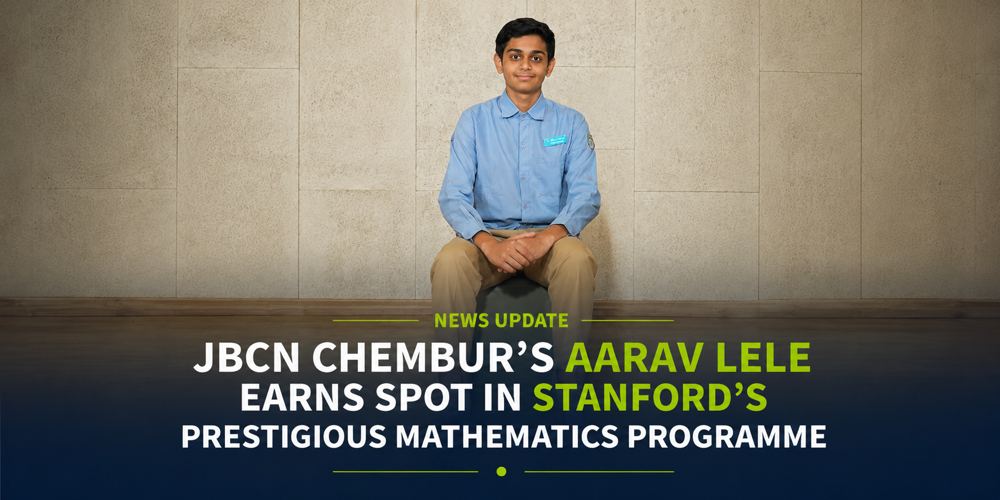
How a Rubik's Cube Led JBCN Chembur's Aarav Lele to Stanford's Prestigious Mathematics Programme
JBCN Chembur student Aarav Lele earns a place in Stanford's selective Discrete Mathematics programme.
While many Grade 10 students spend their summer preparing for board examinations, Aarav Lele, a student of JBCN International School, Chembur, is pursuing an entirely different academic challenge. The 15-year-old has secured admission to Stanford Pre-Collegiate Studies' highly selective Discrete Mathematics programme, joining a small cohort of approximately 80 students from around the world.
The online programme, running from July 6 to July 17, offers academically gifted high school students the opportunity to explore advanced mathematical concepts under Stanford's globally recognised pre-collegiate education initiative.
A Strong Academic Journey Beyond the Classroom
Aarav's selection reflects years of academic curiosity and active participation in enrichment programmes. Alongside serving as a House Captain at JBCN Chembur, he has consistently built his profile through leadership, global learning experiences, and a passion for mathematics.
Before joining Stanford, Aarav completed the Ashoka Young Scholars Programme (YSP) and previously attended the Johns Hopkins Center for Talented Youth (CTY). He believes these experiences broadened his perspective and strengthened his application.
The Stanford application process required students to submit academic records along with personal essays explaining their motivation for joining the programme and describing their learning approach.
"Good grades are important, but they are not enough. I think my essays reflected who I am as a learner. I also highlighted the extracurricular activities that genuinely mattered to me," Aarav shared.
How a Rubik's Cube Sparked a Love for Mathematics
Interestingly, Aarav's fascination with mathematics did not begin in a classroom—it began with a Rubik's Cube. As he explored the puzzle, he became intrigued by the extraordinary number of possible combinations it could generate.
"I kept wondering how something so small could have such an enormous number of possible arrangements. That curiosity pushed me towards understanding the mathematics behind it."
Rather than focusing only on solutions, Aarav became interested in the underlying patterns and structures, eventually developing a passion for combinatorics, discrete mathematics, and mathematical reasoning.
Learning Beyond School
Earlier this year, Aarav participated in the Ashoka Young Scholars Programme, where he explored economics, finance, markets, and Game Theory.
The programme introduced him to university-level learning while allowing him to engage with professors and senior students.
"It made me realise how much there is to learn beyond textbooks."
Inspired by the experience, he applied for Stanford's Discrete Mathematics programme and now sees it as an important stepping stone toward the Stanford University Mathematics Camp (SUMaC), which he plans to apply for next year.
Global Learning Through Johns Hopkins CTY
Before Stanford, Aarav also attended the Johns Hopkins Center for Talented Youth (CTY) residential programme, studying Advanced Geography and international affairs.
Beyond academics, the programme gave him valuable global exposure.
"I met students from different countries and realised that even though we came from different backgrounds, we shared similar interests. Those conversations taught me as much as the classes."
Using AI Responsibly
Like many students, Aarav uses AI tools such as ChatGPT and Gemini as part of his learning process. Rather than relying on AI to complete assignments, he believes it should be used to deepen understanding and discover new resources.
"If I don't understand something, I can ask ChatGPT or Gemini to explain it to me. It's really useful for learning and research."
At the same time, he encourages students to retain originality in their work.
"I wouldn't recommend using AI to write essays. It's a powerful learning tool, but original thinking should still come from the student."
Past Papers Over Productivity Hacks
As he prepares for Grade 10, Aarav follows a simple but effective study strategy—solving previous years' examination papers.
"Past papers teach you everything—time management, exam patterns and application of concepts. You learn while solving them."
He believes regular practice strengthens conceptual understanding while helping students become familiar with examination patterns.
Finding Balance During Exam Preparation
Aarav advises students not to give up hobbies or social media entirely while preparing for exams. Instead, he recommends maintaining a healthy balance and using digital platforms mindfully.
"If you completely restrict yourself, it usually doesn't work. The key is to use social media mindfully and avoid endless scrolling."
He also encourages students to continue reading regularly, believing it strengthens concentration and critical thinking.
Looking Ahead
Aarav hopes to pursue undergraduate studies in mathematics in the United States before exploring economics further. He also plans to apply for the Stanford University Mathematics Camp (SUMaC) once he becomes eligible.
His advice to fellow students is rooted in authenticity.
"Do something because you genuinely enjoy it, not because it looks good on a college application. Passion gives you the motivation to keep going."
He also emphasises the importance of discipline.
"Good habits grow over time. Don't just plan. Keep executing every day."
Why This Matters
As universities increasingly adopt holistic admissions processes, achievements beyond classroom grades are becoming equally valuable. Aarav Lele's journey demonstrates how intellectual curiosity, authentic interests, and participation in academic enrichment programmes can open doors to globally competitive opportunities. His story also reflects the growing importance of interdisciplinary learning, international exposure, and responsible use of AI in preparing students for the future.
Editor's Note
Aarav's achievement highlights a broader shift in global education. Leading universities are increasingly looking for students who demonstrate genuine curiosity, independent thinking, and a willingness to explore learning beyond prescribed curricula. His journey—from solving a Rubik's Cube to studying discrete mathematics at Stanford—illustrates how sustained passion, rather than résumé-building alone, often becomes the strongest foundation for academic success.
Frequently Asked Questions (FAQs)
1. Who is Aarav Lele?
Aarav Lele is a Grade 10 student at JBCN International School, Chembur, who has been selected for Stanford Pre-Collegiate Studies' highly competitive Discrete Mathematics programme.
2. What is Stanford Pre-Collegiate Studies?
Stanford Pre-Collegiate Studies is an academic enrichment initiative by Stanford University that offers advanced learning opportunities for high-achieving school students through rigorous online and residential programmes.
3. How competitive is the Stanford Discrete Mathematics programme?
The programme is highly selective, with only around 80 students admitted from across the world for the 2026 session, making it one of Stanford's most competitive pre-collegiate academic offerings.
4. What is discrete mathematics?
Discrete mathematics is a branch of mathematics that focuses on finite or countable structures, including topics such as logic, combinatorics, graph theory, algorithms, and mathematical reasoning. It forms the foundation of computer science, cryptography, and artificial intelligence.
5. What helped Aarav secure admission to the programme?
Aarav credits his selection to a combination of strong academic performance, thoughtful personal essays, leadership experience, and participation in enrichment programmes such as the Ashoka Young Scholars Programme (YSP) and the Johns Hopkins Center for Talented Youth (CTY).
6. How did Aarav develop an interest in mathematics?
His fascination with mathematics began while solving a Rubik's Cube, which sparked his curiosity about patterns, combinations, and the mathematical principles behind puzzles. This eventually led him to explore combinatorics and discrete mathematics.
7. What role did extracurricular activities play in his application?
According to Aarav, universities look beyond grades. His leadership role as a House Captain, participation in international academic programmes, and genuine interest in mathematics helped strengthen his overall application.
8. How does Aarav use artificial intelligence for learning?
Aarav uses AI tools such as ChatGPT and Gemini to clarify difficult concepts, explore new topics, and support research. However, he believes students should use AI responsibly and rely on their own ideas for assignments and essays.
9. What study advice does Aarav have for students preparing for exams?
He recommends solving previous years' question papers regularly, as they help improve time management, familiarise students with exam patterns, and strengthen conceptual understanding through practice.
10. What are Aarav's future academic goals?
Aarav hopes to pursue an undergraduate degree in mathematics in the United States, explore economics further, and apply for the Stanford University Mathematics Camp (SUMaC) once he becomes eligible.
11. What can students learn from Aarav's journey?
His story highlights the importance of following genuine interests, participating in meaningful learning experiences, maintaining balance during exam preparation, and developing consistent habits. It demonstrates that curiosity, perseverance, and authentic passion can open doors to globally recognised academic opportunities.

Skoobuzz
 Skoobuzz

 Skoobuzz
 Skoobuzz


0 Comments (Please Login To Continue)