








Imperial College London and Wits University Partner on Circular Energy Storage Materials Research
Rio Tinto Centre for Future Materials Leads Global Collaboration on Clean Energy Transition
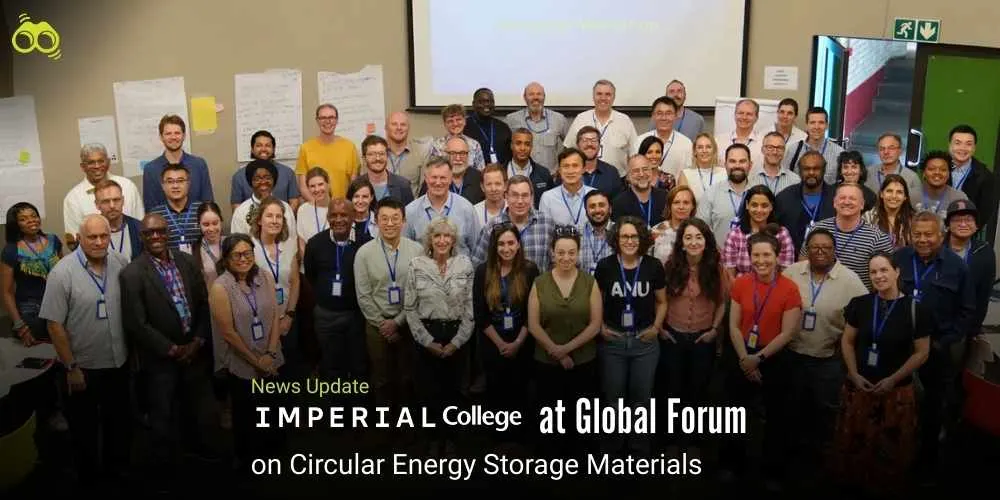
In the month of November in 2025, the Rio Tinto Centre for Future Materials (RTCFM) brought together academic and industrial leaders for the sustainable materials workshop in Johannesburg. Held from 18th to 20th November in conjunction with the G20 summit, the workshop was centred on the circularity of energy storage materials and drew, over the three days, more than 60 participants from the Centre's international network.
After the workshop was organised with Wits, the education part of it was an inspiration for the delegates, and it was explained that the idea was to embed circularity into energy storage systems to ensure that scalability and sustainability are achieved during the clean energy transition. The strategy was confirmed by senior leaders of the Centre as one that can generate highly ambitious transdisciplinary research concepts, but Marie-Pierre Paquin, Science and Partnerships Lead at Rio Tinto, insisted we should always concentrate on solutions to an actual problem rather than seeking to jam solutions into problems.
She maintained that gathering this sort of international academic excellence was precisely the kind of strategic insight the Centre was designed to unlock. According to Co‑Director of the Centre, Professor Matt Jackson, the partnership displayed its strength by bringing together varied kinds of expertise, from First Nations knowledge to mining and geoscience. This partnership, according to Co‑Director Julie Bouchard, is what will propel industry-academic synergy and will be the silver bullet for breakthrough innovation.
Delegates were taken through the Geosciences Lab and Digimine before heading to the Origins Centre museum, which serves as a constant reminder of the long relationship humankind has had with materials and innovation. In 2025, the sustainable materials workshop was officially opened by Professor Thokozani Majozi, Dean of the Faculty of Engineering and the Built Environment at Wits, who noted that African leadership needed to be promoted in a global materials research collaboration.
Facilitator Zak Wood narrated the mechanics of his 'Imaginarium' model, stating it provided a safe environment for robust ideas to be born. He noted that trust, creativity, and ownership were engendered through the process among the participants, culminating in ten high-impact concepts developed and then presented on the final day. Rio Tinto researchers and teams from its five partner universities of Imperial College London, Wits University, University of British Columbia, University of California, Berkeley, and Australian National University brainstormed preliminary Expressions of Interest over the three days of the workshop.
These involved novel recycling techniques, new circularity-oriented business models, and socio-technical systems to minimise environmental harm. According to Grant Bybee, Head of the School of Geosciences at Wits, the workshop's productivity was aided through the highly deliberate process of divergence, convergence, and validation, with informal networking appropriately interspersed through convivial dinner and shared conversation.
Results of the 2025 sustainability workshop do show how international collaboration on academia's interest in sustainable materials can take the circular-economy agenda forward concerning battery materials, with the added hitch of advancing the sustainability footprint for critical minerals for energy transition. Perhaps most importantly, the workshop acted as a forward to the newly initiated second phase of the Centre's mission of inviting funding proposals to upscale their refinement to world-class status.
The overview of the 2025 international workshop on sustainable materials in Johannesburg exemplifies how the Rio Tinto Centre for Future Materials is working towards its goals of nurturing sustainable materials transdisciplinary research. Connecting to universities such as Imperial College London and Wits University, the initiative signals the importance of circularity in materials for clean energy and environmental footprint. Broadly, it has demonstrated how academic and industrial partners can work together for recycling energy storage materials, fund circular economy opportunities for critical minerals, and support interdisciplinary sustainable materials research for a bright future for clean energy.
Editor’s Note:
The Sustainable Materials Workshop held in Johannesburg in 2025 workshop organised by the Rio Tinto Centre for Future Materials at Wits University-provided a critical platform stressing the need for circularity in energy storage systems. Guided by a spirit of innovation, and with more than sixty participants from five global universities, it concentrated on recycling technologies, new business models, and socio-technical systems that lessen environmental harm. The workshop's design intentionally combined structured research with informal networking to invoke bold and practical ideas. Senior leaders emphasised that any solutions must tackle real problems rather than try to fit ideas into the solution. The partnership proved its might by marrying diverse expertise, from First Nations knowledge to mining and geoscience, showcasing how industry and academia can collaborate for breakthrough innovations. To further foster trust and creativity, facilitator Zak Woods' 'Imaginarium' model yielded an impressive ten high-impact concepts presented at the close of the workshop. The outputs underscore the need for collaborative global materials research in promoting the circular economy for battery materials and minimising the environmental footprint of critical minerals. The workshop also set the stage for the next phase of the Centre's mission, soliciting funding proposals to advance these concepts into world-class projects.
Skoobuzz underlines that the workshop successfully demonstrated that sustainable energy systems are built upon a foundation of collaboration, creativity, and shared responsibility. By unifying academia and industry, this event marked a significant step towards a cleaner and more circular future for materials.
FAQs
1. What is the theme of the World Sustainable Development Summit 2025?
The theme is “Partnerships for Accelerating Sustainable Development and Climate Solutions”. It highlights the urgent need for stronger cooperation to meet climate goals and sustainable development targets, as current progress is falling behind.
2. What is the Sustainable Futures Conference 2025?
There are two major events under this name:
- At Amrita University in India, the International Conference on Sustainable & Resilient Futures will focus on experiential learning, inclusiveness, and sustainable innovations.
- In the UK, the University of Cambridge Centre for Risk Studies is hosting Sustainable Futures 2025, centred on business value from sustainability and resilience in global organisations.
3. What is the annual International Conference on Sustainable Development 2025?
The 13th International Conference on Sustainable Development (ICSD 2025) will take place in Rome, Italy. Its theme is “Creating a unified foundation for Sustainable Development: research, practice and education”. The event will bring together researchers, policymakers, and practitioners to share ideas and solutions for global sustainability.
4. Which universities are collaborating on circular energy storage materials research?
The Rio Tinto Centre for Future Materials has brought together Imperial College London, Wits University, University of British Columbia, University of California, Berkeley, and Australian National University. In addition, Stanford University leads the Circular Economy of Energy Storage consortium, working with industry partners to advance recycling and repurposing technologies.
5. What is the major project award for sustainability 2025?
The Royal Academy of Engineering’s Major Project Award for Sustainability 2025 was awarded to Scottish Water for the Winchburgh Waste Water Treatment Works. The project replaced an ageing plant and delivered a sustainable solution with significant impact on society and the environment.

Skoobuzz
 Skoobuzz
 Skoobuzz
 Skoobuzz



0 Comments (Please Login To Continue)