








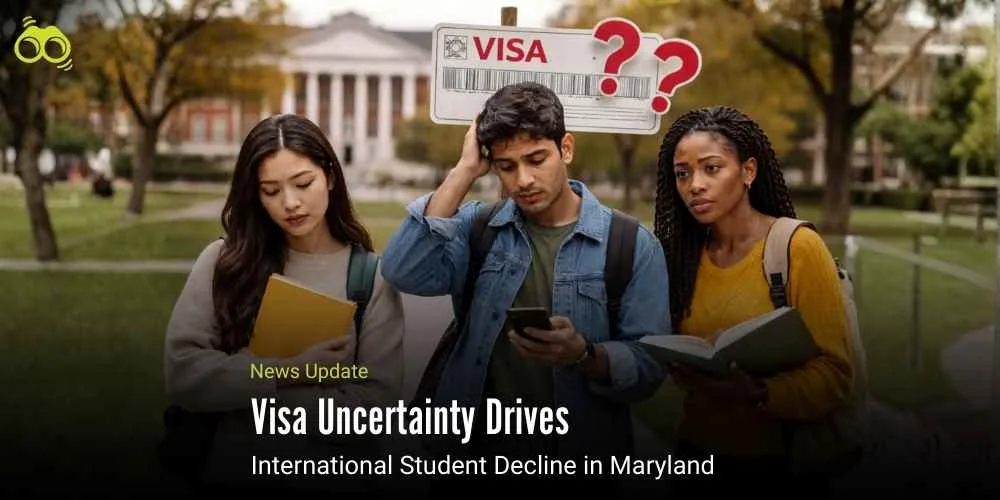
University of Maryland, College Park and UMBC Report Major International Student Declines
Impact of US Visa Policy on International Student Enrolment in Maryland Public Universities
Historically, international students have contributed enormously to higher education research, innovation, and campus diversity while fueling the local economy. On the other hand, an air of uncertainty may be building, particularly with respect to visa policies, travel restrictions, and rules on immigration. Due to this, international students may be looking elsewhere besides the US for a predictable environment: Canada, for example, or the UK, or Australia. Latest news puts international enrollments in Maryland, home to several of the most prestigious public universities, in a steep decline, which mirrors worldwide worry about the future of international mobility in US higher education.
Reports proved that Maryland universities lose international students due to visa uncertainty. Public universities across the state saw a significant overall drop in enrollment from fall of 2024 to fall of 2025. According to statistics obtained from 11 universities, the total international student enrollment declined from 7,608 to 7,159, meaning a net decline in overall international student enrollment in Maryland public universities. Experts did warn, however, that depriving such a substantial portion of data may actually create an even higher true figure.
Deprecation Major across All Campuses
The most significant decline of international students was recorded at the University of Maryland, College Park, which saw a drop of more than 300 students, representing a 6.7 per cent decrease. This does not account for countries where fewer than five students are enrolled, officials said, hinting there may have been a still greater loss.
Other MD institutions also experienced a decrease in the total enrollment of students from abroad. Even though the undergraduate numbers increased slightly, the decline was truly tremendous as more than International graduate students, surpassing over 230, departed from UMBC, which thus caused a 23% decline. This decrease in the international graduate students' total really underlines the point that the impact of the visa policy predominantly struck the graduate student population.
Other small campuses also lost their international students: Frostburg State University at 15.2%, Salisbury University at 11%, and St. Mary's College of Maryland had the largest percentage decline, from five students down to one. The drops are reflected in the available international student enrollment statistics at Maryland public universities.
Visa Policy and Global Competition
Observers linked the slippage of growth in applicants to what US visa policy applies to international students, such as travel bans, delays of visa interviews, and revocations, among others, with minimal support from institutions. Although reinstatement on some visas was done later, it seemed to have caused many applicants to lose interest. Analysts described this issue as part of the larger barriers related to international students' visas in the US, contributing to uncertainty for both international students and US higher education.
According to Rachel Banks of NAFSA, students are considering places like Canada and the UK because those countries seem more predictable and welcoming. Banks also highlighted several rule changes that would discourage PhD applicants and other lengthier programs of study, specifically the rule that would cut student stays to four years instead of allowing students to stay for the duration required to complete degree work.
Selective Institutional Growth
Contrary to most universities, not all have been reporting losses. Coppin State University recorded a 25 per cent increase with the addition of 16 international students. Other institutions which reported slight increases include the University of Maryland Eastern Shore and Morgan State University. Except for these few, such results show that the trends in international student enrollments in 2025 would branch in different ways among universities, though the overall decreasing trend holds.
Effects on Studies and Diversity
Education leaders have maintained that such an impact on the politics affecting campus research diversity involves enormous numbers. Not only do international students contribute to science, technology, and healthcare research, but they also grant cultural and economic enrichment to campuses and their local economies. The long-term risks of visa uncertainty were clearly described as a threat to the state's usefulness in Maryland's higher education system.
But despite all these setbacks, international enrollment at Maryland universities is still championed by officials. They went on to say that, even against growing competition for global talent, Maryland does strive to be considered one of the safe havens for quality students.
In all, this decline shows why Maryland universities lost hundreds of international students over the years from 2024 to 2025. Mainly, it confirms evidence of how US visa uncertainty affects international students' enrollment in Maryland. Minor increases were noted on some campuses, but the greater trend is decreased overall US higher education global talent resources due to visa uncertainty. This reality thus heightens the urgency for better visa support, productivity in recruitment strategies, and community engagement in retaining international enrollment.
Simply put, the two universities in Maryland face immediate losses and long-term challenges. Actually, visa uncertainty describes the backdrop of future international student mobility on a given campus and diversity on that campus.
Editor’s Note:
International students have always been partners in higher education. They bring knowledge, innovation and culture and keep local economies going. However, the changing world has made the US less predictable over recent years with regard to visas, travel restrictions and immigration rules. Therefore, students nowadays choose Canada, the UK or Australia, all of which seem more stable and inviting. Maryland's public universities have succinctly reported international enrollment decreases from autumn 2024 to autumn 2025 due to the gloomy environment. Reports indicate a decline from 7,608 to 7,159; University of Maryland College Park alone lost more than 300 students, whereas UMBC suffered a slashing damage marked by a 23% decline in graduate enrollment. Smaller campuses like Frostburg State and Salisbury also recorded drops in enrollment numbers, while St. Mary's College sustained the worst percentage decline. These statistics serve to underscore how the uncertainty of visas immediately affects the changing pattern of international student mobility. However, some institutions report a slight gain in international students, such as Coppin State University and Morgan State University. This gives the impression that trends across campuses are very different. Nonetheless, the overall picture remains grave, signalling a decline that will affect research, innovation, and campus diversity in the long run. International students are key to research in science, technology, and health. They greatly build and enrich campus life.
Thus, in summary, the evidence indicates losses of immediate and future perils. Visa uncertainty continues to shape the international students' choice and, therefore, threatens the potential of the Maryland higher education system. Skoobuzz firmly believes that in order to enhance international enrollments as well as diversity levels across campuses, there is an urgent requirement for great visa support, aggressive marketing, and involvement of local community members in support of institutional efforts.
FAQs
1. Have US universities seen a 17% fall in new international students?
Yes. Reports confirmed that new international student enrolments at US universities fell by 17% between autumn 2024 and autumn 2025. The decline was linked to visa application challenges, travel restrictions and immigration policy changes.
2. Is Maryland considered a good destination for international students?
Maryland is regarded as a welcoming state for international students. Universities such as the University of Maryland, College Park and UMBC provide strong academic programmes, cultural diversity and support services. Baltimore, in particular, offers a lower cost of living compared with nearby cities, making it attractive for overseas students.
3. Which US universities have a 100% acceptance rate for international students?
A small number of institutions in the United States report acceptance rates close to or at 100% for international applicants. These include certain regional universities highlighted in admissions data, where all qualified international applicants were admitted. While most universities are selective, some smaller or less competitive institutions offer guaranteed entry.
4. What is the most affordable university in Maryland?
The University of Maryland Global Campus (UMGC) is currently the cheapest option, with undergraduate tuition fees around $12,336 per year. Coppin State University is also highly affordable, with fees of about $14,024 annually. These institutions are recognised as the most budget‑friendly among Maryland’s public universities.
5. Which country sends the largest number of students to the United States?
India is now the leading country of origin for international students in the US. In the 2024–2025 academic year, 363,019 Indian students were enrolled, representing about 31% of all international students. This placed India ahead of China, which sent around 265,919 students.

Skoobuzz

 Skoobuzz
 Skoobuzz
 Skoobuzz
 Skoobuzz
 Skoobuzz


0 Comments (Please Login To Continue)