








Cyber Policy Students at MIIS Excel in High-Stakes National Security Simulation
Middlebury Institute Showcases Interdisciplinary Cyber Education at Cyber 9/12 Challenge
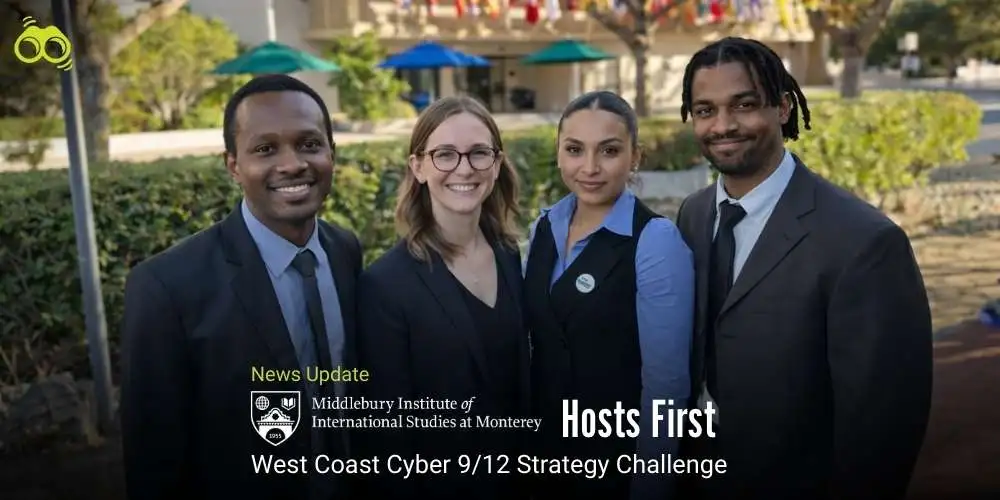
According to reports, this year’s International Cyber 9/12 Strategy Challenge has been recorded to mark history on the West Coast when it was hosted at the Middlebury Institute of International Studies at Monterey. It marked the first-ever West Coast event to be hosted under its flagship cyber policy competition, which is organised by the Atlantic Council. It was reported to have attracted 22 teams from 15 universities, military academies, and international partners across the world.
Widespread Participation by Institutions
Teams reportedly came from well-known universities such as Stanford University, University of California, Santa Barbara, Texas A&M University, Carnegie Mellon University, Brigham Young University, Georgetown University, Louisiana State University, U.S. Air Force Academy, and U.S. Military Academy, West Point. This year, a total of five teams competed from MIIS and Middlebury College, which included the first group of Middlebury students at a West Coast competition.
It was reported that the MIIS Cyber Collaborative showcased several teams, including MIIS information, Threat Ninjas, Team TAMA, and MIIS Cyber Mafia, while Middlebury College was represented by Escape Plan, an undergraduate group. Participants were said to have come from programmes such as NPTS, IPD, Financial Crime Management, Threat Intelligence, and TLM, reflecting the interdisciplinary approach to cyber education promoted by the Middlebury Institute.
A Realistic National Security Scenario
The cybersecurity policy competition “Monterey MIIS” put the participants in a virtual Situation Room where they were policy advisors for the United States National Security Council. Over the course of three increasing levels of intelligence briefs, they were faced with a highly realistic cyber incident affecting the critical infrastructure, the lack of attribution with implications pointing towards state-sponsored actors.
Analysts said each round challenged participants in their roles as intelligence analysts, escalation predictors, and policy responders. MIIS stood out in terms of performance with their team, Threat Ninjas, making it to the semi-finals, while MIISInformation made it to the finals and secured third place overall. It is even considered one of the best showings of MIIS in partnership with the Atlantic Council Cyber 9/12.
What Made the Monterey Conference Special?
Regarding the specific event, the Middlebury Institute West Coast Cyber 9/12 Strategy Challenge has been claimed to have been the only one to embrace an interdisciplinary approach. Cyber strategy and intelligence were not the only things being employed by the MIIS; their translation and interpretation programs were also utilised, with on-site interpretation provided for Chinese, French, and Spanish.
Experts noted that the fact that the aforementioned integration process was unique to the MIIS was indicative of how the Middlebury Institute Cyber Collaborative international cyber strategy challenge extends learning and the realm of research in the area of cyber policy strategy.
The competition began with an event hosted by the Cyber Collaborative, and it included speakers representing various institutions and organisations, including the Department of Defence, Lawrence Livermore Laboratory, Google, Morgan Stanley, and other local participants in Monterey. This activity provided students with an authentic training process in connection with real issues involving national security. Collective Effort and Future Plans
Collective efforts
The roles played behind the scenes included efforts by over 20 judges, over 10 volunteers, and many students of MIIS. The role played by faculty, administrative staff, and the wider community cannot be overlooked. The holding of the international competition at MIIS USA was considered a recognition of the emerging leadership of the Institute within the education of national security and cyber strategy. Additionally, the Cyber Collaborative announced plans to increase the size of the competition at the Monterey venue in the coming years.
Conclusion
The Monterey, California, cyber policy competition of 2025 showed the value of an interdisciplinary MIIS education that brings together elements of threat intelligence and policy analysis. With the combination of language interpretation, global security, and cyber strategies, the institute is considered at the forefront of cybersecurity education. The students, professionals, or anyone interested were encouraged to register for the Cyber 9/12 Strategy Challenge at the Middlebury Institute, apply for the MIIS Cybersecurity/Cyber Policy programmes, as well as the MIIS Interdisciplinary Degrees offered in Cybersecurity and Policy.
Editor's note
The Middlebury Institute of International Studies at Monterey was reported to have made a bold move by hosting the first West Coast event of the International Cyber 9/12 Strategy Challenge last November. In my opinion, there are at least two reasons why this event is of importance. The hosting of the event on the West Coast signifies bringing serious cyber policy education closer to diverse USA talent. It showcases the Middlebury Institute Cyber Collaborative's ability to create a competitive, educational environment encompassing national security, policy, and decision-making. With 22 teams from 15 institutions, the widespread reach and high standards were evident. More importantly, the Monterey competition set a high benchmark, pushing participants in a "situation room" setting to make quick, policy-critical decisions, much like attributing unknown intelligence. The MIIS program's interdisciplinary approach, combining core language interpretation with cyber strategy and intelligence teaching, was particularinternationalised and inclusive approach, applying skills combined with policy thinking, is the essence of MIIS training for cybersecurity. MIIS teams performed well, including a third-place overall finish. While winning is secondary, the true significance lies in the achieved skill level. The Cyber Collaborative nurtures talent, but MIIS's real contribution is demonstrating the importance and possibility of cyber policy competitions.
Skoobuzz asserts that the Monterey Conference showed the MIIS cybersecurity policy competition, developed with the Atlantic Council’s Cyber 9/12 and leveraging MIIS's distinct mix of intelligence, language, and analysis, is more than a platform for ideas. It serves as a vital arena for national security and cyberspace strategy training.
FAQs
1. What is Middlebury Institute known for?
The Middlebury Institute of International Studies at Monterey is widely recognised for its international professional education. It is known for programmes in international policy and management, translation and interpretation, language teaching, sustainable development, and non-proliferation studies. The Institute prepares students to make a meaningful impact in global affairs through immersive and collaborative learning.
2. Which university is best for cybersecurity in the USA?
Rankings vary, but Carnegie Mellon University is often cited as the leading institution for cybersecurity research and education. Other highly regarded universities include Stanford University, Massachusetts Institute of Technology (MIT), and the University of California, Berkeley. These institutions are known for strong academic performance, cutting-edge research, and industry partnerships.
3. Which universities competed at the MIIS Cyber 9/12 event?
The Middlebury Institute West Coast Cyber 9/12 Strategy Challenge welcomed 22 teams from 15 institutions. Universities included Stanford, UC Santa Barbara, Texas A&M, Carnegie Mellon, Brigham Young, Georgetown, Louisiana State, the U.S. Air Force Academy, and West Point, alongside MIIS and Middlebury College. This made the event one of the most globally representative competitions to date.
4. How many years to study cybersecurity in the USA?
A bachelor’s degree in cybersecurity typically takes 4 years. A master’s degree usually requires 1–2 years, depending on full-time or part-time study. For those seeking faster routes, cybersecurity bootcamps last 3–6 months, focusing on practical skills such as ethical hacking and risk management.
5. Can I make $200,000 a year in cybersecurity?
Yes. Senior cybersecurity roles in the USA can pay between $175,000 and $260,000 annually, with some positions exceeding $200,000. Roles such as cybersecurity engineers, directors of product security, and specialised consultants often reach this level, especially with experience and advanced skills.

Skoobuzz

 Skoobuzz
 Skoobuzz
 Skoobuzz




0 Comments (Please Login To Continue)