








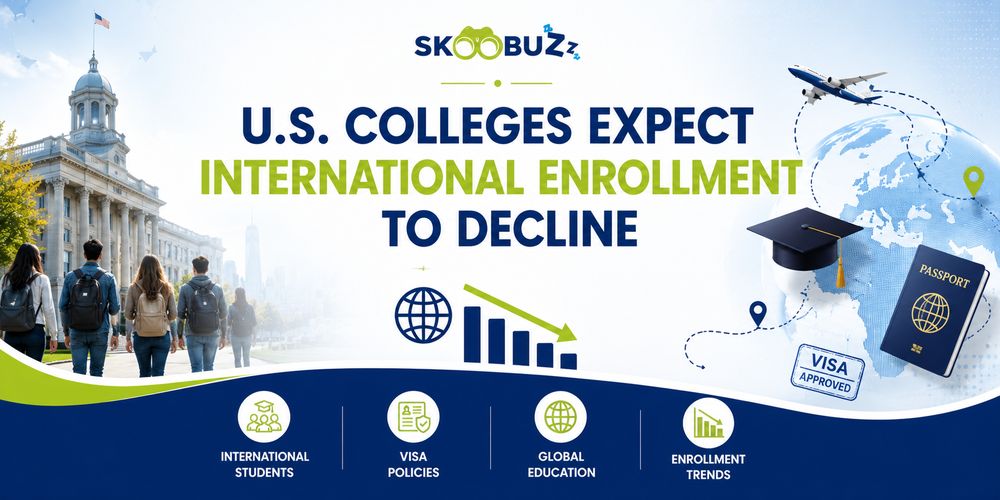
Nearly Two-Thirds of U.S. Colleges Expect International Student Enrollment to Decline in 2026–27
Visa barriers and travel restrictions are reshaping international student mobility to the U.S.
A growing number of U.S. colleges and universities are preparing for a decline in international student enrollment during the 2026–2027 academic year, according to a new survey released by the Institute of International Education (IIE). The report reveals that nearly two-thirds of responding institutions expect fewer international students this year, citing visa challenges, travel restrictions, and increased competition from other study destinations as key reasons.
The findings, published in the Spring 2026 Snapshot on International Educational Exchange, provide one of the earliest indicators of international enrollment trends ahead of the new academic year and highlight the evolving landscape of global student mobility.
IIE Survey Highlights Growing Enrollment Concerns
The survey gathered responses from 585 U.S. colleges and universities, representing institutions that collectively host 48% of all international students studying in the United States.
The findings indicate that international recruitment is becoming increasingly challenging as students weigh alternative study destinations offering lower tuition fees, streamlined visa processes, and stronger post-study opportunities.
Projected International Enrollment for 2026–27
Enrollment Outlook | Percentage of Institutions |
Expect enrollment to decline | 63% |
Expect enrollment to increase | 11% |
Expect enrollment to remain stable | 26% |
The report suggests that the coming academic year could see one of the most significant slowdowns in international enrollment in recent years.
International Applications Continue to Decline
Many institutions are already experiencing lower international application volumes.
International Application Trends
Application Status | Percentage of Institutions |
Applications decreased | 59% |
Applications increased | 14% |
Applications remained stable | 28% |
Graduate programmes have witnessed the sharpest decline.
Application Declines by Study Level
Programme Level | Institutions Reporting Declines |
Graduate programmes | 65% |
Undergraduate programmes | 60% |
The findings indicate that postgraduate recruitment is facing particularly strong headwinds.
Visa Barriers Remain the Biggest Challenge
Among institutions expecting lower international enrollment, most identified immigration-related issues as the primary concern.
Reasons Behind Expected Enrollment Declines
Challenge | Institutions Citing the Factor |
Visa application barriers | 92% |
U.S. travel restrictions | 80% |
Students choosing other countries | 77% |
According to the report, many prospective students are increasingly considering destinations such as Germany, Japan, and other countries that offer internationally recognised degrees at comparatively lower costs and with more accessible immigration pathways.
Global Competition for International Students Is Increasing
The report highlights that countries across Europe and Asia continue to strengthen their international education strategies through:
- Lower tuition costs
- Simplified student visa procedures
- English-language degree programmes
- Attractive post-study work opportunities
- Government-supported international recruitment initiatives
As a result, U.S. universities are facing growing competition in attracting global talent.
International Students Continue to Be a Strategic Priority
Despite the enrollment challenges, most colleges continue to recognise the value international students bring to their campuses.
Why Universities Continue Recruiting International Students
Institutional Benefit | Percentage |
International recruitment remains a priority | 82% |
Students enrich classroom diversity | 74% |
Recruitment aligns with institutional strategy | 61% |
Economic contribution of international students | 61% |
Although international recruitment remains a strategic objective for most institutions, the proportion identifying it as a priority has declined from 89% in 2025 to 82% in 2026, reflecting the increasingly complex recruitment environment.
Universities Are Expanding Student Support Services
Institutions are also strengthening services aimed at helping international students successfully adapt to life in the United States.
Support Services Available
Support Service | Institutions Providing It |
Immigration and visa guidance | Over 90% |
Academic advising and support | Over 90% |
Mental health referrals | 64% |
Universities say these services are designed to improve student wellbeing, ensure compliance with immigration regulations, and enhance the overall international student experience.
What This Means for Prospective International Students
While the survey points to a more challenging admissions environment, U.S. universities continue to invest in international recruitment and student support.
Prospective students may face longer visa processing times and increased uncertainty, but institutions remain committed to welcoming international learners and strengthening campus diversity through global education initiatives.
Why This Matters
International students contribute significantly to U.S. higher education by enriching academic discussions, supporting research and innovation, and strengthening local economies. A sustained decline in international enrollment could affect university finances, research collaboration, workforce development, and the country's position as a leading global education destination.
The findings also underscore the importance of immigration policies, affordability, and student mobility in shaping the future of international education.
Editor's Note
The latest IIE survey reflects an increasingly competitive global higher education landscape. As more countries invest in attracting international talent through affordable education and supportive immigration policies, U.S. institutions are adapting their recruitment strategies while continuing to prioritise international student success.
The coming academic year will provide a clearer picture of how these trends influence global student mobility and the future of international education in the United States.
FAQs
1. What does the latest IIE survey reveal?
The survey found that 63% of participating U.S. colleges and universities expect international student enrollment to decline during the 2026–2027 academic year.
2. Why are international student enrollments expected to decline?
Institutions cite visa application barriers, travel restrictions, and increased competition from countries offering more affordable and accessible higher education.
3. How many institutions participated in the survey?
The survey included 585 U.S. colleges and universities, representing institutions that educate approximately 48% of all international students in the United States.
4. Are U.S. universities still prioritising international recruitment?
Yes. 82% of institutions continue to identify international student recruitment as a strategic priority despite current challenges.
5. What support do universities provide international students?
Most institutions offer immigration guidance, academic advising, orientation services, and mental health referrals to help international students succeed academically and personally.

Skoobuzz

 Skoobuzz
 Skoobuzz
 Skoobuzz
 Skoobuzz


0 Comments (Please Login To Continue)