








Educational Consultants Protest Nepal's New Consultancy Regulations Amid Sector-Wide Concerns
Government introduces stricter rules for foreign university partnerships.
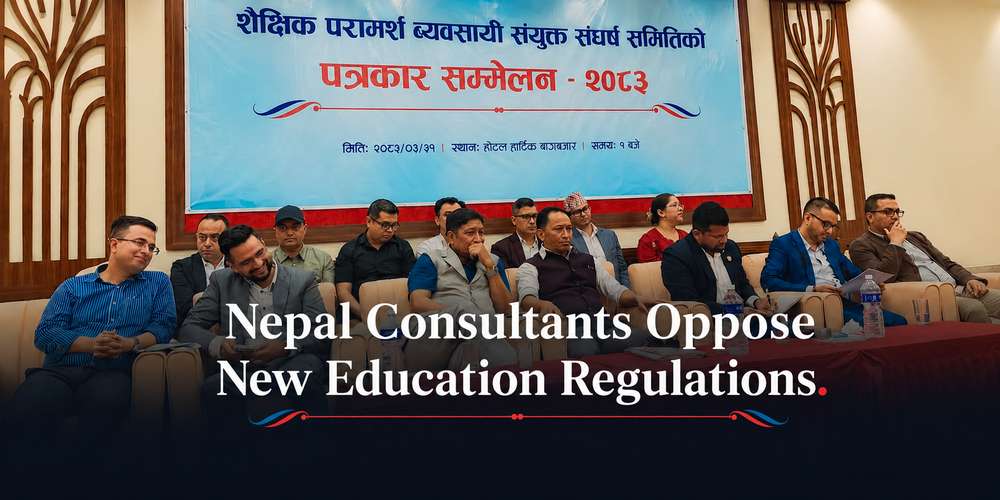
Nepal's educational consultancy sector has launched a coordinated protest against the recently introduced Educational Consultancy, Language Teaching and Preparation Class (Operation and Management) Regulations, 2083 BS, arguing that several provisions are impractical and could significantly disrupt the country's international education ecosystem.
During a press conference in Kathmandu, multiple consultancy associations announced a phased protest programme and warned of an indefinite shutdown if the government fails to initiate meaningful dialogue and reconsider the disputed provisions. The dispute highlights a growing tension between the government's push for stronger regulatory oversight and the private sector's concerns over operational viability.
Consultants Announce Escalating Protest Programme
The Joint Struggle Committee representing educational consultants has unveiled a series of protest activities aimed at pressuring the government to revise the regulations.
The planned actions include:
Date | Protest Activity |
Thursday | Consultants will work while wearing black armbands |
July 16 | Peaceful placard demonstrations across Kathmandu from 11:00 AM to 11:30 AM |
If demands remain unmet | Indefinite protest, including symbolic submission of office keys to the District Administration Office |
Committee coordinator Gurung stated that the government should abandon what he described as policies that discourage private-sector participation and instead work collaboratively with stakeholders to create practical regulations.
Key Demands from Educational Consultants
The consultancy associations have submitted several demands for amendment or repeal of the new regulations.
Five-Year Licence Instead of Annual Renewal
Consultants argue that the current one-year operating permit creates unnecessary administrative burdens. They are requesting that licences remain valid for five years, reducing frequent renewal requirements.
Relaxation of Event Approval Requirements
The regulations currently require prior approval from Nepal's Ministry of Education before consultancies can organise educational fairs or seminars, even within their own office premises. Industry representatives want this requirement removed, along with restrictions on study abroad fairs.
Protecting Consultancy Revenue Models
Consultants are also seeking the removal of provisions that could restrict commissions received from overseas colleges and universities, arguing that such income forms a legitimate part of their business model.
Additional demands include:
- Removal of dual tax filing requirements
- Elimination of mandatory equal fee structures
- Repeal of compensation provisions linked to students' mental or financial damages
- Replacement of security deposits with insurance or fee protection mechanisms
- Elimination of consultancy grading requirements, which the industry considers impractical
Government Introduces Stricter Rules for Foreign University Partnerships
While consultancy organisations oppose the regulations, the government maintains that the reforms are intended to improve quality assurance across Nepal's higher education landscape.
Under the new framework, any institution seeking to operate academic programmes in Nepal under affiliation with a foreign university must first obtain a Letter of Intent (LOI) from the Ministry of Education, Science and Technology.
Applicants must provide:
- Official documentation confirming that the foreign university is legally established in its home country.
- Evidence that the institution is authorised to operate internationally.
- Supporting documentation explaining the legal basis for overseas educational operations.
Only Top-Ranked Universities Will Qualify
One of the most significant provisions requires affiliated foreign universities to rank within the world's top 1,000 according to recognised global rankings such as:
- Times Higher Education (THE)
- QS World University Rankings
The regulations also introduce new standards relating to infrastructure, land ownership and geographical classifications for institutions operating in Nepal.
Government Says Reforms Will Improve Education Quality
Education experts supporting the reforms argue that the stricter eligibility criteria will prevent low-quality or nominal foreign institutions from entering Nepal's education market.
By allowing partnerships only with globally recognised universities, policymakers hope students will gain access to internationally competitive education without necessarily studying abroad. Supporters believe the measures will strengthen Nepal's higher education ecosystem while improving institutional accountability and academic standards.
Why This Matters
Nepal remains one of South Asia's largest sources of international students, making educational consultancies an influential part of the country's higher education landscape. The current standoff reflects a broader policy challenge faced by many countries: balancing stronger consumer protection and educational quality assurance with the operational realities of private-sector education service providers.
The outcome of negotiations could shape Nepal's future international education policies, influence student mobility, and determine how foreign universities engage with the country's growing higher education sector.
Editor's Note
The debate surrounding Nepal's new consultancy regulations illustrates the delicate balance governments must strike between regulation and innovation. While stronger oversight can help eliminate questionable educational providers and improve student protection, excessive compliance requirements may inadvertently constrain legitimate businesses that facilitate international education opportunities.
A collaborative policy review involving both regulators and industry stakeholders may ultimately produce a framework that safeguards students without stifling the sector's contribution to Nepal's education ecosystem.
Frequently Asked Questions (FAQs)
Why are educational consultants protesting in Nepal?
Consultants argue that several provisions in the Educational Consultancy Regulations 2083 BS are impractical, increase compliance burdens, and negatively impact private-sector operations.
What are the consultants demanding?
They are seeking longer licence validity, removal of restrictions on educational fairs, changes to tax and compensation provisions, and the replacement of deposits with insurance-based protection systems.
What is the new Letter of Intent (LOI) requirement?
Educational institutions wishing to partner with foreign universities must obtain prior approval from Nepal's Ministry of Education before establishing or registering programmes.
Which foreign universities will be eligible under the new regulations?
Only universities ranked among the top 1,000 globally, according to recognised rankings such as QS or Times Higher Education, will qualify for affiliation.
Why did the government introduce these regulations?
The reforms aim to improve quality assurance, prevent low-quality foreign institutions from operating in Nepal, and strengthen oversight of educational consultancy services.

Skoobuzz

 Skoobuzz

 Skoobuzz
 Skoobuzz
 Skoobuzz


0 Comments (Please Login To Continue)